

Bulgaria Protests Raise Euro Switch Risk Jan 1, 2026
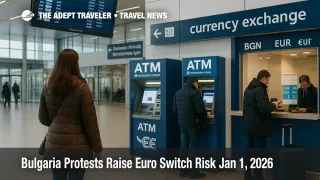
Bulgaria euro switch disruption risk is rising as mass protests and a government resignation converge with the country's planned euro changeover in Sofia, Bulgaria. Travelers arriving in late December 2025 and early January 2026, especially those transiting through Vasil Levski Sofia Airport (SOF), should expect a higher chance of rolling road closures, heavier policing near central government districts, and slower routine services that can complicate airport transfers and tight onward connections. The practical move is to add time buffers, favor resilient transport options like the metro from the airport, and plan payments carefully so the currency transition does not become an avoidable trip problem.
The Bulgaria euro switch disruption problem is that political volatility in Sofia is increasing the odds of transport friction and administrative slowdowns right as the euro replaces the lev on January 1, 2026.
What Changed, And Why The Timing Matters
Bulgarian lawmakers formally accepted the government's resignation on December 12, 2025, after weeks of large protests that Reuters and other outlets describe as some of the biggest street mobilizations in decades. The resignation opens a period of political limbo that can include caretaker governance and a potential snap election cycle, which tends to raise the likelihood of additional demonstrations, counter demonstrations, and heightened police posture in central Sofia.
For travelers, this is less about whether Bulgaria can function, it can, and more about predictable friction at exactly the time many visitors are in the city for year end travel. When crowds gather near parliament and nearby government buildings, police often respond with cordons and traffic diversions that can ripple outward into key boulevards, bridge approaches, and access routes to hotels and transport hubs. The key trip planning takeaway is simple, assume some central Sofia routes will be intermittently constrained, and do not build itineraries that fail if one transfer runs late.
Our December 11 coverage of street disruptions and transfer risk remains a useful baseline for how these protests can affect visitors in Sofia. https://adept.travel/news/2025-12-11-bulgaria-gen-z-protests-government-fall-travel
Bulgaria Euro Switch Disruption: What Travelers Will Notice
Bulgaria is scheduled to adopt the euro on January 1, 2026, and the conversion rate from the lev has been set under EU legal acts. In plain terms, that means travelers should plan for an overnight currency flip at the start of 2026, with normal euro changeover side effects that are usually small but noticeable, especially when large numbers of tourists arrive at once.
Background Euro changeovers typically involve a transition period where retailers must show prices transparently, cash handling systems adjust, and banks, ATMs, and exchange counters shift inventories and settings. Even in smooth transitions, travelers can see short term quirks, an ATM that runs out of small denominations, a card terminal that takes longer, a shop that needs to reprint receipts, or a taxi that is still quoting in the old currency.
What should you do differently in Sofia during this window?
First, plan to lean on card payments where practical, particularly at hotels, reputable restaurants, and larger retailers. That reduces exposure to confusion at small cash points and helps you avoid poor exchange spreads. Second, if you need cash, withdraw smaller amounts more often instead of taking a large lump sum, because it limits regret if you end up holding the wrong notes while a business is still adjusting. Third, keep receipts for any transaction that involves conversion, because the first week of a currency switch is exactly when pricing disputes and rounding questions can pop up.
If you want a general framework for minimizing conversion and fee pain, this payment methods explainer is a good evergreen complement, even though it is not Bulgaria specific. https://adept.travel/insights/us-dollar-outlook-and-travel-impact-for-2025
Sofia Transfer Planning During Protest Periods
Central Sofia is compact, but that can work against you when streets are blocked, because a few closures can force large detours. Treat the last two days of December 2025 and the first two days of January 2026 as a buffer required period if your trip depends on specific appointment times, long distance buses, or onward rail connections.
Vasil Levski Sofia Airport (SOF) has a built in resilience advantage for travelers, the airport is connected to the city by metro, and the airport operator advises that the journey time to the city center is about 18 minutes, with an easy connection pattern that can also reach Sofia Central Bus and Railway Stations via a change at Serdika. In protest periods when road routes are unpredictable, the metro is often the most reliable spine for reaching the center, and then finishing by foot for the last segment if you must.
The airport also notes that Bus Route 84 links the city center with both terminals, and it publishes additional guidance on tickets, shuttle connections between terminals, and the main driving corridors. The practical traveler takeaway is not that you must take public transport, it is that you should have a non road fallback ready. If your hotel is inside the central grid, a metro plus short walk can beat a car that gets trapped behind diversions.
If you must use a car or taxi, build slack and communicate clearly with the driver. Ask them to avoid central government zones and to keep navigation running live, not cached. In an active protest environment, drivers who are willing to reroute early usually do better than drivers who hope a blocked street will reopen.
Finally, do not gamble on tight onward connections through Sofia during the euro switch. If you have a same day intercity bus, rail ticket, or a short connection to another flight, push it later, or add an overnight buffer. A protest that blocks one corridor for an hour can be enough to cascade into missed departures when schedules are winter thin.
What To Watch Over The Next Two Weeks
Travelers should not try to predict exact protest dates from abroad, because demonstration calls can move quickly and can intensify after new political developments. Instead, watch for three concrete signals.
One, official announcements from Bulgarian authorities about the next steps in government formation and any caretaker cabinet, because those moments often trigger rallies. Two, local police and municipal traffic notices, because they indicate where diversions will bite in practice. Three, practical euro changeover notices from the Bulgarian National Bank and EU institutions, because those are the most reliable sources for what the January 1 shift means for cash and pricing.
The plan that holds up is the same in most protest plus policy transitions. Add time, keep routing optionality, avoid the densest crowd zones, and let the metro do the heavy lifting for airport transfers when roads are uncertain.
Sources
- Bulgarian lawmakers approve government resignation, snap election looks likely
- Bulgaria faces turmoil after protests topple government on eve of euro entry
- European Commission, Q and A on Bulgaria adopting the euro
- ECB press release, Council adopts legal acts for Bulgaria to adopt the euro
- BTA, European Commission says euro adoption decisions remain in force
- Sofia Airport, Transportation To And From Airport