

Ebola Outbreak Ends In Kasai, DRC, December 2025
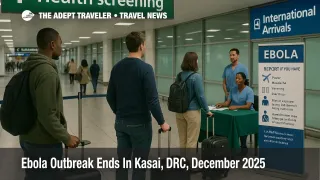
Kasai Ebola outbreak over status is now official in Democratic Republic of the Congo after health authorities declared the end of the Kasai Province outbreak on December 1, 2025. The update matters most for travelers who were watching for health related movement controls, extra screening steps, or operator decisions to pause rural routing near the affected zone. Travelers planning DRC transits, or overland travel that touches central DRC, should still build time buffers and keep a medical contingency plan, but they can treat the Ebola specific uncertainty from Kasai as materially reduced.
The Kasai Ebola outbreak over declaration narrows the health risk picture for most itineraries, while leaving the country's broader security and logistics constraints as the main trip defining variables.
Kasai Ebola Outbreak Over, What Changes For Travel
For travelers, an "outbreak over" declaration is less about a visible switch being flipped at the airport and more about the risk posture behind the scenes. During an active Ebola response, health authorities may tighten surveillance, expand contact tracing, and reinforce screening at points of entry, sometimes including health questionnaires, temperature checks, or additional interviews for people coming from specific areas. When the outbreak is declared over, those Ebola specific measures typically scale back over time, especially when the outbreak was localized and did not spread widely across the country.
In this case, WHO's Disease Outbreak News report says the outbreak was confined to Bulape Health Zone in Kasai Province, and it summarizes totals of 64 cases, including 45 deaths, across six health areas. CDC's situation summary likewise frames the affected province as remote with limited transportation networks, which can reduce spread risk, but also complicates response logistics. That combination is why many travelers never saw meaningful itinerary impacts outside the region, yet still faced uncertainty about what a "DRC Ebola outbreak" headline could trigger at borders, airports, and with insurance and duty of care teams.
What you should not assume is that every trace of Ebola related vigilance disappears. Both WHO and CDC describe a continued period of enhanced surveillance after the end declaration, and WHO's reporting notes ongoing surveillance to rapidly identify and respond to any re emergence. That means travelers can still encounter health messaging, occasional checks at border crossings, or targeted follow up in specific districts, even as the overall posture returns toward baseline.
Background: What "Outbreak Over" Means In Ebola Response
Public health agencies use a clear rule of thumb to declare an Ebola outbreak over. WHO's outbreak notice explains that DRC declared the end after two consecutive incubation periods, a total of 42 days, counted from when the last confirmed patient tested negative and was discharged. WHO reports that discharge date as October 19, 2025, which is why the formal end declaration landed on December 1, 2025. The underlying logic is simple: if you can pass two full incubation windows with no new confirmed cases, the chain of transmission is judged to be broken, even though vigilance continues for flare ups.
For travelers, this is the key nuance: "outbreak over" is a surveillance milestone, not a claim that Ebola can never recur. Ebola can reappear through new spillover events from animal reservoirs, or through rare persistence in survivors, which is why health authorities keep heightened surveillance after the declaration. In practical terms, that translates into lower probability of disruptive travel measures tied to the specific event, not a promise of zero checks.
What This Means At Airports And For Entry Screening
Most international travelers touch DRC through major gateways, not through Kasai Province itself. If your trip is limited to a fly in, fly out itinerary through N'Djili International Airport (FIH), your main planning tasks are still document readiness, conservative timing, and a realistic approach to medical care access if something goes wrong. The end declaration reduces the odds that Ebola specific screening changes will catch you off guard, but it does not eliminate the possibility of health questions at arrival, particularly if public health systems are running multiple parallel surveillance programs.
If your routing involves domestic hops deeper into the country, the calculus changes. Kasai Province is not the typical tourist circuit, but it does appear in some work travel, NGO itineraries, mining related trips, and overland transits. Travelers who plan to move closer to the former outbreak zone should keep a tighter personal risk posture. That means avoiding contact with bodily fluids, skipping any invitation to funeral rites, and treating healthcare settings as higher risk environments unless you have a clear need and a trusted facility. It also means keeping your operator informed about where you have been, because reputable operators may still track district level health context for duty of care even after an outbreak is declared over.
For travelers who follow health alerts closely, it can help to place this update alongside other outbreak reporting across the region. The clearest pattern in late 2025 is that health news often changes the "friction" of travel more than it changes the ability to travel, meaning you may see extra steps, extra forms, or extra wait time more often than outright trip cancellations. If you want a broader planning frame, Adept Traveler's Health & Safety hub is the best jumping off point, and the recent Chikungunya alerts coverage shows how agencies translate outbreak status into traveler level precautions.
Medical Contingency Planning Still Matters
The hard truth is that in many parts of DRC, medical care and evacuation logistics are the limiting factor for traveler risk, regardless of whether Ebola is active. An outbreak ending in Kasai lowers one specific hazard, but it does not change how far you might be from reliable care, how difficult ground movement can be, or how quickly plans can change due to non health disruptions. That is why "outbreak over" should be read as permission to simplify, not permission to be casual.
For higher complexity itineraries, especially overland segments, it is still wise to treat government security advisories and operator risk rules as hard constraints. Adept Traveler's recent reporting on security risks across the Sahel and parts of Africa is a useful reminder that in central Africa, traveler outcomes are often driven by road conditions, checkpoints, and local security dynamics more than by disease headlines. If you are combining destinations, keep your plan modular, avoid tight same day domestic to international connections, and have a clear fallback city where you can safely wait if a segment becomes impractical.
The bottom line is that the Kasai Ebola outbreak over declaration on December 1, 2025 is a meaningful de escalation for health uncertainty tied to that specific event. Travelers should still expect a 90 day enhanced surveillance period, and they should keep basic Ebola avoidance behaviors in mind, but most itineraries can now treat Ebola as a background risk rather than a trip defining variable. If you were holding a decision specifically because of the Kasai Ebola outbreak over status, this is the signal to re check entry requirements, confirm operator routing, and move forward with a more stable information baseline.