

Tunisia Nationwide Strike Disrupts Travel Jan 21, 2026
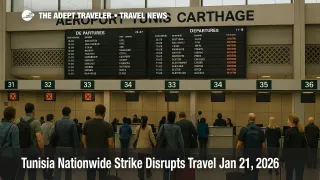
Tunisia nationwide strike travel disruption is now a concrete planning factor for late January trips, after the Tunisian General Labour Union [UGTT] called a nationwide walkout for January 21, 2026. Travelers with flights, tours, and short resort stays that depend on predictable airport transfers should assume higher day of travel friction in and around Tunis, Hammamet, Sousse, and Djerba. The practical move is to add time buffers, reduce same day connections, and line up backup transport in case public services run at reduced capacity.
The Tunisia nationwide strike travel disruption centers on January 21, 2026, a single day action that the UGTT and its affiliated channels describe as covering all sectors, which widens the potential blast radius beyond any one transport mode.
What Travelers Should Expect On January 21
Reuters reports the strike call is tied to pressure over union rights and renewed wage negotiation demands, escalating tensions with the government. For travelers, the key point is not the politics, it is the operational uncertainty that comes when a general strike touches public administration, public services, and private sector employers at the same time. Even if flight schedules remain published, the higher risk often sits in the layers that make an airport day work smoothly, namely staffing, ground transport, and the ability to move across town on time.
In Tunisia, that tends to show up in three traveler visible places. First, getting to the terminal can be harder than flying, especially if urban transit runs reduced, taxis are scarce, or police restrict traffic near central areas. Second, processing inside terminals can slow if contractor staffing or security adjacent services are thinner than normal. Third, routine "tour logistics" can slip, including museum and site hours, intercity bus departures, and the timing discipline that packaged excursions depend on.
Airports And Gateways Most Relevant To Typical Itineraries
Most visitors touching Tunis will pass through Tunis Carthage International Airport (TUN). Many Hammamet and Sousse resort bookings route through Enfidha Hammamet International Airport (NBE) or Monastir Habib Bourguiba International Airport (MIR), depending on airline and season. Djerba stays and flight connections typically route through Djerba Zarzis International Airport (DJE). None of those airports is automatically "closed" by a strike notice, but an all sectors strike raises the chance that some supporting services run at reduced tempo.
Highest Risk Timing For Arrivals And Departures
January 21 is the obvious peak risk day, but travelers should also treat the evening of January 20 and the morning of January 22 as higher than normal friction windows. The reason is mechanical: when staffing and transport are uneven, aircraft and crew may still rotate, but passengers and bags may not flow predictably, and any backlog can take a full operating cycle to clear.
For arrivals on January 21, the most common failure mode is not that the aircraft cannot land, it is that onward movement becomes slow or uncertain. That matters for anyone with pre booked tours that begin the same afternoon, and for travelers planning to connect onward by bus, shared shuttle, or domestic flight.
For departures on January 21, the most common failure mode is missed check in cutoffs because transfers take longer than expected. If you cannot move your departure date, the defensive posture is to arrive in the departure city the night before, and then plan an earlier than usual airport run.
Background
The UGTT is Tunisia's largest and most influential union federation, and the strike call has been presented publicly as a nationwide action across sectors rather than a narrow stoppage limited to one employer group. That breadth is what turns a single calendar date into a travel planning problem, because it increases the number of "links in the chain" that can break, from public offices, to transit, to outsourced services that airports and hotels depend on.
If you want a general playbook for how strikes typically translate into traveler disruption, Adept Traveler's evergreen explainer on strikes is the right companion read: Strike. For recent examples of how a broad strike day tends to affect airport access and day of travel timing, compare the planning guidance in Italy General Strike December 12 To Disrupt Travel and Portugal General Strike December 11 Hits Transport.
What Travelers Should Do Now
Start with the parts you can control. If you have a Tunisia itinerary on January 21, try to move long transfer legs off that date first, then rebuild the day around fewer moving pieces. Travelers going to Hammamet or Sousse should strongly prefer a direct airport to hotel transfer rather than a multi leg transit plan. Travelers going to Djerba should avoid same day domestic connections if the schedule is tight, and should price a backup routing that still gets you to the island within 24 hours.
Next, plan for "self sufficient travel" for a day. Carry on only is ideal because it limits how much you depend on baggage systems if processing slows. Keep medications, chargers, key documents, and a change of clothes in your cabin bag. Download offline maps for Tunis and your resort corridor, and keep your hotel address in Arabic and French to reduce friction if you need to change drivers or routes.
Finally, treat January 21 as a day when street conditions can shift quickly. Reuters and regional reporting note a broader backdrop of political tension and the possibility of unrest around the strike. For travelers, that translates to simple risk hygiene: avoid demonstrations, do not linger near large crowds, and be ready to reroute if police set up rolling roadblocks around government buildings or central squares.
Sources
- Reuters, Tunisia's powerful UGTT union announces a nationwide strike for January 21
- Echaab News, full text of the UGTT administrative body statement announcing the strike
- Echaab News, why workers are striking on January 21, 2026
- Africanews, UGTT calls a nationwide strike for January 21
- Tunis Carthage International Airport (TUN), reference for airport name and code
- Enfidha Hammamet International Airport (NBE), reference for airport name and code
- Monastir Habib Bourguiba International Airport (MIR), reference for airport name and code
- Djerba Zarzis International Airport (DJE), reference for airport name and code