

Portugal General Strike December 11 Hits Transport
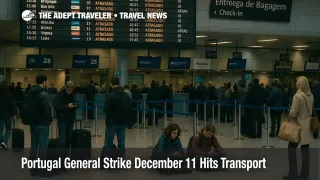
Travelers heading to or within Portugal this week now face a broad national shutdown that will hit almost every part of the transport system on Thursday, December 11, 2025. The CGTP and UGT union confederations have called a general strike against the government's labor reform bill, and ministers openly concede that the walkout is still likely to go ahead. That means flights, long distance trains, metros, buses, and some public services will run on skeleton staffing at best. Anyone relying on tight airport transfers, same day rail connections, or fixed tour start times should now be planning buffers, backup routes, or full date shifts rather than hoping the strike fizzles.
The Portugal general strike transport disruption on December 11 will concentrate risk into one very busy weekday, with public operators warning of severe schedule cuts and private carriers reshaping their plans. National rail operator CP expects widespread cancellations across its mainline network. At the same time, airlines are trimming schedules at Lisbon, Porto, and Faro airports and cautioning that normal operations will be hard to maintain.
How broad is the strike and who is most exposed
This is not a narrow walkout by a single professional group. It is a general strike intended to show cross sector opposition to the government's labor reform package, which would extend fixed term contracts and tweak minimum service rules. Coverage from European outlets suggests that roughly half of the Portuguese workforce could participate, with particular concentration in transport, health, and education.
For travelers, the groups that matter most are railway staff at CP and Fertagus, metro and bus workers in Lisbon and Porto, ground handling and fueling crews at major airports, and airline staff who have chosen to align with the day of action. When all of those layers thin out on the same day, it becomes harder to trust that any single itinerary will run on time, even if it is technically inside a minimum service window.
Rail disruption and CP ticket waivers
CP, Comboios de Portugal, has posted a specific notice for the December 11 strike that warns of severe disruption to Alfa Pendular, Intercidades, InterRegional, and Regional trains. The company is flagging not just the 24 hour window of the strike itself, but also knock on effects from the evening of Wednesday, December 10, through the morning of Friday, December 12, as positioning moves and depot work are delayed.
The important piece for travelers is that CP is offering flexible remedies. Passengers booked on trains that are cancelled or significantly delayed due to the strike can either request a full refund of the ticket price or exchange their ticket free of charge for another train in the same category and class. Requests can be filed online, in the CP app, or at ticket offices, and CP has indicated that refund and exchange requests will be accepted up to around ten days after the strike has ended.
That policy effectively turns December 11 into a flexible travel coupon for most CP tickets. If you have discretion, the safer move is to rebook to December 10 or 12, even if your train has not yet been cancelled, rather than gambling on operating a high risk departure.
Travelers should also remember that Portugal's long distance rail network has limited redundancy. Eurail points out that there are only two daytime cross border rail links into Spain, one between Porto and Vigo and another between Lisbon and Badajoz, which makes each service more critical when disruption hits. If either of those trains is cancelled, there is usually no like for like same day alternative.
Under European rail passenger rules, long distance passengers whose trains are cancelled or severely delayed are entitled to a refund or rerouting, and may be owed partial compensation for long delays once services actually run. However, the compensation element often requires that the traveler first complete the journey, which is another reason to prioritize certainty over fighting to travel on the strike day.
Flight cancellations, minimum services, and EU261
On the aviation side, the general strike overlaps with an already tense winter of Portuguese airport labor. TAP Air Portugal has already cancelled dozens of flights on December 11 and has warned that it will only be able to operate the minimum services required by law, a message echoed by unions representing crews at TAP, easyJet, Ryanair, and Azores Airlines.
At Lisbon Humberto Delgado Airport (LIS), Francisco Sá Carneiro Airport (OPO), and Faro Airport (FAO), a government minimum service order requires airports and fuel suppliers to maintain a basic level of operation, including protected island links to Lajes and Santa Maria and some international flights. In practice, that usually means fewer departures, slower baggage handling, and a greater chance that your flight runs late or is consolidated into another frequency.
Under Regulation EC 261, the European Union's main air passenger rights law, travelers whose flights are cancelled or heavily delayed are entitled to a choice between a refund and rerouting, plus duty of care in the form of meals and accommodation where necessary. Cash compensation is more complicated. Courts and regulators have often treated broad general strikes that affect an entire country as an extraordinary circumstance, especially when the disruption is not confined to a single airline, which limits compensation even while keeping duty of care in place.
For December 11, the safest assumption is that you can insist on a refund or rerouting and on basic care if you are stranded, but you should not bank on a successful cash compensation claim unless the disruption is clearly tied to your carrier's own staffing choices rather than the general strike.
Lisbon, Porto, Algarve, and the islands
Lisbon will absorb the most complex impacts because it combines the busiest airport, the densest urban metro and bus network, and heavy intercity rail flows. If ground handling or airport security staffing thins out, queues at Humberto Delgado can grow quickly, and even flights that technically operate may depart late enough to break connections. In the city itself, general strike participation is likely to thin metro and Carris bus services, which makes taxi and ride hailing demand spike.
Porto faces a similar, if slightly smaller, mix of risks. Francisco Sá Carneiro is less congested than Lisbon, but CP and metro services are important links for getting to and from the airport and for reaching the north of the country. Cancellations on the Porto to Vigo rail corridor or Intercidades services toward Lisbon would hit travelers who are using the city as a rail hub for Galicia or the Douro region.
In the Algarve, Faro Airport depends heavily on ground handling and seasonal staff. If those workers join the strike in significant numbers, flights may operate on paper yet still suffer extended ground delays and baggage backlogs. Regional buses and any CP regional trains that do run are likely to be crowded with travelers seeking alternatives.
On the islands, airlines in the Azores and Madeira have signaled that they will prioritize essential connections, with TAP and Azores Airlines planning to operate a limited skeleton schedule under the minimum service rules. That should keep basic connectivity in place, but passengers connecting from mainland flights that are delayed or cancelled still risk misconnecting, so multi segment bookings need extra attention.
Rerouting common itineraries, Lisbon to Porto, Faro, and Madrid
For Lisbon to Porto trips, rail is normally the default, but on December 11, the safest strategies are either to move the journey or to invert modes. If you can shift the segment to December 10 or December 12, CP's refund and exchange policy makes that relatively painless. If you must move on the 11th, consider early morning buses, shared shuttles, or a one way car rental, keeping in mind that some bus operators may also have partial participation in the strike and that road congestion around toll plazas and city entrances could worsen.
For Lisbon to Faro, the same logic applies, with an extra weather and traffic twist. Traffic on the A2 and A22 can back up when rail and bus passengers shift to cars, so it is better to travel very early or very late in the day, or not at all, rather than aiming for peak midday highway windows. If your trip is anchored by a flight at Faro, ask your airline if it will allow a move to a safer day without fees.
For Lisbon to Madrid, consider bypassing Portuguese rail entirely. Direct flights between Lisbon and Madrid Barajas give you an air bridge outside CP's control, albeit one that still depends on airport staffing in Lisbon. An even more conservative strategy is to reach Spain by air the day before, then continue by Spanish rail on strike day, using RENFE AVE or Alvia services that are not directly affected by Portuguese unions. Long distance buses between the two capitals are another fallback, but they may fill quickly once rail disruption is clear.
How to plan the next 72 hours
The most resilient itineraries now follow three simple rules. First, avoid non essential trips on December 11, and move flexible segments forward to December 10 or back to December 12 or 13 while CP and airlines are still offering fee free changes. Second, where you cannot shift dates, fatten connections so that you are not relying on a tight handoff between a vulnerable train and a flight, or between two carriers that may be operating reduced schedules. Third, prepare documentation and know your rights, including CP's strike notice, EU261 summaries, and national rail and air passenger rights pages.
For deeper background on how European strikes typically unfold and how minimum services shape risk on rail and in the air, readers can also consult Adept Traveler's evergreen guide to strikes in Europe, which explains common scenarios and legal protections in more detail.
Sources
- Strike, 11 December 2025, CP passenger notice
- Portugal strike, major transport disruption to hit
- Strikes threaten to paralyse travel across Portugal
- Services mínimos already fixed for the general strike
- Portugal set for major flight disruptions due to December 11 general strike
- Regulation (EC) No 261/2004 air passenger rights
- Strikes in Europe, Adept Traveler guide
- Portugal airport strikes, what is guaranteed this weekend