

Italy General Strike December 12 To Disrupt Travel
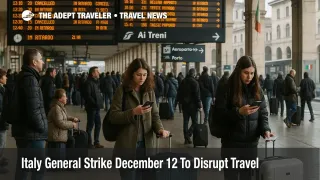
Italy will see a nationwide walkout on December 12, 2025, after union confederation CGIL called a general strike that targets public and private sectors across the country. Rail operators, port workers, and logistics companies are already warning of reduced service, while cities such as Rome, Milan, and Naples expect slower public transport and marches in central districts. For travelers, the Italy general strike December 12 travel disruption turns that Friday into a poor choice for tight rail to flight connections, same day cruise transfers, or time critical deliveries.
In practical terms, the Italy general strike December 12 travel action will disrupt rail schedules, slow freight and port operations, and weaken local transport links that normally feed airports and cruise terminals, so anyone relying on Italian trains or coaches that day should treat their plans as fragile, not guaranteed.
What Is Happening On December 12
CGIL has confirmed a full day general strike for Friday, December 12, 2025, framed as a protest against the government budget and its impact on wages, welfare, and public services. The union has called for rallies and marches in all regions, which means visible street action alongside workplace stoppages. Official strike notices describe a broad participation across public services and private sector logistics rather than a narrow, sector specific protest.
Transport is one of the clearest pressure points. The Italian Ministry of Infrastructure and Transport strike bulletin lists a rail stoppage from 1201 a.m. to 900 p.m. local time on December 12, covering both long distance and regional trains during most of the operating day. December strike calendars highlight that date as the most sensitive day of the month for trains and wider public services, which makes it a focus for anyone planning rail based itineraries.
Although some aviation specific actions are clustered on other dates, the December 12 strike call includes logistics, ports, parts of public administration, and other services that indirectly underpin air travel. In past nationwide strikes, that combination has produced knock on disruption at airports even when air traffic control or airline staff were not the primary target, because ground access, baggage handling, and contractor staffing all came under pressure.
How Rail, Ports, And Logistics Will Be Affected
Rail is at the center of the published transport notices. Under Italian strike rules, Trenitalia and private operator Italo must publish "treni garantiti," or guaranteed minimum service lists, and maintain some essential trains during the stoppage. Outside those protected corridors and times, travelers should expect cancellations, truncated journeys that stop short of their usual endpoints, and long delays as trains stack up behind any disruptions. On a busy December Friday, this will concentrate demand onto the remaining departures, which means more crowding and fewer spare seats for last minute changes.
The practical effect for travelers is that long distance Frecciarossa and Intercity trains will likely run less frequently, especially at off peak times, and regional lines that normally connect smaller towns into hubs such as Rome, Milan, Naples, Bologna, and Florence will see gaps in service. Anyone who has built a same day rail connection to catch a long haul flight, cruise embarkation, or international coach on December 12 should now assume a higher risk of missed connections, forced overnight stays, or rerouting.
Freight operators and port workers are also included in the broader logistics stoppage cited by supply chain advisories. Forwarders warn that truck drivers, warehouse staff, and dockside teams taking part in the action can slow cargo movements and create temporary bottlenecks at major ports. For passengers, that does not automatically translate into a total shutdown of ferries or cruise terminals, but it does mean that supporting movements such as baggage forwarding, equipment shipments, or just in time deliveries to ships and hotels may be delayed.
Where port access roads pass near protest sites, marches or picket lines can also slow traffic, increase waiting times for taxis and shuttles, and briefly complicate parking or drop off. In a worst case, travelers may arrive to find that the rail or public bus service they planned to use to reach the port is reduced or suspended during key hours, forcing a last minute switch to taxis or private transfers if any are still available.
What This Means For Flights And Airports
The December 12 action is not primarily billed as an aviation strike, and official calendars list separate air transport protests on other days in the month. Even so, experience from recent Italian general strikes suggests that pressure on rail, local transport, and logistics will spill over into the airport experience. That spillover can be subtle for some passengers and very visible for others.
Travelers using Leonardo da Vinci Fiumicino Airport (FCO), Milan Malpensa Airport (MXP), Milan Linate Airport (LIN), Naples International Airport (NAP), and Venice Marco Polo Airport (VCE) should treat train and metro access as the weak link on December 12. Thinned out airport rail links, slower metro frequencies, and patchy bus coverage will push more people into taxis and ride hail, which in turn can create longer queues at ranks and heavier curbside congestion.
Inside terminals, airlines and handling agents may face staffing gaps if some workers join the stoppage or struggle to reach the airport on disrupted public transport. That can translate into slower check in and baggage drop, fewer open counters, and longer lines at peak times even when the flight schedule itself has not been significantly cut. Baggage delivery and any same day courier services that move luggage or equipment between cities may also be slower, either because of reduced staffing or because the rail and road legs they use have been disrupted.
Travelers who land in Italy late on December 12 or early on December 13 should also factor in some residual disruption. Trains and buses that fell behind during the strike window may still be recovering, and some airlines may be operating on modified rotations after delays earlier in the day. That increases the value of generous connection buffers and airport hotels adjacent to rail hubs when planning overnight stops.
Who Is Most Exposed
The travelers most exposed to the Italy general strike December 12 travel disruption are those with tightly timed, rail dependent itineraries. That includes visitors planning to land in one city and take a same day train to another for a flight, cruise, or tour, as well as residents using Italian trains to reach major events, sports fixtures, or business meetings that cannot easily move.
Cruise passengers who rely on same day rail or coach journeys to reach ports such as Civitavecchia for Rome, Genoa, Savona, Trieste, or Venice are also at higher risk. If the strike removes one or two key departures in the morning, or if replacement buses are overwhelmed, those transfers can quickly move from comfortable to precarious. Independent travelers who have stitched together multiple low cost tickets across Italy, rather than a single through booking, are particularly vulnerable because each leg may need to be changed separately.
On the other hand, city break travelers who are already in place with walkable itineraries and flexible plans will feel the strike more as an inconvenience than a crisis. They may face slower metro or bus service, changed museum hours, or rerouted tram lines, but they have more room to adapt by shifting sightseeing to different times or neighborhoods away from large marches.
How To Plan Around The Strike
The safest approach is to move critical travel legs off December 12 entirely. If a long haul flight, cruise embarkation, or important rail transfer currently sits on that day, look at shifting it to December 11 or December 13, or at least moving the rail portion to a different day while keeping the flight on the original date. Where tickets are already issued, check whether operators publish special rebooking policies once the guaranteed train lists appear, and use those windows to adjust plans before services fill.
If moving is impossible, the next step is to add buffers and alternate modes. For airport transfers, that could mean taking a train or coach several hours earlier than usual, booking an airport hotel the night before, or arranging a private transfer and planning for possible congestion en route. For cruises, it may be worth arriving in the port city at least one night before embarkation rather than trying to arrive and board on the same day.
Travelers should also protect flexibility in the days around the strike. Choosing refundable or changeable rail fares for December 11 to December 13 creates more room to move if the disruption window widens or if additional protests are announced. When booking through a travel advisor, it is worth asking them to map out fallback routes that do not depend on a single train or bus, so there is a clear Plan B if the first choice connection disappears from the timetable.
Finally, it helps to monitor official channels closely as December 12 approaches. The Ministry of Infrastructure and Transport strike portal, Trenitalia and Italo service update pages, and port authority notices will carry updated lists of guaranteed trains, modified timetables, and any changes to the scope of the strike. Social media feeds from operators and local news outlets can also provide early signals of emerging bottlenecks at specific stations or ports.
How This Fits Into The Wider December Strike Pattern
The December 12 general strike sits inside a wider pattern of winter industrial action in Italy and neighboring countries. In the weeks around the walkout, Italian unions have staged other sector specific protests, while transport workers in countries such as Portugal and France have held their own strikes and slowdowns. For travelers crossing Europe for Christmas and New Year, the effect is less a single day of disruption and more a rolling sequence of risk windows that need to be navigated.
Anyone planning multi country itineraries that combine Italian rail with other strike prone corridors should look carefully at how these windows line up. A trip that uses Italian trains on December 12 and then connects into a French or Portuguese strike later that weekend, for example, stacks vulnerabilities on top of one another. Shifting at least one leg outside those windows, or adding overnight stays to break the chain, can significantly reduce the chance of cascading misconnects.
Sources
- Sciopero Generale CGIL del 12 dicembre, manifestazioni in tutta Italia
- Scioperi, Ministero delle Infrastrutture e dei Trasporti
- Scioperi di dicembre 2025, dai treni agli aerei
- Scioperi, dicembre mese nero, ecco tutti gli stop in arrivo
- Scioperi dicembre 2025, calendario completo
- Italy faces nationwide strike on 12 December 2025
- Transport in Italy disrupted by strikes against PM Meloni
- Italy general strike on 12 December 2025 and key travel disruptions
- December strikes in Italy, Portugal and France could derail your Christmas travel