

Snow, Cold Snap Halt Xinjiang Trains, Close Roads
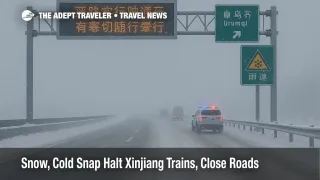
Xinjiang snow halts trains, and it is now closing roads too, turning northern and western China winter itineraries into a higher risk logistics problem this week. Rail operators in Xinjiang suspended multiple passenger services between December 9 and December 11, 2025, and traffic police in Urumqi added temporary controls on key expressways and mountain approach roads as accumulation and reduced grip spread. Travelers who normally rely on overland legs, tour buses, or self drive routes should shift plans toward daylight moves, flexible tickets, and routing choices that preserve backup options if one corridor shuts.
The Xinjiang snow halts trains pattern is not just an inconvenience, it is a network stressor that can cascade. When rail suspensions hit, passengers shift into limited flight inventory, long distance coaches, and rental cars, which can quickly overload remaining capacity and turn small schedule changes into missed hotel check ins, missed ski transfers, and broken multi city plans. The most reliable playbook is to stop treating timing as precise, and start treating it as probabilistic.
What Changed, Rail Suspensions Across Multiple Corridors
Rail bulletins summarized by Xinjiang local outlets say weather conditions drove "dynamic adjustments" and outright suspensions on several routes over a three day window, with notices attributed to accounts for Urumqi railway operations plus Aksu, Kashgar, and Korla rail segments.
The disruptions span both within Xinjiang and beyond it. Examples include Urumqi to Alashankou service suspended on December 9, Urumqi to Tacheng and multiple Urumqi to Aksu services suspended on December 10, and additional suspensions on December 11 that included Urumqi to Kashgar and Urumqi to Hotan services, plus a long distance Urumqi to Shenyang train that can matter for travelers threading Xinjiang onto broader China itineraries. Kashgar origin trains to Xi'an and to Chengdu West were also listed as suspended for December 11, a reminder that this is not only a local shuttle problem, it can disrupt long distance repositioning and onward connections far outside Xinjiang.
For travelers, the actionable takeaway is not memorizing train numbers, it is recognizing which trip types are most exposed. Any itinerary that depends on a single overnight rail leg to protect a morning tour, a ski lesson, or an onward flight is now fragile. If your plan involves arriving into Urumqi late, then catching an early southbound rail the next day, build an extra night and treat same day rail to air connections as high risk until the weather stabilizes.
Road Closures And Controls Around Urumqi
On the road side, Urumqi traffic police described a Level 1 response for the morning peak on December 11, 2025, with traffic management focused on sharp curves, steep grades, slippery segments, and areas prone to blowing snow and fog. They also flagged monitoring and patrol emphasis on major corridors including sections of the G30 Lianyungang Khorgas Expressway, the G3003 Urumqi Ring Expressway, and the G7 Beijing Xinjiang Expressway.
The same notice listed specific segments as not meeting passability conditions at the time of publication. These included two way traffic controls on parts of the western ring expressway, two way controls across the eastern ring expressway corridor, and restrictions on local mountain access roads such as the approach corridor to the Tianshan Wildlife Zoo area, plus Shiren Gou road segments, where snow and slip risk reduced safe capacity. A section of National Highway 314 within Dabancheng District was also described as heavily snow covered and subject to two way control during the response window.
If you are self driving, the operational risk is not just slower speeds, it is sudden closure with few services. In Xinjiang winter conditions, a road that is "moving" at 10:00 am can become a controlled convoy segment by noon, and a closure by late afternoon, especially where crosswinds push drifting snow back onto cleared pavement. That is why daylight travel is more than comfort, it is a safety and recovery strategy.
Ski And Northern Itineraries, Where Pinch Points Form
Altay and other northern Xinjiang winter destinations are popular precisely because they are remote, and remoteness is what makes disruption more expensive. Travelers often stitch together a rail leg, a regional flight, or a long road transfer, then rely on a fixed check in window or prebooked ski transport. When rail suspensions and road controls happen at the same time, your trip can fail at the handoff.
The best mitigation is to reduce the number of handoffs. If you are headed to northern Xinjiang ski areas, consider anchoring one extra buffer night in Urumqi, and avoid same day transfers that require both a road corridor and a timed rail departure to behave perfectly. If you have to travel during the active disruption window, prioritize routings that keep you near higher capacity recovery options, such as repositioning through Urumqi Diwopu International Airport (URC), rather than committing early to low frequency segments where the next backup might be tomorrow.
What To Do Now, A Practical Winter Disruption Playbook
First, treat rail status as a live variable, not a timetable. The rail notice explicitly says final operating information should be confirmed via 12306 channels and station announcements, and it describes full refund processes for suspended trains within set time windows.
Second, replan around the idea that roads may be controlled even when not fully "closed." If Urumqi ring roads and key highways are under active management, that can still add hours through convoy pacing, reduced lane capacity, or temporary holds while crews clear ice and drifting snow.
Third, stop stacking tight connections. If your itinerary includes Kashgar Laining International Airport (KHG), Hotan Kungang Airport (HTN), Aksu Airport (AKU), or Korla Airport (KRL) on separate tickets, add time and keep receipts, because the most common real world failure mode is a small upstream delay that breaks a separate ticket connection, leaving you self funding the fix.
For broader winter disruption context and buffer strategy, see our recent weather driven overland planning coverage in Austria Winter Travel Alert For Flights, Trains, and Roads, and our Asia wide storm season framing in Asia Floods And Cyclones Disrupt December Travel.