

Flash Flood Risk Jordan Petra Road Trips and Tours
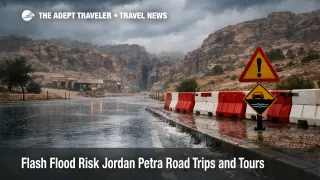
Jordan's south corridor travel plans are under a familiar but trip breaking risk pattern, short notice flash flood warnings tied to cold, unstable weather that can bring locally heavy rain, thunderstorms, and rapid runoff into valleys and low lying routes. Travelers heading to Petra, Jordan, Wadi Rum, Jordan, Aqaba, Jordan, or long desert highway drives are the most exposed, because a single closure can collapse a full day tour, an intercity transfer, or a same day flight plan. The practical move is to treat severe weather days as flexible days, add buffer, avoid wadis and canyon routes, and keep an overnight fallback ready if a road or attraction closes.
The Jordan Meteorological Department warnings being echoed publicly this week are explicit about where the risk concentrates, valleys and low lying areas in the south, including the southern Jordan Valley and Aqaba, with reduced visibility and slick roads adding a second hazard for drivers. The Public Security Directorate guidance reinforces the traveler level rule that matters most, do not enter flood prone terrain, and do not attempt to cross water on foot or by vehicle.
For travelers building Petra to Wadi Rum to Aqaba itineraries, the operational detail is that the risk is not only rain at your hotel, it is rainfall upstream from your route, and that is why authorities focus on valleys, flood channels, and low spots. Recent radar based reporting also pointed to moderate to heavy rainfall north of Aqaba and in Wadi Araba during similar conditions this month, which is the same corridor many travelers rely on for southbound transfers and desert road trips.
Who Is Affected
Travelers with timed Petra entry, guided walks through narrow passages, and day tours that cannot slide by a few hours are the first group to feel the disruption. Even if Petra itself is not seeing peak rainfall, tour operators may pause departures if there is active lightning nearby, if the Siq and side drainage channels look unsafe, or if local authorities signal a higher runoff risk.
Self drive travelers are the next group at risk, especially anyone stacking a long drive with a hard deadline, such as a fixed check in, a cruise embarkation style timing window in Aqaba, or a flight out of Queen Alia International Airport (AMM) after an overnight in the south. When rain, fog, or dust reduces visibility, the trip does not only slow down, it becomes higher variance, and that is what breaks same day planning.
Air travelers using King Hussein International Airport (AQJ) for Aqaba area departures also need to plan for the ground side problem. Even when flights operate normally, a closed or slowed road segment can turn a normal transfer into a missed check in, and rebooking options in smaller airports can be thinner than in the capital.
A separate, predictable friction point can overlap with weather plans, demonstrations and security controls in Amman, Jordan, and on approaches that feed major corridors. Travel advisories note that demonstrations often occur after Friday noon prayers, and they can result in road closures, so travelers should treat Thursday and Friday movements as higher risk windows for tight connections and cross city transfers.
What Travelers Should Do
If you are in Petra, Wadi Musa, Wadi Rum, or Aqaba during active warnings, prioritize safety and schedule resilience over squeezing in one more stop. Keep canyon and wadi activities off the calendar until warnings clear, confirm whether your tour operator will shift the departure time, and add buffer to any intercity drive, especially if you are trying to reach a hotel check in deadline or an airport counter cutoff.
Rebook rather than wait when your plan depends on a narrow passage, a valley road, or a fixed start excursion that is likely to be paused by runoff risk. If your day requires a Petra entry plus a same day drive to Wadi Rum or Aqaba, and the forecast messaging includes thunderstorms, hail, or flash flood language for southern valleys, treat that as a trigger to shift the drive to the next safe window, or to overnight closer to your next morning commitment. Waiting can make sense only when your next step is flexible, your lodging is secure, and you can stay put without losing a flight, a border crossing slot, or a prepaid tour that will not move.
Over the next 24 to 72 hours, monitor Jordan Meteorological Department updates, Public Security Directorate guidance, and direct messages from your hotel, driver, or tour operator, because closures and restarts often happen faster than broad news updates. Also keep the standing Amman transfer rule in mind, Thursdays and Fridays often see demonstrations and heavier security posture, which can mean rolling roadblocks and checkpoints, so avoid stacking a long southbound road trip with a same day international departure, and leave earlier than you think you need to when moving through the capital.
How It Works
Flash flooding in Jordan is a geometry problem as much as a rainfall problem. Many signature experiences, including canyon style walks and desert valley drives, sit downstream of high ground that can shed water quickly when storms build over a ridge line. That is why you can see relatively ordinary rain at a hotel, while a wadi system nearby becomes dangerous within minutes.
The travel system ripple starts at the source, road segments slow or close, guided routes are retimed, and some attractions restrict access until runoff drops. The second order effects are what usually cost travelers money, missed hotel check ins that force late night arrivals or unplanned nights, broken connections to prebooked drivers, and rebook pressure on limited capacity transport in the south. When group transport pauses, private drivers get scarce fast, and prices and pickup times can move against you.
The third layer is air and long distance timing. A delayed south corridor drive can cascade into missed check in at Queen Alia, or into rebooking at a smaller airport such as King Hussein in Aqaba, where daily flight frequency can be limited. If you want a comparable playbook for how wadi driven disruption works elsewhere in the region, see Oman Heavy Rain Alert, Flash Flood Risk Dec 16. For the non weather transfer risk that can overlap with Jordan itineraries, see Jordan Protests Snarl Amman Airport Transfers Thu Fri.
One more reason to take the flash flood warnings seriously is that Petra has a documented history of evacuations during flood events, including a widely reported incident where tourists were moved out after flash flooding hit the area. The right posture is not panic, it is humility about terrain, and a plan that does not rely on getting through a valley at a specific hour.
If you are rebuilding a Jordan itinerary after a weather day, verify entry and timing constraints before you shift flights or hotel nights, and use Jordan Entry Requirements For Tourists In 2026 as a quick reference when your arrival date changes.
Sources
- PSD Urges Caution Amid Severe Cold Weather, Jordan News Agency (Petra)
- Unstable Conditions Bring Thunderstorms to Southern Regions, Jordan News Agency (Petra)
- Cold, Rainy Conditions Persist With Flood and Fog Warnings, Jordan News Agency (Petra)
- Downpours, thunderstorms forecast in Aqaba, Wadi Araba, flash flood alerts issued, Jordan News Agency (Petra)
- Jordan: Unstable weather conditions expected Wednesday, with fears of flash floods, especially in the south and east of the kingdom, ArabiaWeather
- Jordan Travel Advice & Safety, Smartraveller
- Safety and security, Jordan travel advice, GOV.UK
- Hundreds of tourists evacuated after flash floods hit ancient Jordan city of Petra, ZAWYA