

FAA Dec 16 Flight Delays, JFK and LAX Weather Risks
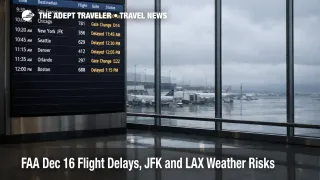
The FAA is warning of weather driven throughput reductions that can slow departures and arrivals across several major U.S. hubs today. Low clouds could trigger delays at Seattle Tacoma International Airport (SEA), San Francisco International Airport (SFO), Los Angeles International Airport (LAX), San Diego International Airport (SAN), and Tampa International Airport (TPA), and wind is expected to add disruption risk in the New York metro area at John F. Kennedy International Airport (JFK), LaGuardia Airport (LGA), and Newark Liberty International Airport (EWR).
The FAA Command Center's current operations planning also pointed to specific constraints that matter for passenger itineraries. The advisory notes low ceilings and visibility at LAX that may require terminal initiatives, SFO opening at a reduced arrival rate with metering, and fog risk around Orlando International Airport (MCO) and Tampa. It also flags the potential for ground stop or delay programs at SAN and LAX through 4:00 pm ET, and at SFO through midnight ET, which is the kind of tool that can turn a normal delay day into a missed connection day.
Early day delay counts showed friction at several of the same nodes travelers rely on for connections. FlightAware's airport dashboards listed 81 delays and 12 cancellations at JFK, 60 delays at LaGuardia, and 33 delays and 4 cancellations at Newark, alongside 60 delays and 4 cancellations at LAX, 24 delays and 3 cancellations at SFO, and 49 delays and 5 cancellations at Seattle Tacoma.
Who Is Affected
Travelers are most exposed if they are connecting through the New York metro airports, Southern California, or the Bay Area, because those hubs feed dense banks of departures that rely on inbound aircraft arriving on schedule. If your itinerary touches JFK, LaGuardia, Newark, LAX, or SFO, a modest airport arrival rate reduction can quickly become a rolling gate and crew problem that persists after the weather itself improves.
Florida travelers can get caught in a different pattern. Fog and low visibility do not always create headline ground stops, but they can slow ramp operations and spacing, which stretches turn times and can create late day cancellations when airlines need to protect aircraft and crews for the next morning. This matters most for same day connections and for the last departures of the night, when there is little remaining schedule slack.
Even travelers not flying through these airports can still feel the effects. When a hub compresses, airlines often protect long haul and high density routes first, then cancel lower frequency spokes, which can strand travelers in secondary cities waiting for the next available seat. If you are planning around New York recovery after yesterday's storm impacts, related coverage is here: NYC Snowstorm Delays JFK, Newark, LaGuardia December 15.
What Travelers Should Do
Start by checking your airline app for an aircraft assignment and inbound flight, not just a departure time, then look for a waiver or free change option if your routing touches JFK, LaGuardia, Newark, LAX, SFO, or Seattle Tacoma. If you can switch to a nonstop, do it, and if you cannot, add buffer on the connection by moving to an earlier first leg or a later second leg while seats still exist.
Use a simple threshold for deciding whether to wait or rebook. If your departure airport is under a ground delay program, or your flight is already sliding past 60 to 90 minutes with no firm new departure time, rebook early because reaccommodation inventory tends to disappear fast once a program is in place. If your flight is only modestly delayed and your inbound aircraft is already on the ground with a legal crew, waiting can be rational, especially if later flights are already full.
Over the next 24 to 72 hours, monitor ATCSCC advisories and airport status tools for changes in arrival rates, metering, and any new ground stops, and keep an eye on knock on constraints like runway work that reduces capacity during recovery. For deeper context on why ATC and system design choices matter when the network is stressed, see: U.S. Air Traffic Control Privatization: Reality Check.
Background
Most flight delay days are not about a single airport, they are about how quickly disruptions propagate through the network once arrival and departure rates dip below schedule demand. Low ceilings reduce runway acceptance rates and increase spacing, which creates arrival queues, gate holds, and longer taxi times, then pushes departures late because aircraft cannot turn on time. When a hub like SFO is metered at a reduced rate, that constraint does not stay local, it forces airlines to hold aircraft at origin, reshuffle gates, and sometimes cancel flights to reset rotations.
The second order effects show up in connections, crew legality, and downstream capacity. A late inbound into New York can break a day of short haul turns, which then deprives other airports of their inbound aircraft, and pushes crews toward duty time limits that can trigger cancellations even after conditions improve. Add in known capacity reducers like runway work at LaGuardia through December 31, 2025, and the system has less slack to absorb weather, which can prolong recovery and push disruption into later banks.
Beyond aviation, the ripples hit hotels, rental cars, and prebooked tours. Missed connections and late arrivals raise the odds of overnight stays, late check ins, and no show penalties on separately booked ground components, and they can strain inventory at airport hotels when multiple flights cancel into the same evening window. For travelers, the practical implication is that a "minor" ceiling day at a hub can still turn into a full itinerary disruption if you are connecting, traveling on separate tickets, or arriving late enough that your alternatives narrow.
Sources
- FAA Daily Air Traffic Report, Tuesday, December 16, 2025
- FAA ATCSCC Current Operations Plan Advisory, 12/16/2025
- FlightAware delays and cancellations, JFK (today)
- FlightAware delays and cancellations, EWR (today)
- FlightAware delays and cancellations, LGA (today)
- FlightAware delays and cancellations, LAX (today)
- FlightAware delays and cancellations, SFO (today)
- FlightAware delays and cancellations, SEA (today)
- FlightAware delays and cancellations, SAN (today)
- FlightAware delays and cancellations, TPA (today)
- FlightAware delays and cancellations, MCO (today)