

Flight Delays and Airport Impacts: December 18, 2025
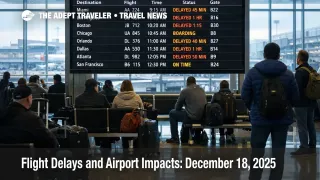
Flight delays are concentrating today around the New York metro hubs, Philadelphia, and Orlando, with FAA status pages showing active gate holds and longer taxi times at several airports. Travelers connecting through Newark Liberty International Airport (EWR), John F. Kennedy International Airport (JFK), LaGuardia Airport (LGA), Philadelphia International Airport (PHL), or Orlando International Airport (MCO) are the most exposed because even moderate ground holds can break tight banks, rebooking inventory, and crew rotations. The practical move is to widen buffers, avoid tight same day connections on separate tickets, and be ready to rebook earlier departures if holds keep rising through the day.
The FAA flight delays December 18 outlook is also being shaped by the Air Traffic Control System Command Center (ATCSCC) plan, which highlights low ceilings at multiple major terminals, and notes that additional traffic management programs are possible later, including around Charlotte Douglas International Airport (CLT) and Newark.
Who Is Affected
Travelers flying into, out of, or connecting through Newark are seeing posted gate hold and taxi delays in the 15 to 29 minute range tied to FAA equipment constraints, which can still become a bigger problem if it hits your specific departure bank. JFK is showing longer ground delay conditions, with posted 46 minute to 1 hour gate hold and taxi delays tied to traffic management initiatives, which is enough to trigger missed connections when itineraries leave little slack.
Philadelphia is showing a similar 46 minute to 1 hour delay profile, tied to a fire alarm or safety event, which can be especially disruptive because many domestic connections and transatlantic departures rely on tight sequencing at gates and on the ramp. LaGuardia is also showing delays in the 15 to 29 minute range tied to a safety related event, which matters for short haul shuttles where a short hold can still turn into a cancellation if the aircraft and crew are needed for later legs.
In Florida, Orlando is showing 31 to 45 minute departure delays attributed to traffic management initiatives and volume, a pattern that frequently spills into the rest of the day because late departures arrive late to their next station, compressing turn times and increasing the odds of downstream delays, missed crews, and aircraft swaps. The ATCSCC plan also references Florida flow management and active initiatives that can reshape routings into and out of the state as volume builds.
What Travelers Should Do
If you are traveling today through Newark, JFK, Philadelphia, LaGuardia, Charlotte, or Orlando, take action before you leave for the airport. Check your airline app for a rebooking waiver, switch to an earlier flight if your first leg is already showing a long ground hold, and pad your curb to gate timeline because gate holds often coincide with crowded checkpoints and packed gate areas.
Use a hard decision threshold for connections. If your inbound is delayed enough that your connection time drops below about 90 minutes for a domestic to domestic connection, or below about 2 hours for an international departure with checked bags, treat the itinerary as likely broken at Newark, JFK, Philadelphia, or Orlando, and rebook while seats still exist, rather than waiting at the gate for a recovery that may not come.
Over the next 24 to 72 hours, keep monitoring whether the ATCSCC plan's "possible" programs turn into active ground stops, ground delay programs, or flow restrictions, especially if low ceilings persist and volume remains high. Also watch for reroute and airspace initiatives affecting Florida and the East Coast centers, because those can quietly add time to flights even when your departure airport looks normal.
How It Works
Most large delay days start with a capacity drop at one or more busy nodes, then propagate through the network. Low ceilings, low visibility, wind, or snow can reduce an airport's arrival rate, forcing air traffic control to meter flights with ground delay programs or gate holds, which then pushes departures late and creates aircraft and crew shortages at later stops. The ATCSCC operations plan for December 18 flags low ceilings at multiple major hubs, and it also notes that additional programs may be needed later for Charlotte and Newark, which is exactly the kind of mid day trigger that turns localized delays into a multi region ripple.
The ripple usually shows up in two places travelers feel immediately. First, connections break because the arriving bank slips and the departing bank does not wait, especially at New York area airports and Florida hubs during heavy volume periods. Second, irregular operations multiply as late arrivals compress turnaround windows, which increases the odds of aircraft swaps, gate changes, and crew legality issues that cancel later flights even after weather improves. Today's posted delays at Newark, JFK, Philadelphia, LaGuardia, and Orlando are the kind of early signal that can create those downstream effects if conditions do not ease.