

Rome Trevi Fountain Fee Starts February 1, 2026
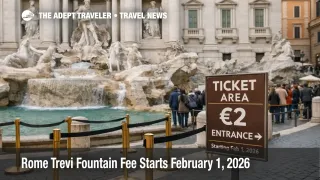
Rome will begin charging tourists a €2 fee for close access to the Trevi Fountain starting February 1, 2026, shifting the landmark from a purely open public square experience to a managed, ticketed close viewing zone during daytime hours. The city says the fountain will still be visible for free from the surrounding Piazza di Trevi, but stepping into the tightly controlled area closest to the basin will require a ticket for non residents. The move follows a year of crowd controls that already limit how many people can stand directly in front of the fountain at once, and it is framed as both an overtourism response and a maintenance funding stream.
Details vary slightly across early reporting on operating hours, but the plan is consistent on the main traveler takeaway: daytime close access becomes paid, and late night or early morning access remains the easiest way to see the fountain without ticketing. Rome has described free access overnight, with ticketing intended to cover the busiest daytime window. City leaders have also tied the new fee to a broader "new tariff system" for civic museums and monuments, with the goal of stabilizing upkeep funding while reducing gridlock in one of the city's most constrained public spaces.
Who Is Affected
Visitors who plan to photograph the fountain from the steps, toss a coin from the closest edge, or linger in the immediate viewing pocket should expect the biggest change, because that close area is where ticket checks and capacity limits will concentrate. Travelers on tightly scheduled walking tours, shore excursions, or day trips are also more exposed, because even a small per person fee can be trivial while a 30 to 60 minute queue swing can derail timed entries elsewhere.
Families and travelers managing mobility constraints should watch the final exemption and verification rules closely. Italian press reporting indicates exemptions may apply for children up to age five, and for travelers with disabilities plus one companion, and some reporting also mentions MIC Card holders, but travelers should confirm the final posted rules and accepted documentation before relying on exemptions at the checkpoint.
The change also affects travelers who build Rome days around a "free stops" loop. Five other previously free Rome sites, including the Villa of Maxentius and several small civic museums, are slated to introduce a tourist ticket at the same time, which can turn an inexpensive filler afternoon into a paid day if you stack multiple stops.
What Travelers Should Do
Plan for time first, then money. If Trevi is a must do close up stop, aim for early morning, late evening, or overnight hours when crowd density is typically lower and ticketing may be off, then use the middle of the day for larger footprint sites that absorb crowds better. If you plan to visit during the ticketed window, build a realistic buffer around the fountain, because the queue will be shaped by capacity caps, payment friction, and security checks, not just foot traffic.
Use a simple decision rule for re routing on the day. If the queue looks long enough that it will cut into a timed entry, a rail departure, or a prepaid tour start, do not gamble. Shift Trevi to a night pass, and keep your timed commitments, because the fountain remains viewable from the square without paying, and your downside risk is mostly schedule damage, not missing the monument entirely.
Over the next 24 to 72 hours before your visit, monitor three practical signals: the published ticketed hours and where tickets can be bought, whether any pilot rules change as February 1, 2026 approaches, and whether nearby attractions are experiencing knock on queues that change walking time between stops. If your Rome trip also includes Schengen airport entry or a domestic flight connection, keep an eye on system wide disruption risk too, because added friction at borders or airports can shrink your sightseeing day margins and make long queues at Trevi more consequential, especially during peak arrival weeks. For related planning context, see Schengen EES Airport Delays Worsen With Jan 9 Ramp and Italy Airport Strike Disrupts Flights January 9, 2026.
How It Works
Trevi is a worst case geometry problem for overtourism: a world famous monument squeezed into a small square with limited approach space, heavy pickpocket interest, and constant flows of people trying to stop, turn, and photograph at the same choke points. Rome has already been experimenting with a controlled access pattern that channels visitors into defined lanes and limits the number of people who can occupy the closest area at a time, a cap that has been widely reported at about 400 people. The new €2 ticket essentially monetizes that controlled zone while keeping the broader square open, which is why casual pass through viewing stays free but "steps and basin edge" access becomes a checkpointed experience.
For travelers, the first order effect is simple: queues and verification become part of the Trevi visit during the day. The second order effects spread outward into the city's visitor logistics. Walking tour groups tend to bunch at landmarks like Trevi, so a slower throughput there can push crowd pulses into nearby narrow streets, and it can force tour operators to adjust pacing, swap stop order, or shorten dwell time elsewhere to stay on schedule. That ripple is felt at other timed entries, at dinner reservations that depend on predictable neighborhood transit times, and even at hotel check in patterns when early arrivals try to fill time at free sites. The third layer shows up in how Rome manages tourist loads citywide: when one flagship site becomes more regulated, demand can shift to other "free and easy" stops, which is one reason the city is pairing Trevi's ticket with new tourist tickets at several smaller civic museums and sites.
Trevi's ticket also sits inside a broader Italian trend of charging for access at high pressure heritage sites, including newer fees and controls that are designed to fund conservation while discouraging unmanaged surges. Rome's messaging stresses that revenue will support maintenance and the quality of the visitor experience, and that residents retain access, but visitors should expect the operational reality to be shaped by staffing, payment speed, and the city's willingness to enforce dwell limits in a space that was historically uncontrolled.
Sources
- Ticket per turisti a Fontana di Trevi
- Rome to charge tourists to get close to the famed Trevi Fountain
- Visiting the Trevi Fountain now will cost more than just a coin toss with a 2-euro tourist fee
- Sindaco di Roma Gualtieri: "Dal primo febbraio a Fontana di Trevi ticket di 2 euro per i turisti"
- Rome's Trevi Fountain to reopen after restoration works
- Fontana di Trevi a Roma a pagamento con biglietto da 2 euro, ora è ufficiale: chi è esentato dal ticket