

Italy Airport Strike Disrupts Flights January 9, 2026
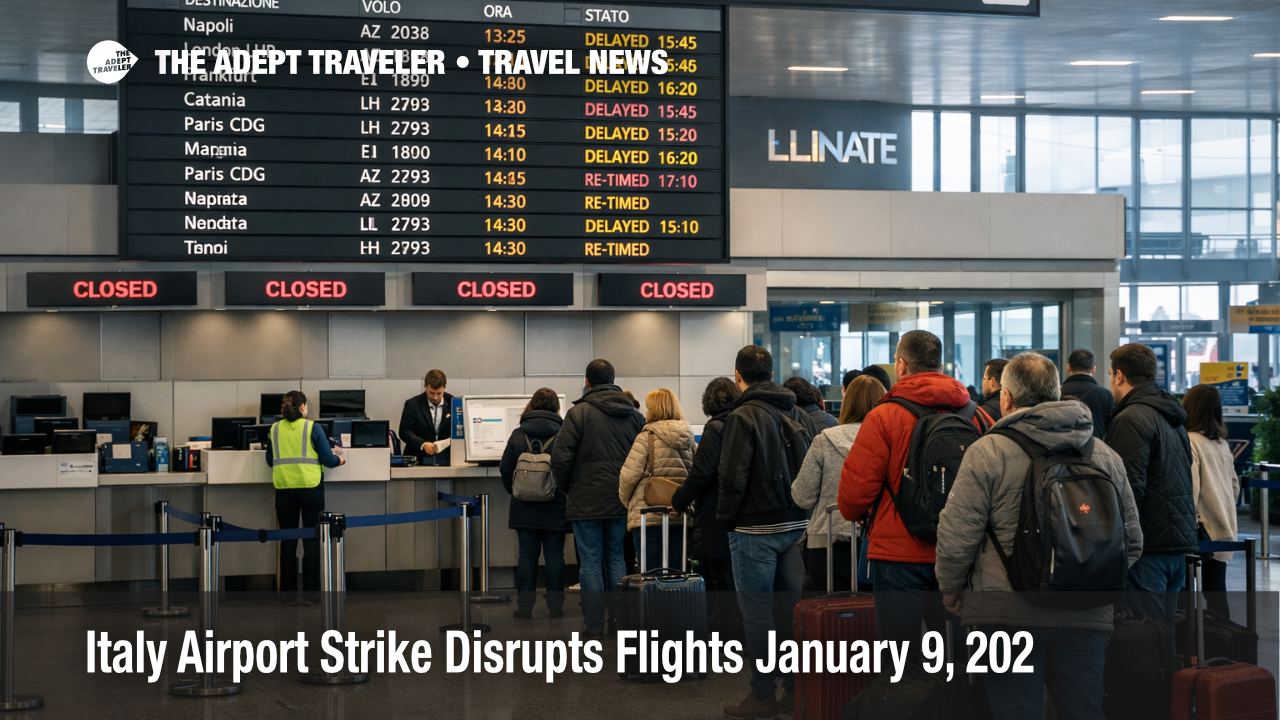
Italy's aviation strike calendar now includes a national ground staff walkout on Friday, January 9, 2026, scheduled from 1:00 p.m. to 5:00 p.m. local time, which can disrupt departures and arrivals across the country. Travelers flying into, out of, or connecting within Italy, especially via Milan Linate Airport (LIN), face the highest risk of baggage delays, longer check in lines, and last minute cancellations. If travel is flexible, shifting away from January 9 and building larger buffers for transfers, rail links, and hotel check ins is the safest play, while those who must fly should target protected time bands and monitor airline waivers closely.
The Italy airport strike January 9 combines a four hour national handling action with a full day Swissport Italia walkout at Milan Linate, raising the odds of irregular operations during peak winter travel. Strike notices listed on Italy's official strike calendars point to two overlapping pressure points on January 9. First, a nationwide four hour action tied to airport ground operations is set for the early afternoon. Second, Milan Linate has an additional, airport specific 24 hour ground handling walkout tied to Swissport Italia, which can stretch disruption beyond a single peak window because aircraft turnarounds, bag rooms, and gate staffing are constrained for an entire operating day. Separately, another date to watch is Saturday, January 31, 2026, when ENAV air traffic control, ATC, staff at Verona are flagged for a four hour window that can reduce arrival rates, trigger airborne holding, and force reroutes that cascade into missed connections later in the day. ## Who Is Affected The most exposed travelers are those whose itineraries touch Italy on January 9, and rely on tight same day sequencing, such as a morning flight into Milan followed by a short hop onward, or an afternoon arrival that depends on a same day rail connection and a timed hotel check in. Milan Linate is especially sensitive because it is slot constrained, heavily business oriented, and operationally reliant on smooth, repetitive turnarounds, so a ground handling shortfall shows up quickly as gate holds, late bags, and aircraft that depart out of sequence. Italy's protected flight windows reduce the odds of a total shutdown, but they do not prevent the system effects that matter most to travelers. When ground staff availability drops, airlines often pre cancel marginal frequencies, then concentrate remaining flights into fewer departure waves, which lengthens queues, slows baggage delivery, and raises misconnect risk. Those ripples can spread beyond the airport layer into intercity rail and road transfers as passengers pivot to trains at short notice, and into hotel inventory near hubs as stranded travelers extend stays. Northern Italy winter travel amplifies this, because ski week patterns concentrate arrivals into narrow bands, and last mile transfers can become the bottleneck even when an alternate flight or train exists. Travelers routing through Verona on January 31, including those connecting to the Dolomites and Lake Garda area, should treat the ENAV action as a separate risk event. Even a time boxed ATC slowdown can push arrivals later, which then breaks pre booked car pickups, shared transfers, and same day rail legs, especially when schedules are already thin in winter. For additional Italy strike context and timing patterns, see [Italy airport worker walkouts set for October 13 and 29](https://adept.travel/news/2025-10-09-italy-airport-worker-walkouts-oct-13-29) and [Italy air transport strike: guaranteed flights and your EU261 rights](https://adept.travel/news/2025-09-26-italy-air-transport-strike-guaranteed-flights-eu261). For a broader, reusable playbook on rerouting logic and traveler rights during European strike disruption, see [Europe Airport Strikes: Compensation and Re-Routing Guide](https://adept.travel/news/2025-07-26-europe-airport-strikes-compensation-waivers). ## What Travelers Should Do Travelers with flexibility should move nonessential trips off January 9, or at minimum, avoid itineraries that require tight same day connections in Italy. Where a change is not possible, plan for friction by shifting to a morning departure inside the protected band where available, traveling carry on only when practical, pre booking a refundable hotel buffer night near Milan, and treating any onward rail or ski transfer as a separate leg that needs slack. If a flight is already showing schedule changes, or if the itinerary depends on a short haul feeder into Milan, rebooking earlier is usually better than waiting. A useful threshold is this, if a missed connection would force an overnight anyway, or if you are on separate tickets, rebook proactively to a same day itinerary with a larger buffer, or to January 8 or January 10, rather than gambling on day of reaccommodation when airport lines and call centers are busiest. Over the next 24 to 72 hours before travel, monitor three signals in parallel, airline app notifications for pre cancellations and rebooking options, airport advisories for processing and staffing impacts, and whether a carrier publishes a dedicated "guaranteed flights" or waiver page for Italy on January 9. For January 31 Verona travelers, watch for ATC flow restrictions and arrival rate reductions, because those can appear as delays even when no flights are formally canceled. ## How It Works Italy's aviation strike framework is designed to preserve basic mobility while allowing industrial action. ENAC, Italy's civil aviation authority, publishes minimum service guidance, including protected time bands from 7:00 a.m. to 10:00 a.m. and from 6:00 p.m. to 9:00 p.m. local time, when flights scheduled in those windows must still operate, alongside an "indispensable" flights list for certain protected services. In practice, that means the highest cancellation risk often concentrates outside the protected bands, but operational knock ons can still push into the evening as aircraft and crews fall out of position, and as delayed bags and gate congestion slow turnarounds. For travelers, the second layer is how airlines manage the day. When ground handling is constrained, carriers tend to cancel lower priority frequencies first, then protect longer haul or higher load flights, and they may retime departures to concentrate staffing where it can serve the most passengers. That triggers second order impacts across the system, including misconnected passengers who need reaccommodation, inbound aircraft that arrive late and miss their next rotation, and short notice demand spikes for rail seats and airport area hotels. The same logic applies differently for air traffic control actions, where a reduced arrival rate can force airborne holding, longer routings, and missed slot times, which then propagates into crew duty limits and downstream delays. Traveler rights basics remain consistent even when compensation does not. Under EU passenger rights rules, passengers on eligible itineraries are generally entitled to rerouting or a refund when a flight is canceled, and to duty of care such as meals and lodging when stranded, while cash compensation often depends on whether the root cause is considered within the airline's control, which is frequently not the case for third party airport or ATC strikes. ## Sources * [Christmas travel chaos: All the European airport strikes to expect in December](https://www.euronews.com/travel/2025/12/19/christmas-travel-chaos-all-the-european-airport-strikes-to-expect-in-december) * [Ricerca Scioperi, CGSSE calendar results](https://www.cgsse.it/index.php/calendario-scioperi?fbclid=IwAR3wTQnMq8zhNVJd-jH1i0PQmy4CNTpzA8JaDyBXLaLm4nXHaT7_7zker88&mibextid=uc01c0&page=1) * [Ricerca Scioperi, Swissport Italia entry](https://commissionegaranziasciopero.it/calendario-scioperi?page=2) * [Ricerca Scioperi, ENAV Verona entry](https://www.cgsse.it/calendario-scioperi?data_fine=&data_inizio=&settore%5B%5D=108) * [Voli garantiti in caso di sciopero, ENAC](https://www.enac.gov.it/trasporto-aereo/diritto-alla-mobilita/scioperi-nel-trasporto-aereo/voli-garantiti/) * [Regulation (EC) No 261/2004 Official Text](https://eur-lex.europa.eu/legal-content/EN/TXT/?uri=celex%3A32004R0261)