

Madrid Airport Strike Dates, Barajas Dec 26 to Jan 7
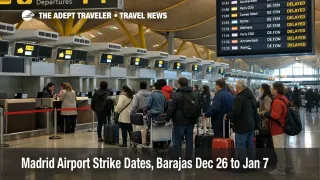
Madrid airport strike dates at Adolfo Suárez Madrid Barajas Airport (MAD) now extend beyond the December 23, 2025, disruption day, with additional strike dates in play on December 26 and December 30, 2025, plus January 2 and January 7, 2026. Holiday and New Year travelers using Madrid as a hub, especially those flying carriers served by the same ground handler, face higher risk of check in queues, baggage delays, and late departures even when flights still operate. The practical next step is to reduce reliance on checked bags, avoid tight same day connections, and use airline waivers early if your itinerary is fragile.
The Madrid airport strike dates expansion matters because it increases the number of peak period travel days where a handling slowdown can turn into missed bag cutoffs, delayed aircraft turns, and broken connections through Madrid Barajas.
Who Is Affected
Aena's notice says the strike is called by handling staff from the company South, which provides ground handling services to various airlines at Madrid Barajas, and that the action is planned for December 23, December 26, and December 30, 2025, plus January 2 and January 7, 2026. Aena also lists the two daily strike blocks as 800 a.m. to 1200 p.m., and 600 p.m. to 1000 p.m. local time, and advises passengers to check flight status with their airline. Those time blocks matter because they sit on top of common departure and arrival banks, when the system has the least slack.
The most exposed passengers are the ones who need staffed processes in Terminal 4, including travelers checking bags, traveling with bulky items, needing document checks at the desk, or relying on short curb to gate timing. Terminal 4 is the core operating area for several affected carriers, including Iberia, British Airways, Aer Lingus, and Vueling, and airline pages published by Aena and the carriers themselves place their Madrid operations in Terminal 4, which concentrates queue risk in the same building during the strike windows.
Connections amplify the impact. A handling slowdown does not just delay one flight, it can push an aircraft off schedule, which then hits the next rotation, and that knock on effect is most punishing on short haul Europe where planes and crews cycle quickly. When the arrival bank comes in late, the departure bank leaves late, and misconnects stack up fast, especially for travelers on separate tickets who have no protected onward rebooking. Travelers with onward rail plans out of Madrid, Spain, are also exposed, because a delayed arrival plus slow baggage delivery can push you past a fixed train departure, and it is often harder to recover during holiday peaks when alternatives sell out.
What Travelers Should Do
Start with immediate actions that remove you from the fragile parts of the system. If you can travel carry on only, do it, because bag drop, sorting, and loading are among the first processes to degrade when staffing is reduced. If you must check a bag, arrive earlier than normal, and treat the airline's bag drop cutoff as non negotiable, because queues can jump sharply once the first wave of passengers realizes counters are moving slowly. If you are meeting a car service, a tour pickup, or a cruise transfer after landing, build extra buffer for baggage delivery on strike days.
Use decision thresholds that force a choice before you are stuck. If your flight departs during the 800 a.m. to 1200 p.m. or 600 p.m. to 1000 p.m. strike blocks on December 26, December 30, January 2, or January 7, and your trip fails if you arrive more than about 60 to 90 minutes late, it is rational to proactively move to a non strike day, or to a departure outside the blocks, before airport lines build. If you are on separate tickets, treat any schedule change or delay warning as a reason to reroute early, because same day reaccommodation can collapse when holiday load factors are high.
Over the next 24 to 72 hours, monitor the signals that actually predict whether your day will break. First, watch for schedule changes inside your booking, including retimings that move you into a strike block. Second, watch your airline's waiver page and app alerts, because that is where fee free change options appear first. Iberia has published guidance for eligible customers that can allow rebooking through January 15, 2026, under defined conditions, and it also notes that refund treatment can differ depending on whether a flight is canceled. If you want a broader comparison point for how ground handling strikes typically affect check in and baggage flows around year end peaks, see Portugal Airports Ground Handling Strike Dec 31 to Jan 1. If your backup plan involves rerouting via other major European hubs that are also seeing holiday labor actions, see London Airport Strikes Disrupt Christmas Flights.
How It Works
Ground handling disruptions propagate through the system differently than full flight cancellations, and that is why travelers can be caught off guard. Even when an airline intends to operate the schedule, a slowdown at check in and bag drop can strand passengers landside, while a slowdown on the ramp can delay pushback, stretch turn times, and throw off aircraft rotations for the rest of the day. Aena's notice frames this as a handling strike tied to the company South and gives two daily windows, which points to staffing dependent processes rather than a single all day shutdown.
Terminal concentration increases the ripple. When multiple carriers share Terminal 4 facilities, queues and baggage flows compete for the same physical space, and delays can compound as late passengers arrive at gates in a surge, slowing boarding and pushing departures further back. Once flights leave late, the second order effects often grow larger than the first order delay, because missed connections must be reaccommodated onto already full flights, which can force unplanned overnights, and tighten last minute hotel inventory in Madrid and in leisure destinations that depend on Madrid connections.
Airline handling rules also shape traveler outcomes. Iberia's published strike guidance for eligible ticketed customers includes a defined rebooking window through January 15, 2026, and notes limits on refunds when flights are still operating, which is exactly why travelers should not assume that every delay day behaves like a cancellation day. The safest posture is to document expenses, keep receipts, and make proactive changes while waivers are available, rather than waiting until airport lines make changes harder.
Sources
- Home page, Adolfo Suárez Madrid-Barajas Airport, Aena
- Strike at Madrid Airport, Iberia Agencies
- British Airways at Adolfo Suárez Madrid-Barajas Airport, Aena
- Aer Lingus, Adolfo Suárez Madrid-Barajas Airport, Aena
- Iberia, Adolfo Suárez Madrid-Barajas Airport, Aena
- Airport strikes to hit major European hubs this Christmas, Euronews Travel