

France Rail Strike To Disrupt SNCF Trains Jan 13, 2026
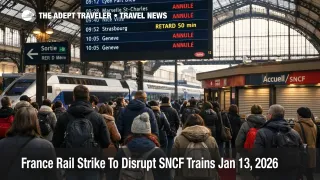
A strike notice targeting SNCF services has flagged January 13, 2026 as a potential disruption day for rail travel across France. The highest exposure is for travelers relying on TGV INOUI and OUIGO high speed services, Intercités routes, regional TER trains, and Paris region commuter operations where a single cancellation can break a tightly timed itinerary. Travelers should treat January 13 as a day to add buffer, avoid separate ticket chains, and be ready to move to an earlier or later departure once the final operating plan posts.
The France rail strike Jan 13 risk is that SNCF service levels can be reduced with little lead time, forcing rebookings, mode switches, and last minute overnights.
The driver of the action is labor pressure around annual pay negotiations, with the union SUD Rail calling for a strong start to 2026 in the run up to talks scheduled for January 13. Media coverage has framed the day as a nationwide risk, but the operational outcome can range from targeted disruption to broader cuts depending on how many key staff declare intent to strike.
Who Is Affected
Any traveler riding SNCF branded services on January 13 is in scope, even if the route itself looks simple on paper. A Paris, France itinerary is especially sensitive because rail and urban transport layers interlock, and disruptions tend to concentrate demand into fewer trains and fewer station access routes. Travelers heading to Paris Charles de Gaulle Airport (CDG) or Paris Orly Airport (ORY) by rail should treat airport links as a critical dependency, because missed airport trains cascade into missed check in windows and rebooking queues that are harder to solve same day.
Cross border passengers are also exposed because many international trains depend on French crews, French rolling stock, and French station operations. That includes routes into Brussels, Belgium, London, United Kingdom, Switzerland, Germany, Spain, and Italy where a single SNCF constraint can force schedule changes on both sides of the border. If you are chaining rail into a flight bank, a cruise departure, a ferry sailing, or a fixed time event, the practical risk is not only cancellation, it is also late afternoon crowding and the loss of rebooking inventory once remaining departures sell out.
Second order effects are predictable. When rail capacity drops, short haul flights often see a same week demand spike, rental cars and private transfers get more expensive, and hotels around major stations fill as stranded travelers convert into unplanned overnights. Even if your own train runs, you can still be hit by station crowd control, longer boarding dwell times, and knock on delays when inbound equipment arrives late or out of position. Those operational ripples can bleed into January 14, because crews and trainsets need to be reset to their starting points before schedules fully normalize.
For background on how French strike days tend to break itineraries, and where airport rail links become the pinch point, see France December 2 Strike To Disrupt Trains And Paris Transit and France rail strike: What changed on October 2.
What Travelers Should Do
If you can move travel, shifting long distance rail trips off January 13 is the cleanest risk reduction, especially on routes where there are only a handful of departures you would accept. For time sensitive plans, the safer pattern is to travel on January 12, book a refundable hotel near the station or airport, and complete the final leg on January 13 only if service confirms as stable. If you must travel on the day, build slack into station arrival times, plan for carry on only when feasible, and keep your itinerary from depending on a single last train.
Decision thresholds matter. If missing arrival would trigger a missed flight, a cruise embarkation, or a nonrefundable event, waiting for day of updates is usually the wrong play, because rebooking inventory collapses after cancellations are confirmed. In those cases, switching to air, or splitting the trip with an overnight, is often cheaper than trying to salvage a same day connection under crowding and reduced service. If your plans are flexible and you have a direct train with multiple later backups, it can be reasonable to hold, but only if you are prepared to accept a later arrival and you have a hotel cancellation window that will not punish you.
Over the next 24 to 72 hours, the key is monitoring the final service plan and the commercial rules that follow it. SNCF typically builds the operating plan after key employees declare their intent to strike, then posts what is running and what is canceled through its traveler information channels. Watch SNCF Connect for real time traffic updates, train specific status by number and date, and any temporary exchange and refund waivers that appear once disruption is confirmed. If you are traveling in the Paris region, also monitor commuter and RER status closely, because those links can be the hidden point of failure even when a mainline train is still operating.
If you are visiting Paris during this window and want a broader planning layer that already assumes transit can be imperfect, use Paris Travel Guide: The Ultimate 7-10 Day First-Timer's Itinerary.
How It Works
French rail strike days are unusually sensitive to late changes because the operator needs near final staffing visibility before it can publish a credible timetable. Groupe SNCF explains that certain categories of employees must declare strike intent in advance, which is what allows a "plan de transport" to be built around available staff. In practice, that means travelers often see the most actionable information arrive the evening before travel, and then evolve again on the morning of the disruption as operations adjust in real time.
For travelers, the operational takeaway is that "nationwide strike notice" does not automatically mean every train is canceled, but it does mean the itinerary failure rate increases sharply for trips that depend on precise timing. The system ripple starts with fewer trains and fewer crews, then spreads into platform crowding, slower turnarounds, and missed connections that strand passengers away from their endpoints. Those stranded passengers create downstream pressure on hotels, flights, and alternate ground transport, and the repositioning problem can persist beyond the strike day even after normal schedules are restored on paper.
Sources
- En grève le 13 janvier pour augmenter nos salaires ! - SUD-Rail
- SNCF : un préavis de grève déposé en janvier 2026 !
- Vers une grève à la SNCF le mardi 13 janvier ? | TF1 Info
- Grèves, mouvements sociaux, comment ça marche ? | Groupe SNCF
- Prévision et information des perturbations de trafic - SNCF Connect (Grève SNCF, incident...) : | SNCF Connect - Questions fréquentes
- Info trafic SNCF - Perturbations trains, métro, RER, Transilien, Tramway
- Communiqués et dossiers de presse | Transilien