

Schengen EES Biometric Queues At Airports And Ports Rise
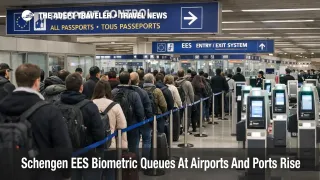
The EU Entry Exit System is adding biometric registration steps at more Schengen external border crossing points, and that expansion is making passport control less predictable at airports, ferry ports, and juxtaposed UK France controls. Non EU travelers taking a first post rollout trip are most affected because fingerprints and a face image typically add time beyond a routine document check. If your itinerary depends on timed connections, treat border control as a variable, add buffers, and be ready to reroute or overnight when queues spike.
The operational reality is that the EES rollout is progressive. EES started operations on October 12, 2025, and the EU travel portal describes a phased implementation that runs through April 9, 2026, with full operation from April 10, 2026. That means January 2026 is not a single switch flip, it is another month where additional lanes, terminals, and ports can add biometric capture, and where staffing and kiosk flow can still change week to week.
Who Is Affected
EES applies to non EU nationals traveling for a short stay into the Schengen area, including travelers who need a short stay visa and travelers who do not need a visa for stays up to 90 days in any 180 day period. On first use, EES stores travel document data plus biometric identifiers, and the EU travel portal describes capturing a facial image and fingerprints, with fingerprints generally not collected for children under 12.
Where you feel the friction depends on how you enter. At many airports, the time hit appears after landing at immigration, when arriving passengers funnel into kiosks or staffed booths, for example at Paris Charles de Gaulle Airport (CDG) during peak long haul arrival banks. At ports and ferry terminals, the same steps can create long vehicle and foot passenger lines because processing capacity is physically constrained by the terminal footprint and by how quickly people can be routed through capture points.
Juxtaposed controls are the other special case. If you travel from the UK via Eurostar or via the Channel vehicle and ferry corridors, EES processing can occur before departure at the UK side controls, effectively moving some of the queue risk earlier in the day and earlier in your journey. Eurostar has described optional pre registration kiosks in station areas, and the UK government has warned travelers to expect fingerprint and photo checks as EES coverage expands.
For recent examples of how this shows up in live travel days, see EU EES Passport Control Queues, January 9 Ramp and Geneva Airport EES Queues Up To 4 Hours. For travelers pairing the UK with mainland Europe, UK Entry Requirements For Tourists In 2026 also covers practical document readiness and buffer planning across borders.
What Travelers Should Do
Build time where the system can hurt you, not where it is convenient on paper. Add buffer after landing before any fixed pickup, tour departure, or rail departure that you cannot move, and treat same day airport to city connections as higher risk during peak arrival waves. If you are crossing via Eurostar or the Channel vehicle corridors, arrive earlier than your usual routine because any queue at pre departure controls can make you miss the train, the sailing, or the booked check in window.
Set decision thresholds before you travel, and stick to them. If your plan depends on clearing immigration and then catching a separately ticketed flight or a last train, a realistic threshold is, rebook when you cannot absorb a one to three hour border delay without losing the whole day. When your airline or rail operator offers a proactive change option, using it early can be smarter than waiting for the airport or port to overload, because reaccommodation inventory disappears fastest once a late arrival bank starts missing onward departures.
Over the next 24 to 72 hours before departure, monitor signals that actually predict queue risk at your entry point. Look for airport or border messaging about kiosk availability, flow changes, or temporary scaling back, and check whether your arrival time sits inside a heavy international arrival bank. If you are entering through a hub that has reported long waits during the rollout, consider switching first entry to a less peaked gateway, or adding an overnight at the entry city to protect the rest of the itinerary.
Background
EES is designed to replace manual passport stamping with a digital record of entry and exit, and to enforce the 90 days in any 180 day rule more consistently by tracking travel in a central system. The catch is that the first order impact is physical and local, every additional biometric step adds seconds or minutes per traveler, and when multiple flights, ferries, or trains arrive close together those small additions compound into long lines because the processing area has fixed lane capacity.
The second order ripples spread quickly through the travel system. When passengers clear late, they miss banked connections, they trigger rebooking workload for airlines and rail operators, and they concentrate demand onto later departures that may already be full in peak season. Late clearing also shifts pressure onto airport hotels and city hotels when last departures are missed, and it can disrupt ground transport because buses, rideshares, and prebooked transfers get hit by sudden passenger surges instead of a steady flow. At juxtaposed UK France controls, the same dynamics can spill into station and port approach roads, because the delay occurs before boarding rather than after arrival.
Sources
- Entry/Exit System (EES), Travel to Europe
- FAQs about EES, Travel to Europe
- Data Held By the EES, Travel to Europe
- Entry Exit System, European Commission
- British travellers told to expect checks under EU's Entry/Exit System, GOV.UK
- What's the EU's Entry/Exit System (EES)?, Eurostar Help Centre
- EU begins gradual rollout of digital border system, Reuters
- EU Entry/Exit System rollout leaves passengers waiting up to 3 hours at airports, Euronews