

Bulgaria Euro Switch, Lev Cash Still Works in January
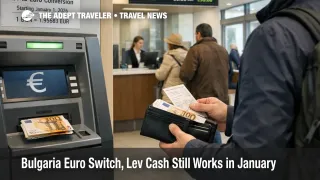
Bulgaria has switched to the euro, and euro cash is now circulating nationwide. Travelers arriving for ski trips, city stays, and Black Sea itineraries are entering a one month transition where lev cash is still accepted, but everyday cash handling starts pivoting to euros. The practical move is to rely on cards and euro withdrawals, and treat lev as bridge cash only, because change making and pricing cues are shifting quickly. This is day one reality, not a policy preview, so ATM behavior, front desk deposits, and cash only transactions are where the friction shows up first.
The Bulgaria euro switch lev changeover replaces the lev with the euro for daily payments, and it alters how cash, change, deposits, and refunds are handled during January 2026.
Euro adoption took effect on January 1, 2026, with the conversion rate set at BGN 1.95583 per €1. For January, both currencies can be used for cash payments, but the system is designed to push euro cash into circulation fast, which means travelers paying in lev should expect to receive change in euros in most normal transactions. That design matters most in places where travelers use cash for small purchases, tips, toll like payments, and last mile transport, because mixed wallets tend to slow lines and trigger disputes when people misread conversions.
Who Is Affected
Any traveler carrying lev banknotes or coins into Bulgaria in January 2026 is affected, including visitors arriving from neighboring countries who are used to treating lev as the default for small purchases. The same is true for travelers who pre budgeted in lev cash for ski resort expenses, cash only restaurants, or local market spending, because the changeover shifts what is easy to spend and what is cumbersome to unload.
Travelers paying for hotels and car rentals are also exposed, not because the booking itself breaks, but because deposits, incidental holds, and refunds can move through a different currency path than expected. During dual circulation, rules around refunds and cash availability can lead to a different outcome than a traveler assumes at the counter, especially if a merchant does not have enough euro cash on hand to complete a cash refund instantly. That is a quiet but real failure mode for early January trips, particularly when a traveler is trying to close out a deposit fast to catch a transfer.
There is also a timing impact that looks unrelated to currency until it breaks plans. In early January, queues can build at bank branches, post offices, and exchange counters, and those lines can push airport runs and tour meet ups out of tolerance, especially for travelers chaining modes on separate tickets or tight check in cutoffs. If a group is meeting for a tour, a transfer, or a rental car pickup, one person stuck converting lev can become the delay that costs everyone.
For travelers heading to Sofia, Bulgaria, during this window, political and street level disruption can stack on top of the currency transition. Bulgaria Protests Raise Euro Switch Risk Jan 1, 2026 remains relevant for transfer buffers and resilience planning around central city movement.
What Travelers Should Do
In January 2026, default to euros and cards for day to day spending. Withdraw euros in smaller amounts so you are not stuck managing large notes when merchants are still building euro float, and keep a small reserve of coins and low denomination notes for tips, public toilets, small cafés, and minor transport payments. If you still have lev, spend it deliberately on predictable cash purchases early in the month, and avoid ending the trip with a pocket full of low value lev coins that are harder to exchange quickly.
Use a decision threshold for waiting versus rerouting your cash plan. If a merchant cannot make change cleanly, if a payment terminal declines due to bank security checks, or if an exchange point is charging a spread that feels punitive, stop trying to force the original plan and switch to the simplest path, card for larger amounts, euro cash for small amounts, and lev only as a last resort. For deposits and holds, if a counter cannot clearly explain how the amount will be handled in euros, it is usually better to switch the deposit to a card transaction that will settle in euros rather than pushing more lev cash into a process designed to retire it.
Over the next 24 to 72 hours, monitor three things that signal whether the changeover friction is easing or getting worse for travelers. Watch whether ATMs are consistently dispensing euros without outages in your arrival area, whether local businesses are smoothly honoring dual circulation without extended arguments at tills, and whether exchange points are becoming crowded at predictable times that clash with your transfers. If you see persistent lines or inconsistent cash handling in your first day, add buffer for every cash dependent step, and shift the rest of the trip toward card based spending.
How It Works
Bulgaria's euro changeover is built around an irrevocably fixed conversion rate, BGN 1.95583 per €1, and a short dual circulation period to get euro cash into daily use quickly. Prices are displayed in both lev and euro for one year starting August 8, 2025, which is meant to reduce confusion and discourage opportunistic rounding, but it also creates a perception trap where travelers feel like prices changed even when the conversion is correct. The most reliable way to counter that perception is to use the displayed conversion consistently and to focus on the final charged amount on receipts.
January 2026 is the key operational window for travelers because both lev and euro cash can be used for payments during that month, while cash handling rules generally return change in euros to accelerate the drawdown of lev in circulation. On February 1, 2026, the euro becomes the sole legal tender for cash payments, so lev stops functioning as spendable travel cash inside Bulgaria even though it can still be exchanged.
For exchanging leftover lev, the infrastructure matters as much as the law. Commercial banks and certain post offices exchange lev banknotes and coins for euros free of charge until June 30, 2026, and they can continue at least through December 31, 2026, with possible fees after June 30. The Bulgarian National Bank provides unlimited, free exchange indefinitely at the fixed rate, which is the cleanest backstop for travelers who end up with more lev than expected. The ripple through the travel system is straightforward: when cash conversion is slow or confusing, it creates queues, those queues eat transfer time, and missed transfer time forces rebooking and unplanned hotel nights, especially in peak winter travel weeks when inventory is tighter.