

San Diego Storm SAN Diversions, Cancellations Spike
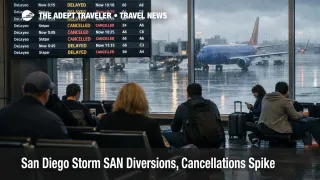
A New Year's Day storm in San Diego, California disrupted operations at San Diego International Airport (SAN), triggering a surge of diversions, cancellations, and long delays. Travelers arriving into SAN and anyone departing during the peak disruption window were most exposed, especially on tight same day connections. The practical next step is to treat January 2, 2026 as a recovery day, confirm whether your aircraft is already in position, and rebook early if your itinerary depends on the first departure bank.
San Diego storm SAN flights were disrupted by weather, low visibility operations, and air traffic control constraints that pushed many passengers into rebooking and longer ground transfers.
Public flight tracking data cited by Business Insider showed 40 inbound flights diverting away from SAN on January 1, 2026, alongside 53 cancellations and nearly 270 delays, with roughly 40 percent of flights running behind schedule. The FAA told Business Insider it slowed inbound traffic due to poor visibility and weather conditions, and to perform maintenance on an instrument landing system glide slope, a key part of precision approach guidance when ceilings drop. Local reporting also described an FAA ground stop for departures tied to an equipment outage during the morning push, which is the kind of hard constraint that can turn a manageable delay day into a full schedule reset.
Who Is Affected
The highest exposure group is travelers whose plans depend on SAN behaving like a reliable spoke airport, meaning anyone connecting onward the same day, anyone traveling on separate tickets, and anyone with a nonrefundable timing commitment after landing. Diversions often land aircraft at alternate airports, then crews time out or gates fill, so even when weather improves, the inbound aircraft that should operate your departure may still be out of position.
Travelers rerouted through alternates such as Los Angeles International Airport (LAX) and Phoenix Sky Harbor International Airport (PHX) can also see second order impacts that feel unrelated to the original storm. Diversions compress gate availability at alternates, then late arrivals miss their next scheduled turn, which pushes cancellations into later banks and makes rebooking inventory disappear quickly.
Ground access is a separate failure mode on heavy rain days in San Diego. The National Weather Service precipitation summary showed 2.45 inches recorded at SAN as of late afternoon on January 1, 2026, and local storm reports documented flooding impacts across key corridors. Times of San Diego reported that airport access roadways were temporarily affected by flooding before reopening, which means the traveler problem can shift from airside delay to landside inability to reach the terminal.
Cruise travelers are another group that can get hit indirectly. When inbound flights divert or arrive hours late, passengers heading for same day embarkation in Southern California can miss boarding windows and end up paying last minute hotel and ground transport costs while working with cruise lines on catch up options.
What Travelers Should Do
Start with immediate actions and buffers. If you have travel on January 2, 2026, verify your flight status, then verify aircraft position by checking whether the inbound leg for your aircraft has operated, because that is often the fastest predictor of whether an early departure will go. Add extra time for terminal arrival and curbside access, and route to the airport using an alternate corridor if local flooding reports show closures near your normal approach.
Use decision thresholds for rebooking versus waiting. Rebooking makes sense if your flight is canceled, if your inbound aircraft is still outside San Diego within a few hours of departure, or if you are on a last flight of the day with limited alternatives. Waiting makes sense when you have multiple later protected options on the same ticket, and your arrival time is flexible enough to absorb a multi hour slip without triggering hotel, cruise, or car rental penalties.
Monitor specific indicators over the next 24 to 72 hours. Watch for FAA traffic management language that signals continued constraints, and track whether carriers publish waivers for lingering irregular operations. Also monitor local rainfall and flood warnings because landside access can remain the hidden constraint even after flight schedules begin to normalize, especially in low lying areas tied to the San Diego River corridor.
How It Works
Airport storm disruption propagates through two connected systems, air traffic control capacity and airline network recovery. In low visibility, arrival rates drop because spacing increases and approach availability can tighten. When the FAA must also take critical navigation components offline for maintenance, such as an instrument landing system, ILS, glide slope, the combined effect can reduce the number of aircraft that can be safely accepted per hour, which pushes delays onto the ground and forces diversions when holding is not practical.
Traffic management tools then decide how the pain is distributed. A ground stop is a formal FAA tool that temporarily halts departures to manage demand, and it often shows up when equipment outages or rapid weather deterioration make it unsafe to keep feeding traffic into a constrained airport. The ripple starts at SAN with diverted arrivals and gate plan disruption, then spreads into missed connections and broken aircraft rotations across the Southwest network. The next layer hits crews, because duty limits can force cancellations even after the weather improves. The final layer is traveler behavior, where rebooking demand compresses hotel inventory, rental cars, and seats on alternate routes, especially in a region where multiple airports are competing for the same recovery resources. For related guidance on managing landside storm access risk, see SoCal Flood Watch, Burn Scars, Airport Transfer Delays. For broader context on how localized constraints can still cascade nationally, see Flight Delays and Airport Impacts: January 1, 2026. For deeper system context on why equipment and staffing resilience matters during recovery days, reference U.S. Air Traffic Control Privatization: Reality Check.
Sources
- 40 New Year's Day flights were diverted away from San Diego after a storm hit the city
- San Diego County emerges from historic rainfall totals for New Year's
- National Weather Service Precipitation Summary (RRMSGX) for January 1, 2026
- National Weather Service Record Event Report for January 1, 2026
- National Weather Service Local Storm Report for January 1, 2026
- FAA ATCSCC Current Operations Plan Advisory (ATCSCC ADVZY 059 DCC 01/02/2026)
- San Diego Airport access roads reopen after flooding, flight delays possible
- NBAA explainer: Ground Stops