

Flight Delays and Airport Impacts: January 1, 2026
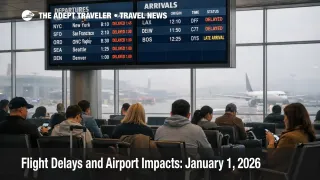
US flight delays on January 1, 2026 are being driven less by a single nationwide storm, and more by localized low ceilings, wind, and visibility limits that force the FAA to meter arrivals into specific hubs. The sharpest traveler facing constraint is in Las Vegas, Nevada, where the FAA published an active ground delay program and the airport status page showed arrival delays averaging 1 hour 28 minutes. Travelers connecting through the Northeast corridor are the other high exposure group, because FAA planning flagged wind, low ceilings, and visibility issues that can reduce arrival rates and trigger delay programs later in the day.
The operational takeaway is that the network can look calm at midday while still being fragile for late afternoon banks. FAA planning language for January 1 included possible ground stop or ground delay programs after 100 p.m. ET for John F. Kennedy International Airport (JFK) and Newark Liberty International Airport (EWR), after 200 p.m. ET for San Francisco International Airport (SFO), plus potential constraints for Aspen Pitkin County Airport (ASE) into the evening. In parallel, FAA reroute and flow constrained area advisories were active for holiday Gulf routings and Florida airspace, which can shift delays to the departure gate far from the destination.
Who Is Affected
Las Vegas itineraries sit at the top of the risk stack today. Harry Reid International Airport (LAS) has a mix of local arrivals, long haul turns, and dense connecting banks, so when ceilings restrict approach rates, the first order impact is longer arrival spacing and fewer available gates as late aircraft occupy stands longer. The second order ripple is missed onward connections, because the same aircraft then departs late to California, the Pacific Northwest, the Mountain West, and the Midwest, carrying delay into later bank structures.
Northeast travelers should treat the corridor as a fast changing system rather than a set of independent airports. FAA planning flagged wind and low ceilings affecting Boston Logan International Airport (BOS), plus the New York area complex and Philadelphia International Airport (PHL). Even if JFK, LaGuardia Airport (LGA), EWR, and BOS are posting only minor baseline delays in the late morning snapshot, arrival metering can still appear quickly once winds shift runway configurations or visibility drops. That is when gate occupancy and taxi congestion become the real traveler problem, because a small arrival rate cut can erase connection buffers in under an hour.
California travelers have a different failure mode today. Los Angeles International Airport (LAX) and SFO were both called out for low ceilings and visibility risk in FAA planning, and San Diego International Airport (SAN) is already operating under a construction driven traffic management program with average delays near 21 minutes for arrivals. If SFO or LAX shift from minor delays into an active program window, the knock on effect is that aircraft that should be repositioning for the evening long haul bank arrive late, which can cascade into missed international connections, and into rebook pressure for travelers trying to get home after holiday trips.
Finally, Florida and Gulf routings can be disrupted even when local conditions look fine at the terminal. FAA flow constrained areas and reroutes tied to holiday Gulf routes and Miami area airspace can impose structured routing and controlled departure times. The traveler visible effect is a long gate hold at the origin, then an on time arrival, or a late arrival that breaks a separate ticket connection.
What Travelers Should Do
Start with immediate actions and buffers. If you are flying through LAS, assume your arrival and connection time will be less reliable than the schedule suggests, and add at least 60 to 90 minutes of buffer for any onward segment that is not fully protected on the same ticket. For SAN, plan for modest but persistent arrival delay tied to construction programs, and do not stack a tight curbside pickup, a last ferry, or a timed event immediately after landing.
Use decision thresholds for rebooking versus waiting. If you are on the last flight of the day, if your connection drops below 45 minutes after a delay posts, or if you see the FAA shift your hub from steady state into a ground delay program or a ground stop window, rebook early while seats still exist. Waiting makes sense only when you have multiple later protected options on the same ticket, and you can tolerate arriving several hours late without triggering hotel and ground transport penalties.
Monitor specific indicators over the next 24 to 72 hours. Watch whether Las Vegas low ceiling conditions persist into the first major departure wave on January 2, 2026, because repeated programs are what turn normal delays into reaccommodation backlogs. For the Northeast, monitor FAA planning advisories for JFK and EWR after 1:00 p.m. ET, and track whether reroutes and flow constrained areas remain active for Gulf and Florida routings, since those tools often explain why a flight is held at the gate even when the departure airport looks clear.
How It Works
The FAA Air Traffic Control System Command Center manages national demand when airport or airspace capacity drops, using tools such as ground delay programs, ground stops, and flow constrained areas. When ceilings, visibility, or wind reduce the number of arrivals that can be safely accepted each hour, the FAA often moves delay time onto the ground through assigned departure holds, rather than letting aircraft burn fuel in airborne holding. That choice is safer and more efficient, but it also means travelers can be delayed far from the constrained airport, and may not see storms or fog outside their own window.
Disruption then propagates through the travel system in layers. First order effects appear at the constrained airport, arrivals slow, gates remain occupied, and departures inherit late turns. Second order ripples spread through connections and crew flow, because aircraft rotations and duty limits mean one late hub arrival can degrade later departures in multiple cities, including cities that had no weather issue at all. A third layer shows up off airport property, because missed last flights collide with limited late night ground transport, rental car counter hours, and hotel inventory near hubs, which raises out of pocket costs fast.
For more context on how similar winter patterns have been affecting the network and how to read FAA planning language, see Flight Delays and Airport Impacts: December 31, 2025 and FAA Evening Operations Plan Flags Weather, Smoke Delays. For deeper system context on why staffing and facility constraints can amplify weather driven delays, reference U.S. Air Traffic Control Privatization: Reality Check.
Sources
- FAA Daily Air Traffic Report
- ATCSCC Current Operations Plan Advisory (ATCSCC ADVZY 045 DCC 01/01/2026)
- ATCSCC Current Reroutes
- FAA ATCSCC Harry Reid International Airport Real Time Status
- FAA ATCSCC San Diego International Airport Real Time Status
- FAA ATCSCC John F Kennedy International Airport Real Time Status
- FAA ATCSCC Newark Liberty International Airport Real Time Status
- FAA ATCSCC LaGuardia Airport Real Time Status
- FAA ATCSCC Boston Logan International Airport Real Time Status
- FAA ATCSCC Philadelphia International Airport Real Time Status
- FAA ATCSCC San Francisco International Airport Real Time Status
- FAA ATCSCC Los Angeles International Airport Real Time Status
- FAA ATCSCC Minneapolis St Paul International Airport Real Time Status