

Eastern Caribbean Recovery Flights Add American Seats
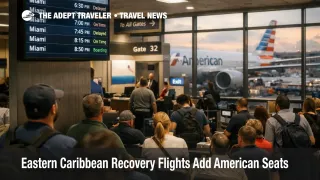
American Airlines is ramping up recovery flying in the Eastern Caribbean by adding extra flights and seats, including a rare, limited time interisland move into San Juan, Puerto Rico. Travelers affected include passengers stranded on smaller islands, plus anyone whose itinerary depends on a tight connection through San Juan or Miami. The practical next step is to confirm that a specific flight is operating, then use the added capacity to rebook onto a cleaner bank, and to pad connections and overnights where possible.
The change is that Eastern Caribbean recovery flights are now being reinforced with nearly 7,000 added American seats and new connection paths via San Juan Luis Muñoz Marín International Airport (SJU) and Miami International Airport (MIA), but recovery day schedules can still churn while aircraft and crews reset.
American says it has added nearly 2,000 additional seats, bringing its recovery total to nearly 7,000 seats supported by 43 extra flights across the region. The airline is concentrating a meaningful share of that lift into San Juan, where it is also scheduling added San Juan to Miami service on January 5, 2026 using the Boeing 777 300, the largest aircraft in its fleet. The goal is simple, absorb stranded demand fast, and move travelers back into the U.S. network before missed connections and sold out hotels compound the disruption.
The most unusual operational detail is the one day interisland flying. On January 5, 2026, American and Envoy Air plan two special segments into San Juan, one from Clayton J. Lloyd International Airport (AXA) in Anguilla, and one from Terrance B. Lettsome International Airport (EIS) in the British Virgin Islands. These flights are designed to feed the added San Juan to Miami lift, effectively turning San Juan into a recovery bridge for travelers who cannot find space directly off their island.
American is also adding extra Miami flying across several Eastern Caribbean markets during January 4 and January 5, 2026, including additional service touching islands such as Barbados, Bonaire, Dominica, Grenada, and St. Kitts and Nevis, alongside other extra sections the carrier already announced for January 4. The net effect for travelers is more chances to move, but not necessarily a smooth trip, because the system is still rebuilding the correct aircraft and crew placements after the FAA action forced a broad wave of cancellations.
Who Is Affected
The core affected group is travelers whose flights were canceled or heavily delayed during the FAA mandated Eastern Caribbean airspace closure, especially passengers trying to get home after weekend travel and holiday peak returns. That includes travelers holding reservations on American, Envoy, and other U.S. carriers, plus anyone on partner itineraries where a U.S. airline operates one of the legs.
Passengers originating on smaller islands face the sharpest constraints because even one canceled departure can erase most same day alternatives. When those travelers are also trying to connect onward to the continental U.S. through San Juan Luis Muñoz Marín International Airport (SJU) or Miami International Airport (MIA), the problem becomes a capacity math issue, too many displaced passengers chasing too few seats in the same banks. Even with added sections, standby lists, same day changes, and reaccommodation queues can stay long.
Travelers with time critical commitments are disproportionately exposed. Cruise embarkations, prepaid tours, weddings, and business travel with fixed start times are all vulnerable because recovery flying tends to bunch arrivals into fewer workable windows, and because a late inbound can force an unplanned overnight. For cruise travelers in particular, the same air arrival disruption that hits island stays can also hit turn days, which is why it helps to compare the aviation recovery to the parallel cruise side impacts described in Venezuela Action Delays Caribbean Cruise Embarkation.
What Travelers Should Do
First, treat every segment as unconfirmed until you verify it directly with the airline, and again before you leave for the airport. Recovery operations can still include aircraft swaps, crew legality issues, and rolling cancellations, even after airspace restrictions expire. If you are traveling on separate tickets, prioritize protecting the first leg that gets you to a hub, because that is the piece that unlocks the widest set of reaccommodation options.
Next, set clear decision thresholds for rebooking versus waiting. If you must arrive on January 5, 2026, and your itinerary involves the last flight of the day off an island, a tight connection in San Juan, or any cruise embarkation cutoff, moving to an earlier bank or to January 6 is often safer than waiting for a late day departure to stabilize. If your trip is discretionary and you are protected on a single ticket with multiple later alternatives, waiting can make sense, but only if you can absorb an overnight without paying peak pricing near the airport.
Finally, monitor the signals that indicate whether recovery is improving over the next 24 to 72 hours. Watch for added sections, aircraft upsizing, and updated airline advisories, and pay special attention to whether the main hub banks out of San Juan and Miami run on time through midday and afternoon peaks. For the broader timeline and network mechanics behind this restart, and the reason the tail can last beyond the restriction end time, see Venezuela Airspace Curbs Disrupt Caribbean Flights and the system context in U.S. Air Traffic Control Privatization: Reality Check.
How It Works
An FAA airspace restriction is a safety action that can prohibit or limit U.S. civil flight operations in defined airspace when the risk picture changes quickly. Even if a destination airport is open and weather is fine, airlines may be unable to legally operate a flight if the routing requires crossing the restricted region, which forces cancellations rather than delays.
The first order effects show up immediately as mass cancellations and stranded passengers at origin airports, at Caribbean gateways, and at connection hubs. The second order ripples arrive during the restart, because aircraft that were supposed to overnight on islands are now elsewhere, crews hit duty and rest limits, and maintenance routing breaks, which means the next day's schedule launches short of the right resources in the right places. That is why a restriction that ends overnight can still produce rolling disruption for days, and why airlines lean on two levers during recovery, added sections and larger aircraft, to rebuild lift fast.
American's one day interisland segments into San Juan are a textbook example of recovery triage. They create a way to pull travelers from thinly served islands into a hub where more seats exist, which reduces the number of people competing for the same single daily nonstop. The tradeoff is added connection complexity, and higher misconnect risk if any single link breaks, which is why confirmed inventory, longer buffers, and flexible dates matter more than usual during this recovery window.
Sources
- American leads Eastern Caribbean recovery with interisland flights and another nearly 2,000 seats added to the region
- Airlines Rebuild Caribbean Schedules After U.S. Action In Venezuela
- Maduro's capture leads to hundreds of Caribbean flight cancellations
- San Juan, Puerto Rico (SJU) Airport Information
- Anguilla, AI (AXA) Airport Information
- Terrance B. Lettsome International Airport