

Palm Springs PSP Ground Stop Delays Weekend Flights
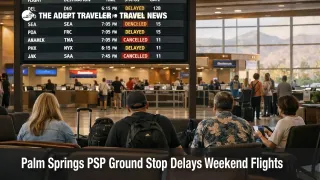
An FAA air traffic control issue affecting Southern California airspace triggered a ground stop that halted departing flights at Palm Springs International Airport (PSP), disrupting a high demand weekend arrival and departure window. Leisure travelers, regional flyers, and anyone trying to connect onward through bigger Los Angeles area airports faced cancellations, diversions, and long rebooking queues because PSP has limited same day replacement lift. The practical next step is to confirm whether your airline can rebook you out of PSP within a workable window, and if not, pivot quickly to a confirmed seat through a nearby alternate airport with enough time for the drive and a new check in cutoff.
The Palm Springs PSP ground stop mattered because it shut off departures at the source, then forced a slow system restart where aircraft, crews, and gate plans had to be rebuilt flight by flight, not instantly.
Local reporting and airport messaging indicated that arrivals were able to continue during the disruption, but some inbound flights diverted, and schedules became uneven as airlines tried to protect their wider networks. KESQ reported the ground stop was lifted at 4:20 p.m. on January 3, 2026, with the airport warning that delays would continue while operations normalized. PSP later posted that operations were normalizing on January 4, 2026, but that delays were still expected and could continue through January 6, 2026, which is a typical "delay tail" pattern after a hard constraint, even when the immediate restriction ends.
Who Is Affected
Travelers booked to depart PSP were the most exposed because the ground stop paused outbound flow, and that usually produces the worst customer outcome, missed departures that cannot simply "make up time" later. If a departing flight canceled instead of delaying, the remaining same day seats out of PSP often disappear quickly, especially on airlines that only operate a handful of daily frequencies to each hub.
Arriving passengers were also affected in a less predictable way. Even when inbound aircraft can land, an upstream airspace restriction can force reroutes, holding, or diversions that push arrival times late enough to miss rental car pickup windows, hotel check in cutoffs, and prebooked tours. That risk is amplified in Palm Springs because many trips are short, time sensitive, and tied to weekend check in and event schedules.
Travelers trying to salvage itineraries by shifting to larger airports should expect second order friction on the ground. When a leisure airport stalls, passengers often compete for the same limited set of alternates, and that can compress rideshare supply, raise last minute car rental prices, and create long counter lines at the alternate airport. It also increases misconnect risk because a "fixed" flight plan becomes two legs, a long ground transfer, plus a flight, with more points of failure.
What Travelers Should Do
Start with information capture and fast options. Check your airline app for waivers, same day change offers, and protected reroutes, then call only if the app cannot complete the change you need. If you are still in the Coachella Valley and your flight is delayed without a firm departure time, wait to head to PSP until the airline shows a realistic new departure, because ground stops and flow limits often create long gate holds and unpredictable boarding sequences.
Use a clear cutoff to decide between waiting and switching airports. If your new departure would arrive after a hard commitment, like a cruise embarkation, a wedding, or a nonrefundable first night, treat that as a trigger to rebook through a larger airport with more frequency, even if it means a longer drive. If your airline can only offer standby, or the next confirmed seat is more than a full day away, switching to Los Angeles International Airport (LAX), Ontario International Airport (ONT), or San Diego International Airport (SAN) usually beats waiting, but only if you can leave enough time to drive, park or drop a car, clear security, and meet the new baggage cutoff.
Over the next 24 to 72 hours, monitor three signals that show whether the system is actually recovering. First, watch whether cancellations stop and shift to delays, because that indicates airlines have aircraft and crews back in rotation. Second, watch whether your airline restores normal departure spacing out of PSP, which usually means the network is no longer triaging aircraft to other stations. Third, watch PSP's public updates and your airline's day of travel messages, because PSP has already warned that delay effects could persist through January 6, 2026, even after the initial ground stop ended.
How It Works
A ground stop is an air traffic management action that pauses departures to prevent unsafe congestion when a constraint hits, for example an air traffic control, ATC, system issue, reduced staffing, or an airspace bottleneck. In the PSP event, the airport said the disruption was tied to an FAA air traffic control issue affecting Southern California airspace, and KESQ reported that outbound flights were not operating while arrivals continued with some diversions. That split, arrivals partly flowing while departures pause, can still create a backlog because aircraft that land need gates, crews need duty time, and the next outbound legs cannot leave on schedule.
The ripple matters more than the initial pause. First order effects are straightforward at PSP, delayed departures, diversions, missed connections, and rapid sellouts on remaining seats. Second order effects spread across at least two other layers. The first layer is airline network recovery, where a diverted aircraft ends up in the wrong city for its next flight, and crews can time out, triggering late day cancellations even after the original constraint eases. The second layer is traveler behavior, where passengers shift to alternates like LAX, ONT, and SAN, increasing demand for last minute flights and stressing ground transport, hotels, and rental car inventory across Southern California.
This is also why "technical" aviation problems tend to produce uneven recovery. Even after an ATC constraint clears, airlines still have to unwind irregular operations, reposition aircraft, and rebuild schedules while serving passengers who were already displaced. For another example of how communications or guidance constraints can cascade into multi day disruptions, see Greece Air Traffic Radio Failure Delays Flights Nationwide, and for deeper context on why staffing and infrastructure resilience remain binding constraints in U.S. air traffic control, see U.S. Air Traffic Control Privatization: Reality Check. A similar "constraint ends, delays persist" pattern also appears in airport equipment events like Landing System Outage at Milan Bergamo Delays BGY Flights, where the restart is governed by aircraft positioning and crew legality, not the moment the technical fault clears.
Sources
- Parking - Palm Springs International Airport (PSP) - Palm Springs, California
- Ground stop lifted at Palm Springs airport after air traffic control issue - KESQ
- Air traffic, explained - LAist
- LAX issues ground delay due to staffing issues, FAA says - NBC Los Angeles
- FAA Ground Stop Halts Departing Flights at Palm Springs International Airport - NBC Palm Springs