

San Juan Cruise Delays After Venezuela Airspace Curbs
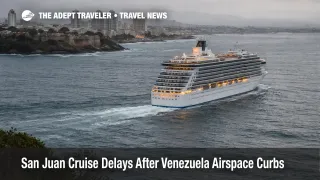
Cruise departures in the Eastern Caribbean are running late and, in some cases, shifting port timing because flight cancellations and rolling recovery schedules have disrupted the steady flow of embarkation day arrivals into key homeports. The pinch is most visible in San Juan, where cruise lines have warned that guests are struggling to reach ships on schedule after U.S. airline flying was disrupted by safety driven airspace restrictions linked to events in and around Venezuela. Travelers with tight same day flight to pier plans should treat the next sailing as at risk, build an overnight buffer, and coordinate airline rebooking and cruise line policies before heading to the port.
The San Juan cruise delays are a downstream effect of an air network shock, followed by an uneven restart. Reuters reported that U.S. authorities lifted temporary Caribbean airspace restrictions that had prompted mass cancellations, but warned that it could take days for airlines to fully restore normal operations. That time lag matters for cruises because a ship's departure time is tied to pilots, berth windows, downstream port reservations, and the next week's turnaround, not just whether more guests might arrive later.
Several operators have already published specific remedies. Virgin Voyages posted a travel update tied to disruptions into San Juan and said any guest unable to embark because of the situation would receive a full future voyage credit. Windstar said guest turnaround operations were impacted by temporary airport closures affecting St. Maarten and Bridgetown, and it secured a berth delay so Wind Surf and Wind Spirit could sail late on January 5, 2026, with itineraries resuming as scheduled effective January 6, 2026.
For related reporting and traveler playbooks tied to this same disruption chain, see Venezuela Airspace Curbs Disrupt Caribbean Flights and Venezuela Action Delays Caribbean Cruise Embarkation.
Who Is Affected
The highest risk group is any cruise passenger scheduled to embark or disembark in the Eastern Caribbean while airline schedules are still normalizing, especially travelers relying on U.S. carriers and same day inbound flights. In San Juan, that means guests routing through Luis Muñoz Marín International Airport (SJU) on the day of sailing, including passengers booked on ships that routinely turn there in January, such as Virgin Voyages' Valiant Lady and Royal Caribbean ships like Jewel of the Seas and Brilliance of the Seas, as highlighted by cruise industry reporting.
Barbados turnarounds face similar fragility because many itineraries depend on a limited set of long haul arrivals into Grantley Adams International Airport (BGI), then tightly scheduled transfers to Bridgetown. When a flight bank fails, a large share of the ship's new arrivals can miss the boarding cutoff at once, which is operationally harder to fix than a handful of late guests.
Boutique and small ship operations can feel the shock fastest because they rely on fewer weekly flights and smaller port windows. Windstar explicitly tied its guest turnaround issues to disruptions affecting St. Maarten and Bridgetown, routes that commonly funnel through Princess Juliana International Airport (SXM) for regional positioning. Disembarking travelers are also exposed because a missed flight home after leaving the ship can force an unplanned hotel stay, and it can break onward domestic connections and prebooked ground transfers.
What Travelers Should Do
Act as if your airline itinerary is provisional until you see it operating in real time. Confirm your specific flight status, secure a confirmed rebooking in writing if your original flight cancels, then contact your cruise line with the revised arrival plan before you commit to ground transfers and hotels. If you are within 24 hours of sailing, prioritize arriving the day before, even if it costs more, because recovery flying can look fine on paper and still produce same day cancellations as aircraft and crews reposition.
Use a clear threshold to decide whether to chase the sailing or pivot. If you cannot reach the homeport before final boarding using at least one realistic backup routing, and your cruise line confirms you will be treated as a no show, it is usually smarter to stop spending on last minute flights and instead trigger the operator's credit policy, insurance claim steps, and a rebook plan. If your cruise line allows a controlled later join, and immigration rules and port logistics make it feasible, you can pursue a catch up strategy, but only with explicit written guidance on where and when you can board.
Over the next 24 to 72 hours, monitor three signals that show whether the system is stabilizing. First, whether airlines are operating full midday and afternoon banks into San Juan and Bridgetown, not just one early flight. Second, whether your cruise line updates sail times, boarding windows, and port order changes, which will affect transfers and excursions. Third, whether airports and cruise operators continue posting advisories that indicate lingering constraints, which usually means higher misconnect risk for at least another day.
How It Works
Cruise turnarounds are a choreography of air arrivals, transfers, port security, provisioning, and departure windows, and they are less flexible than many travelers assume. The first order disruption begins when airspace restrictions or safety directives force widespread flight cancellations, which strands embarking guests at origin airports and disembarking guests at the destination gateway. Even after restrictions lift, the recovery is constrained by where aircraft and crews ended up, and by how quickly airlines can rebuild schedules without creating new misconnects and crew timeouts.
The second order ripple spreads across multiple layers of the travel system. Homeport hotels tighten because stranded passengers extend stays, and because catch up travelers arrive in fewer, denser waves, which can reprice rooms quickly. Ground transport then becomes less reliable because drivers and coaches are staged for passengers who never arrive, while other passengers arrive at once on recovery banks. Shore excursion operators also take a hit when ships delay departure, compress port time, or resequence calls, which can shorten tours or force last minute cancellations even for passengers already onboard.
Cruise lines then have to choose between holding the ship for more guests or protecting the integrity of the remaining itinerary. Holding can help more travelers board, but it can also create knock on problems with downstream berth windows, customs processes, and the next week's embarkation. That is why many operators pair limited departure delays with standardized remedies like future voyage credits, and why travelers should plan buffers into air to cruise journeys, even when the weather is calm and the port itself is operating normally.
Sources
- US lifts Caribbean airspace curbs after attack on Venezuela | Reuters
- Important Travel Update for San Juan Disembarkation | Virgin Voyages
- Our Cruise Line Terms and Conditions | Windstar Cruises
- American resumes Eastern Caribbean flying | American Airlines Newsroom
- Caribbean Travel Disrupted Following U.S.-led Ousting of Venezuelan President | Cruise Critic
- US military operation in Venezuela disrupts Caribbean holiday travel | AP News