

France Rail Strike May Disrupt Trains January 13, 2026
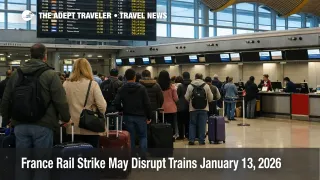
A strike call by the SUD Rail union could disrupt SNCF train operations across France on Tuesday, January 13, 2026, creating a real risk of cancellations and late timetable changes on the services most visitors use. Travelers are most exposed on high speed TGV and Intercités corridors, plus regional TER links that act as the glue between airports, city centers, and smaller towns. The smartest move is to de risk tight sequences now by shifting travel days where possible, then building a road based backup for airport transfers and any fixed check in, tour, or event times.
The France rail strike January 13 matters for travel planning because SNCF can publish a reduced operating plan close to departure, which turns "normal looking" itineraries into last minute rebooking problems on the exact day many travelers need rail to make a flight, a cruise, or a timed hotel arrival.
Who Is Affected
Travelers moving between Paris, France, and major regional cities such as Lyon, France, Bordeaux, France, and Marseille, France are the core risk group because these are the densest TGV and Intercités markets, and they are also the ones most likely to be sold tight around peak hours. Even if you are not riding a long distance train, the strike can still affect you if your last mile relies on a TER or other SNCF operated regional leg to reach a resort area, a theme park day trip, or a smaller city that does not have a robust coach alternative.
International and cross border itineraries can also take a hit through knock on effects rather than direct cancellations. When domestic services are cut, Paris stations become recovery magnets, and that tends to tighten hotel inventory, ridehail availability, and coach capacity for travelers stranded overnight. If you are also tracking other northern Europe rail reliability issues this month, keep an eye on Eurostar Netherlands Trains Suspended, Paris Limits Jan 5, because crowding and station controls in Paris can compound disruption when multiple networks are stressed at once.
Airport dependent travelers should treat January 13 as a higher risk day if their transfer plan depends on SNCF operated rail. For example, a same day arrival into Paris Charles de Gaulle Airport (CDG) with an onward train from a Paris station, or a regional airport arrival that depends on TER into the city center, can fail even when flights operate normally, because rail thinning breaks the chain. If you are already managing aviation irregular operations in the region this week, Paris CDG, Orly 15% Flight Cancellations After Snow is a useful reminder that snow driven displacement plus a later rail strike day can create separate, sequential failure points for the same trip.
What Travelers Should Do
If you have a time critical commitment on Tuesday, January 13, 2026, shift the rail portion off that day now if your fares allow it, because inventory for January 12 and January 14 can tighten quickly once cancellations start posting. If you cannot move the date, prioritize a booking you can change, avoid the last departure of the day, and set a personal buffer threshold, because a single canceled train can push you into an unplanned overnight.
Use a decision rule for rebooking versus waiting that matches your downstream risk. If missing your arrival would cost you a flight, a cruise departure, a paid tour start, or a nonrefundable hotel night, do not "wait for the plan," reroute by a different mode or move the whole itinerary to a non strike day. If you can tolerate arriving late, waiting can make sense only when your specific train number is still operating and you have a realistic backup for the last leg, such as a confirmed coach seat or a reserved car.
Over the next 24 to 72 hours, monitor train specific status inside SNCF Connect rather than relying on general headlines, because the operational plan is built around available crews and rolling stock, and it can differ sharply by corridor and time band. Also watch whether additional unions formally join the action, since broader participation can turn a targeted disruption into a higher magnitude nationwide cut. If you end up forced into an extra night in Paris, Paris Travel Guide: The Ultimate 7-10 Day First-Timer's Itinerary can help you pick neighborhoods and transit choices that reduce friction around the major stations.
Background
French rail strikes usually propagate through the travel system in two layers, the immediate cancellations on the affected day, then a recovery tail driven by misplaced trainsets and crews. A reduced plan on a key trunk line is not just one missed departure, it can remove the inbound equipment that was meant to operate a later service, which is how a localized staffing gap becomes a rolling pattern across several city pairs. This is why travelers often feel the pain at the nodes, major Paris stations, and big interchange cities, where late arrivals collide with crowded concourses, limited customer service capacity, and a scramble for replacement seats.
For this specific action, SUD Rail has framed January 13 around wage negotiations at SNCF and has published calls to strike tied to those talks. Reporting indicates that, at least as of the initial notice, SUD Rail was the only union openly calling for the January 13 walkout, which is important because participation breadth is a major driver of how deep the timetable cuts go. Travelers should plan as if disruption is possible even with partial participation, because long distance services can be fragile when a small number of critical roles are unavailable.
On passenger rights, the practical headline is that you generally have options when a train is cancelled or heavily delayed, including reimbursement or re routing, and those obligations sit under EU rail passenger rights frameworks as well as national guidance. SNCF Connect guidance also matters operationally, because a cancelled train does not necessarily mean your ticket is automatically cancelled, you typically need to take action to cancel to receive the refund, and exchange and cancellation rules can shift during disrupted circulation.
Sources
- En grève le 13 janvier pour augmenter nos salaires !
- LE 13 JANVIER 2026, LES ADC METTENT LA PRESSION SUR LES NAO
- SNCF : un préavis de grève déposé pour le 13 janvier - Déplacements Pros
- Vers une grève à la SNCF le mardi 13 janvier ? | TF1 Info
- Prévision et information des perturbations de trafic - SNCF Connect
- Échanger ou annuler un billet de train | SNCF Connect
- Voyage en train : quels sont vos droits en cas d'annulation ou de retard ? | Ministère de l'Économie
- Rail passenger rights - Your Europe