

FAA Runway Closures at US Airports Raise Delay Risk
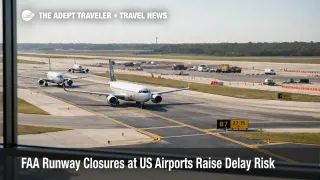
FAA current operations advisories are flagging runway and airfield constraints at several U.S. airports that can create localized delay spikes through mid January, even when weather is fine. Travelers connecting through affected airports, or trying to make tight airport to city transfers, are the most exposed because arrival rates can be reduced with little warning once peak banks begin. The practical move now is to add connection buffer, avoid last flight of day plans where possible, and monitor FAA airport status trends before you leave for the airport.
The latest FAA Operations Plan advisory lists runway and system impact items at Nashville International Airport (BNA) and Orlando International Airport (MCO) with closures shown through Friday, January 15, 2026 (Zulu times), plus active construction markers at San Diego International Airport (SAN), San Antonio International Airport (SAT), and a ramp expansion item at Charlotte Douglas International Airport (CLT).
At Orlando International, a Greater Orlando Aviation Authority board packet describes a coordinated closure window for Runway 17R 35L from Sunday, January 5, 2026, through Friday, January 10, 2026, tied to concrete panel repairs in the runway safety area and consolidated pavement marking work. At San Antonio International, the City of San Antonio says Runway 13R 31L is scheduled to be closed from Sunday, January 12, 2026, through Friday, March 6, 2026, with traffic shifted to Runway 4 22 during the work period.
Who Is Affected
Anyone flying into, out of, or connecting through Nashville International Airport (BNA) or Orlando International Airport (MCO) during peak periods through mid January is more likely to see arrival metering, longer taxi times, and departure queues if runway capacity is reduced and demand stays high. That matters most for itineraries with short connections, international onward flights that depart in fixed banks, and trips where a late arrival cascades into a missed rental car counter cutoff, a cruise embarkation, or a prepaid tour.
Travelers using San Diego International Airport (SAN) and San Antonio International Airport (SAT) should treat published construction markers as a risk multiplier for tightly timed travel days, especially when a single runway configuration becomes the default and any small disruption has fewer recovery options. The biggest hidden risk is not the first delay, it is the inability to "make it back" later in the day when capacity is capped.
For Charlotte Douglas International Airport (CLT), the FAA advisory's ramp expansion flag aligns with an airport program that is explicitly aimed at reducing terminal ramp congestion and improving bidirectional aircraft flow during high traffic periods, but construction staging can still create uneven taxi and gate dynamics during busy banks. If you are connecting at Charlotte on American's hub structure, a small inbound delay can still be enough to miss a short connection when gate availability tightens.
What Travelers Should Do
Add time where it actually absorbs shocks. For flights touching any of the airports flagged in FAA advisories, build in a larger connection than you normally would, prioritize carry on only if you can, and avoid separate tickets that turn a missed connection into an out of pocket rebook. If you must keep a tight same day plan, choose an earlier departure so you have more remaining flights to fall back on.
Use decision thresholds instead of hope. If your itinerary relies on a last flight of the day, or a sub one hour domestic connection, a runway closure day is a rational time to proactively switch to a longer connection or an earlier flight, even if your flight still shows on time. If you have a mid day buffer and multiple later options exist, it is usually better to wait until day of and only change once delays begin trending worse.
Monitor the right signals in the 24 to 72 hours before travel. Watch whether your airport is showing rising arrival delays and whether your airline starts issuing waiver language for the affected city pair, because that often arrives before the worst bank impacts. On travel day, recheck your inbound aircraft status and the airport arrival delay picture before you leave for the terminal, because that is when you will see whether metering has started.
How It Works
Runway and airfield work is a quiet capacity reducer because the schedule can look normal while the airport's practical acceptance rate is lower. When one runway is closed, or when construction shifts operations onto a narrower configuration, the tower and approach control have fewer options to sequence arrivals and departures efficiently. That can trigger arrival metering, longer taxi out queues, and gate holds as aircraft land later and gates do not clear on schedule.
The first order effect shows up at the source airport as delayed turns and missed push times. The second order ripple spreads across the network because aircraft rotations slip, crews time out, and an inbound delay at one hub becomes an outbound delay at the next hub, even if that next airport has perfect weather. When the final banks of the day do not recover, travelers see the most painful outcome, missed last flights, forced overnight stays, and a crowded next morning rebooking queue.
For travelers, the most useful habit is to treat FAA operational advisories and airport status dashboards as a risk calendar. The FAA publishes a Current Operations Plan advisory that highlights system impact items such as runway closures, and the FAA NAS Status dashboard is designed to surface active events affecting the National Airspace System. If you want local context on what an airfield or ramp program is trying to change, airport capital project pages, like Charlotte's runway and airfield project summaries, can explain why surface congestion and runway crossings matter to delay propagation.
For recent examples of how small FAA constraints can still produce visible delay patterns in the traveler experience, see Flight Delays and Airport Impacts: January 6, 2026 and Flight Delays and Airport Impacts: January 5, 2026. For broader capacity context, see U.S. Air Traffic Control Privatization: Reality Check.
Sources
- Current Operations Plan Advisory (FAA ATCSCC)
- Board Packet 12-17-2025 (Greater Orlando Aviation Authority) (PDF)
- Airport Begins Runway Improvements to Enhance Safety and Efficiency (City of San Antonio)
- Runway and Airfield Projects (Charlotte Douglas International Airport)
- FAA NAS Status Dashboard
- National Airspace System Status User Guide (FAA) (PDF)