

LAX Terminal 5 Bridge Demolition Closes Lanes
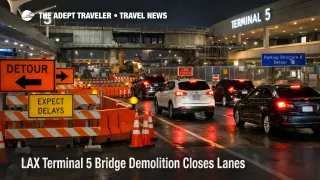
Overnight construction work at Los Angeles International Airport (LAX) is narrowing roadway capacity near Terminal 5 as crews demolish the pedestrian bridge that links Terminal 5 and Parking Structure 5. Travelers arriving late at night, departing on red eyes, or picking up passengers in the Central Terminal Area are the most exposed because the work requires lane closures and detours on both the arrivals and departures levels. The practical move is to add buffer time, confirm where your parking and shuttle pickup points have shifted, and avoid building a plan that depends on a last minute curbside drop off.
Airport construction bulletins describe two separate disruption windows. On the arrivals level, outer lanes at the bridge location are scheduled to close nightly from late Tuesday, January 6, 2026, through early Sunday, January 11, 2026, during roughly 1130 p.m. to 600 a.m. PT, with vehicles pushed into inner lanes through the work zone. On the departures level, all lanes at the bridge location are scheduled to close overnight on Wednesday, January 7, 2026, and Thursday, January 8, 2026, during roughly 1159 p.m. to 400 a.m. PT, with detours routed via Upper West Way and Upper East Way.
Who Is Affected
The highest risk group is anyone whose itinerary touches the terminal loop during the late night window, especially travelers trying to hit bag drop cutoffs, families coordinating a pickup where minutes matter, and anyone relying on shuttles that normally stop near Terminal 4 or Terminal 5. Even if a traveler is not using Terminal 5, the lane compression effect is shared across the loop, because detoured vehicles re merge into the same limited lanes and can create stop and go spillback into adjacent terminal segments.
Drivers heading for Parking Structure 6 are also directly affected on the arrivals level during the nightly work window. The arrivals level entrance on World Way South to Parking Structure 6 is scheduled to be closed during the bridge demolition impacts, with drivers routed to use the Lower West Way entrance to Parking Structure 5 to reach Parking Structure 6. That routing change can add time and can be easy to miss if a traveler is following an old mental map of LAX rather than posted detour signs.
Ground transport riders should plan for shuttle stop friction. Bulletins list temporary closures for the Terminal 4 LAX it shuttle stop and the Terminal 5 rental car shuttle stop on the arrivals level during the demolition window, plus a closure of the Terminal 4.5 hotel and private parking shuttle stop during the departures level closure window. Charter buses and FlyAway are also directed to the arrivals level during the departures level restriction nights, which changes where travelers should queue, and how they should move between levels.
What Travelers Should Do
Travelers with flights during the affected overnight windows should treat curbside access as the variable, not the airside operation. Add a meaningful buffer to your drive in, and if you are being dropped off, agree on a fallback plan before you enter the loop, such as using the arrivals level if the departures level approach is blocked or gridlocked. If you are parking, confirm your structure entry route before you start the final approach, because the Parking Structure 6 entrance closure changes how drivers reach that garage during the work hours.
Use clear decision thresholds for rebooking versus waiting when your ground timing is deteriorating. If you are still off airport and your map ETA is slipping toward check in or bag drop cutoffs, move fast, either reroute to a less congested approach, switch to a closer drop off strategy, or contact your airline to see whether same day changes are available, especially if you are holding a separate ticket connection later in the night. If you are already inside the loop and traffic is moving, waiting can be rational, but only if you still have margin for parking, walking, and terminal processing.
Over the next 24 to 72 hours, monitor the airport's construction advisories and treat overlapping nighttime restrictions as a stacking risk. LAX frequently publishes ground transportation construction alerts that cover additional lane restrictions beyond a single work site, so a traveler is better served by checking for compounding closures before committing to a tight pickup plan. If you need a local reference point for how Southern California ground transfers can swing in timing even when flights are operating, see SoCal Flood Watch, Burn Scars, Airport Transfer Delays.
Background
The bridge removal is part of the Terminal 5 Renovation and Reconstruction Project, and the immediate traveler impact comes from how LAX must protect workers and equipment inside a constrained roadway loop. When one side of the loop loses lanes, vehicles are forced into fewer channels, merges slow down, and any hesitation cascades into stop and go movement that can persist well beyond the exact work location. Flaggers and protected walkways can keep vehicles and pedestrians moving, but they do not eliminate the fundamental constraint, there is less road space for the same late night demand pattern.
Second order effects show up quickly. Late arrivals to the curb compress check in and security timelines, which can push travelers into rebooking decisions, and create a spillover into hotels, rental cars, and next morning inventory when people miss departures. The same propagation logic is familiar in flight delay days, a small capacity drop early can create outsized disruption later, because the system loses slack. For a quick explainer on how constraints cascade through a hub day, see FAA Dec 16 Flight Delays, JFK and LAX Weather Risks.