

Shimane Earthquake Rail Delays Western Japan January 7
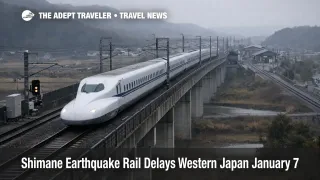
A strong inland earthquake struck eastern Shimane Prefecture, Japan, on January 6, interrupting the rail network that most visitors rely on for city to city travel across western Honshu. Travelers using the Sanyo Shinkansen corridor and JR West regional lines were the most exposed, particularly those moving between Osaka, Japan, Hiroshima, Japan, and Fukuoka, Japan. For January 7 travel, the practical move is to keep your rail plan flexible, confirm live operating status before heading to the station, and add buffer anywhere a Shinkansen ride feeds a flight, a cruise, or a fixed tour start.
The Shimane earthquake rail delays story is that aftershocks and safety inspections can force repeat slowdowns even after headline services restart, so tight connections in western Japan should be treated as fragile for the next several days.
JR West said it suspended Shinkansen bullet train operations between Shin Osaka and Hakata immediately after the quake, reflecting the standard safety response of halting high speed service until checks clear. Kyodo reporting carried by The Times Union said Sanyo Shinkansen service was suspended between Okayama and Hiroshima stations due to a power outage, then resumed at around 1 p.m. on January 6. By late January 7, JR West's English status feed for the Sanyo Shinkansen showed "service on schedule," a sign that the main corridor had stabilized, at least at that update point.
The earthquake sequence itself matters for travel decisions because it sets expectations for repeated checks. Reuters reported the Japan Meteorological Agency initially described the quake as magnitude 6.2 with no tsunami danger. Kyodo reporting said the agency later revised the initial quake to magnitude 6.4, with additional sizable aftershocks shortly after, and officials publicly warned that earthquakes of similar scale could occur for about a week.
Who Is Affected
Travelers riding the Sanyo Shinkansen between Shin Osaka, Okayama, Hiroshima, and Hakata are the most directly affected, including visitors doing classic multi city itineraries that link Kansai, Hiroshima, and northern Kyushu in a single week. Even when trains are running, post quake operations can include temporary speed restrictions, longer station dwells, and short notice stops for inspections, which is exactly how a 10 minute plan becomes a missed check in window.
Travelers connecting rail to domestic flights face a second layer of risk. Kansai International Airport (KIX) and Osaka International Airport (ITM) are common fallback gateways for disrupted rail journeys in the region, while Hiroshima Airport (HIJ) and Izumo Enmusubi Airport (IZO) can be relevant for travelers closer to the quake zone. If rail legs slip, same day flight connections on separate tickets can fail without any automatic protection, and last flights of the day become the hardest to salvage.
Overland transfers also deserve attention because disruptions can stack. Kyodo reporting said parts of the Yonago Expressway and the Sanin Expressway were suspended after the quake, which matters if travelers are pushed from trains into buses, hired cars, or improvised road routings. When highways are restricted, replacement transport can slow dramatically, and that pushes arrivals into late evening, compressing hotel check in, dinner reservations, and guided tours.
What Travelers Should Do
Start with immediate protection moves for January 7 and January 8. Check JR West's English status pages before leaving your hotel, then recheck again when you arrive at the station, because the site is designed to flag meaningful network wide delays and suspensions. If your day includes a timed event, for example a museum entry slot or a ferry departure, build a buffer that assumes at least one short operational pause somewhere on the corridor.
Use clear decision thresholds for rebooking versus waiting. If your next viable train would push you past a hard deadline, such as an international departure from Kansai International Airport (KIX) or a nonrefundable tour meet time, treat that as the point to reroute, either by switching to a domestic flight, shifting the sequence of cities, or adding a hotel night to reset the plan. If you are only protecting flexible plans, waiting can be reasonable, but do not anchor on the first departure board you see, because inspections can restart if aftershocks hit.
Monitor three things over the next 24 to 72 hours. Track official aftershock messaging from the Japan Meteorological Agency via major newswires, watch JR West corridor status for the Sanyo Shinkansen and regional lines, and keep an eye on road corridor advisories if you might need a bus or car backup. If you are moving between regions, it also helps to keep a mental fallback of flying instead of riding, which pairs well with the flexibility advice in Japan Domestic Flight Disruptions Hit Key Hubs November 30. For broader seismic context and why Japan sometimes issues extended vigilance messaging, the earlier Japan Megaquake Advisory Puts Northern Travel On Watch is useful background, even though this event is in western Japan.
How It Works
Japan's high speed railways default to safety first behavior during earthquakes, and that safety logic is what drives the travel disruption pattern. When shaking meets thresholds, operators halt trains, confirm infrastructure integrity, and only then resume service, sometimes with temporary speed limits until more detailed inspections are complete. That means the first order effects show up at the source as stoppages, slower running, and platform crowding, even when there is no visible damage and no tsunami risk.
The second order ripples are where itineraries break. A halted Shinkansen spine strands passengers at interchange stations, which then overloads local trains, taxis, and hotel inventory in the nearest large city, because travelers tend to cluster where they are stopped. Those clusters propagate into aviation because missed rail arrivals translate into missed domestic departures, and once flight loads tighten, rebooking options shrink fast, especially on popular Osaka and Fukuoka flows. Surface transport becomes the pressure valve, but if expressways are restricted or detoured, bus substitutes take longer, and that pushes arrivals into late evening, increasing the chance of lost hotel nights and tour cancellations or resequencing.
The practical takeaway for travelers is that the biggest risk window is not just the initial halt, it is the period where aftershocks can restart inspections and create repeated stop start operations. That is why a schedule that looks normal in the morning can still produce afternoon misconnects, and why buffers, flexible bookings, and early reroute decisions tend to beat waiting until the last minute.