

TSA Touchless ID Expands To 65 Airports By Spring
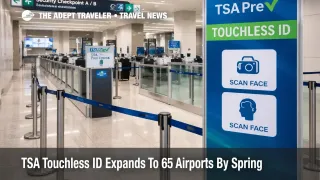
TSA intends to expand its TSA PreCheck Touchless ID program across the United States, growing the footprint to 65 airports by the end of spring. The change affects TSA PreCheck travelers flying on participating airlines, because Touchless ID lanes let you move through the checkpoint without presenting a physical ID, pausing only for a quick photo match. If you want to use it, the practical next step is to opt in through your airline profile before travel, confirm the Touchless ID indicator appears on your mobile boarding pass, and still carry an acceptable physical ID as a fallback.
The TSA Touchless ID airports expansion matters because the time saving happens at the front of the checkpoint, where document check backups often set the pace for the entire lane. TSA's stated goal is to cut the identity verification step to around 10 seconds or less, which can meaningfully change how long PreCheck travelers spend waiting when staffing or peak departures create a pinch point.
Today, Touchless ID lanes are already operating at major hubs such as Hartsfield-Jackson Atlanta International Airport (ATL), Dallas Fort Worth International Airport (DFW), Denver International Airport (DEN), Detroit Metropolitan Wayne County Airport (DTW), Harry Reid International Airport (LAS), Los Angeles International Airport (LAX), Newark Liberty International Airport (EWR), John F. Kennedy International Airport (JFK), LaGuardia Airport (LGA), Phoenix Sky Harbor International Airport (PHX), Portland International Airport (PDX), Salt Lake City International Airport (SLC), San Francisco International Airport (SFO), Seattle-Tacoma International Airport (SEA), and Ronald Reagan Washington National Airport (DCA). TSA's first priority expansion wave targets additional high volume airports including George Bush Intercontinental Airport (IAH), Washington Dulles International Airport (IAD), Boston Logan International Airport (BOS), Palm Beach International Airport (PBI), Miami International Airport (MIA), John Wayne Airport (SNA), Dallas Love Field (DAL), Kansas City International Airport (MCI), William P. Hobby Airport (HOU), Fort Lauderdale-Hollywood International Airport (FLL), Norman Y. Mineta San Jose International Airport (SJC), Sacramento International Airport (SMF), Ted Stevens Anchorage International Airport (ANC), Baltimore/Washington International Thurgood Marshall Airport (BWI), Orlando International Airport (MCO), and Long Beach Airport (LGB).
Who Is Affected
This change primarily affects TSA PreCheck members who fly frequently out of large hubs, and who already manage airport time around predictable choke points such as the document check podium during morning and late afternoon peaks. If your airport is adding Touchless ID, the benefit is most noticeable on days when standard PreCheck lanes look fine until the ID check stalls and the queue suddenly stops moving.
Eligibility is not universal, even at airports that advertise the lane. Touchless ID access depends on the combination of your airline, the airport, and whether you opted in ahead of time, because participating airlines manage enrollment through their apps and frequent flyer profiles. Alaska Airlines, American Airlines, Delta Air Lines, Southwest Airlines, and United Airlines are among the carriers that have published opt in flows, but the exact airport coverage can vary by airline and can shift as TSA adds lanes and expands pilots.
Travelers who rely on a paper boarding pass, who do not want to store passport data in an airline profile, or who prefer not to use facial comparison technology should expect a standard identity check instead. The program is optional, and airlines emphasize that you can opt out through your account preferences, while still being able to fly using a physical ID.
What Travelers Should Do
If you want the time savings, opt in before you leave for the airport. In practical terms that means saving your Known Traveler Number and a valid passport in your airline profile, consenting to the Touchless ID feature, and checking that your mobile boarding pass shows the Touchless ID indicator. If you do not see the indicator, assume you will use a normal TSA PreCheck lane even if the airport is on an expansion list.
Use clear decision thresholds for tight itineraries. If you are planning an unusually short connection, or you have a fixed event time on arrival, treat Touchless ID as a potential bonus, not a guarantee, because staffing, equipment issues, or a mismatch between your airline and the airport lane can eliminate the benefit on a given day. If your plan only works if security is unusually fast, you should still add buffer or rebook to a safer itinerary.
Over the next 24 to 72 hours before departure, watch for two signals that matter more than headlines. First, monitor your airline app for the Touchless ID indicator and any check in prompts, because that is the real gatekeeper to lane access. Second, monitor airport level conditions that can swamp any single lane improvement, such as irregular operations, terminal traffic constraints, or security staffing surges, and adjust your arrival time accordingly. If you are connecting at a large hub, tools that protect tight connections elsewhere in the journey, such as American Connect Assist Expands at U.S. Hubs, can still matter more than a few seconds saved at the podium.
How It Works
Touchless ID is essentially an alternate identity verification flow inside TSA PreCheck. Instead of handing over a physical ID, an enrolled traveler pauses briefly while a camera captures a live photo that is compared against an image associated with their passport information, which the traveler provided through their airline profile. If the match succeeds, the traveler continues through the checkpoint, and the lane keeps moving.
The first order effect is at the document check position, where even small per passenger time cuts can reduce a queue that would otherwise stretch into the terminal at peak times. When a busy airport is departure banked, meaning many flights board at once, the ID check becomes a metering point that limits how quickly passengers can enter the X ray and body screening area. If the ID check speeds up reliably, it reduces the chance that a short staffing dip or a rush of arrivals creates a stop and go queue that feels unpredictable.
Second order ripples show up across the rest of the airport system. Faster security throughput can reduce the need for early airport arrivals, which can slightly ease curbside congestion, rideshare dwell time, and parking shuttle crowding at the same peak periods. It can also change how airlines and airports allocate space to premium ground products and faster paths, which is part of a broader shift toward segmented airport flows, similar in spirit to dedicated premium intake spaces discussed in Delta One Check In Expands At Eight U.S. Hubs. On disruption days, however, the benefit can evaporate if downstream screening equipment, bins, or staffing become the true bottleneck, which is why travelers should treat Touchless ID as a targeted improvement, not a full checkpoint overhaul.
Sources
- TSA PreCheck Touchless ID
- TSA is undertaking a large expansion of Touchless ID
- TSA PreCheck Touchless ID Will Expand to 50 New Airports This Spring
- TSA PreCheck Touchless ID, American Airlines
- TSA PreCheck Touchless ID, Southwest Airlines
- TSA PreCheck Touchless ID, Delta Air Lines
- TSA PreCheck Touchless ID: Every airport with the speedy new security lanes