

Malpensa Gate Protest Triggers ENAC Security Measures
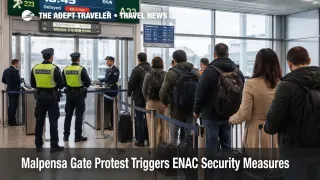
A gate area blockade at Milan Malpensa Airport (MXP) has prompted an aviation security response from Italy's civil aviation authority, ENAC, after activists prevented passengers from reaching a Tel Aviv bound flight's boarding position. ENAC said the January 4 incident lasted about 20 minutes and contributed to a roughly two hour delay to departure. Travelers connecting through Malpensa, and travelers departing on time sensitive long haul banks, should plan for the possibility of tighter gate area controls and faster intervention if similar disruptions appear in the terminal.
The Malpensa gate protest matters because it can turn into a highly localized failure that still breaks itineraries, even when the wider airport operation is running normally.
ENAC said it is reconstructing the incident, coordinating with airport operator SEA, and putting measures in place intended to prevent repeats, including asking police to identify those involved. ENAC also linked the response to passenger rights and non discrimination principles inside the air transport system, and it has framed the outcome as a security and access control issue rather than an airline customer service dispute.
Who Is Affected
Passengers departing from Milan Malpensa Airport (MXP) are the most exposed when disruption concentrates at the gate, because boarding is the final choke point before an on time pushback. Even a short blockage can compress boarding, force last minute document re checks, and cause a late push that misses the planned slot, especially on routes that already carry heavier security procedures.
Connecting passengers are affected differently. A gate disruption does not have to be airport wide to create misconnects, because long haul banks and feeder waves are built on tight sequencing. If one departure pushes late, arriving passengers may miss onward flights in Milan, Italy, and inbound aircraft may also arrive late into other hubs on the same rotation, which can trigger downstream retimes that look unrelated to the original gate incident.
Travel advisors should treat this as a situational risk that clusters around specific flights, gates, and times rather than a blanket warning that Malpensa is broadly closed or gridlocked. That distinction matters, because the best mitigation is not avoiding MXP entirely, it is avoiding brittle itineraries that fail if boarding is interrupted for even a short period.
What Travelers Should Do
For any departure from Milan Malpensa Airport (MXP) in the next few days, travelers should arrive earlier than their personal norm, keep passports, boarding passes, and any required entry documentation accessible, and plan to stay close to the gate once it is posted. If movement in the gate area becomes restricted, the best practical move is to follow airline and airport staff directions quickly and avoid engaging with any confrontation that could draw attention or slow processing.
Decision thresholds should be simple and ruthless. If a Malpensa connection is under 90 minutes, or if the itinerary is on separate tickets where bags and protection are not through checked, travelers should shift to a later departure, add an overnight, or reroute through a different hub that offers more rebooking options. If the trip includes a must not miss event, such as a cruise embarkation, a tour start, or a legal appointment, the safer choice is adding buffer time rather than trusting the published minimum connection time.
Over the next 24 to 72 hours, travelers should monitor three streams that move fastest in real time. First, airline app notifications for gate changes, boarding time shifts, and irregular operations waivers. Second, Milan Malpensa Airport (MXP) advisories from the airport operator and ENAC statements for any clarified measures that change gate access flow. Third, travel insurance and credit card coverage rules for delay and misconnect claims, because a short disruption that triggers a missed connection often becomes an expenses problem as much as a logistics problem.
Background
Gate area disruptions are unusually efficient at creating knock on effects because the gate is where multiple dependencies converge. Boarding requires staff availability, passenger circulation, document checks when required, and a clear physical path through the boarding lane, and any interruption in that chain can create a delay that is difficult to recover inside the scheduled turn time.
Once a departure slips, the first order effect is the late pushback and late arrival at the destination. The second order ripple is aircraft rotation and crew flow, because aircraft and crews are scheduled to operate multiple legs in sequence. A delay on one flight can reduce the available slack for the next leg, and that is how a single localized incident can produce broader disruption across a day's timetable, including missed connections, bags arriving late, and forced overnight stays when the last bank is missed.
This Malpensa incident also lands in a month where Italy has other reliability risks that can compound a traveler's buffer plan. If a disrupted flight forces a same day switch to rail or airport express service, travelers should account for any parallel transport constraints already on the calendar, including Italy Jan 9 Strikes Disrupt Flights and Trains and Italy Rail And Freight Strike January 20 Disrupts Trains. For travelers whose disrupted routing still includes Israel, entry documentation can be a secondary failure point during rebooking, so confirm requirements in Israel Entry Requirements For Tourists In 2026 before accepting a last minute itinerary change.
Sources
- Enac condanna episodio accaduto a Malpensa durante imbarco volo per Tel Aviv
- Enac: Ferma condanna per episodio accaduto a Malpensa dove attivisti pro-Palestina hanno ostacolato imbarco per Tel Aviv
- Italy aviation agency condemns pro-Palestinian protest that blocked Israel-bound passengers
- Dopo il blocco "pro Palestina" del volo per Tel Aviv Enac rafforza la vigilanza