

Italy Jan 9 Strikes Disrupt Flights and Trains
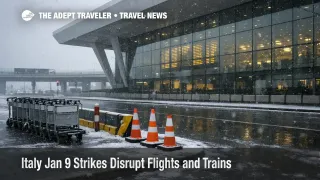
Italy's January 9 strike day is now being reported with tighter, traveler usable scope across both aviation and rail, and the sequencing matters. On Friday, January 9, 2026, aviation disruption risk concentrates around airport ground handling and airline crew work stoppages, and then rail disruption risk rises from late Friday into Saturday, January 10, 2026, when the national rail strike window starts at 9:00 p.m. local time. The practical shift versus a generic warning is that you can now plan around protected flight time bands, anticipate the highest baggage and counter friction when handling stops, and treat late Friday intermodal transfers as the point most likely to fail.
ENAC protected flight windows in Italy are 700 a.m. to 1000 a.m., and 600 p.m. to 900 p.m. local time. Those bands are not a promise that every flight will operate perfectly, but they often shape how airlines retime schedules and how airports prioritize scarce resources when staffing drops. For this strike day, that means the middle of the day is where processing friction, gate holds, and delayed baggage are most likely to compound, even if your flight itself is not canceled.
This update is also important because the travel system does not fail at only one layer. When handling slows, check in lines, bag rooms, aircraft turn times, and dispatch sequencing get longer, which increases missed connection odds and pushes crews toward duty time limits. Then, when rail infrastructure and operations are strained from Friday night into Saturday, the usual recovery tools, which are high speed rail substitutions, airport express trains, and same day city transfers, become less reliable at exactly the moment more travelers are forced to re route.
For earlier background and the initial watch phase, see Italy Transport Strike Hits Flights, Trains January 9-10 and Italy Airport Strike Disrupts Flights January 9, 2026.
Who Is Affected
Air travelers flying to, from, or within Italy on Friday, January 9, 2026, are affected first, especially anyone who needs check in services, baggage drop, or tight connections. The most exposed are itineraries that stack dependent steps, such as an arriving flight followed by a separate ticket connection, a same day rail link, a timed tour start, or a cruise or ferry departure that cannot be missed.
Milan Linate Airport (LIN) and Milan Malpensa Airport (MXP) are repeatedly highlighted in reporting because of added handling exposure at those airports, and because Milan is a high demand rebooking market when winter schedules are tight. Rome Fiumicino Airport (FCO) is also high consequence even when the disruption is uneven, because it concentrates long haul banks where a single missed short haul feeder can create an overnight problem that ripples into the next day's departures.
Rail travelers become most exposed starting Friday evening and through Saturday, January 10, 2026, particularly those relying on late departures, early Saturday repositioning, or airport rail links as their buffer plan after a flight cancellation. RFI lists a national rail strike window from 900 p.m. Friday, January 9, to 900 p.m. Saturday, January 10, and it notes the impact can begin before the start and continue after the end. That timing is brutal for intermodal travel because it hits the last wave of Friday arrivals into city centers and can reduce Saturday recovery capacity when travelers are trying to salvage trips.
What Travelers Should Do
If you are traveling on January 9, treat checked baggage as the biggest avoidable failure point. Go carry on only if you can, complete online check in as early as possible, and arrive earlier than usual for bag drop and security because the trip can break even when the aircraft still operates. If you must check a bag, prioritize earlier departures, and plan for delayed delivery on arrival, including the possibility that your bag misses your onward connection.
Use decision thresholds that force earlier action. If your itinerary relies on a rail to air connection, or an air to rail connection, with less than three hours between scheduled arrival and the next departure, rebook now or add an overnight buffer, because mid day handling delays and late day crew legality issues can erase that margin quickly. If you have a single protected window flight option, choose the 700 a.m. to 1000 a.m. band first for reliability, and use the 600 p.m. to 900 p.m. band only if you can tolerate a late arrival and a higher chance of having to overnight.
Over the next 24 to 72 hours, monitor three things, and be ready to pivot when any one of them turns negative. First, watch your airline for schedule retimes, cancellations, and waivers, especially if you are on easyJet or Vueling, since both are widely reported in the January 9 actions. Second, watch airport operator updates for Milan and Rome because local handling constraints often determine whether the airport can recover the day's bank. Third, watch rail operator advisories for Saturday, January 10, because the RFI strike window can degrade the fallback plan you were counting on, and can also strand you between the airport and the city center if airport express service is thinned or replaced.
How It Works
Aviation strikes rarely feel like a single on off switch to travelers. Ground handling stoppages tend to create uneven impacts by airport, carrier, and time of day, because the system is built on repeated, tightly timed turns that assume steady staffing. When the number of available agents drops, queues grow at check in, gate staffing slows boarding, baggage can fail in both directions, and aircraft sit longer waiting for basic services. Even when flights are protected in the ENAC time bands, upstream delays can still push an aircraft outside the window, and then the day's recovery depends on spare crew, spare aircraft, and available gates, all of which are limited in winter schedules.
The second order effects appear quickly outside the airport perimeter. As cancellations rise, demand surges for short haul alternatives and hotel rooms near the hub airports, especially around Milan and Rome. That pressure also pushes travelers onto rail, but a rail strike window that begins at 9:00 p.m. Friday and runs through Saturday evening reduces the network's ability to absorb displaced passengers. The result is that the usual mode switch strategy, which is to fly if trains fail and take the train if flights fail, can break down across a single weekend, increasing overnight displacement and the risk of missing hard deadline events such as cruise embarkation, group tours, and prepaid resort check ins.
For rail specifics, start with the strike notice timing from RFI, then use operator minimum service rules to identify what still runs, and when. Trenitalia's minimum service guidance emphasizes essential regional service in the 600 a.m. to 900 a.m., and 600 p.m. to 900 p.m. weekday commuter bands, with weekend protected bands that typically shift to a 700 a.m. start, and it also notes rules for trains already in motion when a strike begins. On this strike weekend, that means late Friday services are exposed right as the rail strike starts at 900 p.m., and Saturday planning should assume fewer reliable options outside the protected bands, even if some long distance trains remain guaranteed by list.
Sources
- Voli garantiti in caso di sciopero, ENAC
- SCIOPERO NAZIONALE DEL TRASPORTO FERROVIARIO, RFI
- Servizi minimi garantiti in caso di sciopero, Trenitalia
- Scioperi a gennaio 2026: calendario manifestazioni, date e orari, Sky TG24
- Scioperi gennaio 2026, aerei e treni: 9 e 10 le giornate nere, Adnkronos
- Confermato lo sciopero del 9 gennaio. Chi si ferma, The Flight Club