

Italy Rail And Freight Strike January 20 Disrupts Trains
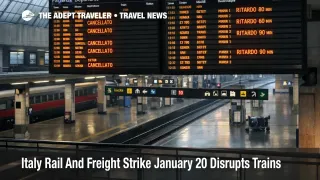
A national scale rail and rail freight stoppage is being flagged across Italy for Tuesday, January 20, 2026, and it can cut passenger trains that tourists depend on for city to city travel and airport transfers. Travelers on Trenitalia services, and on corridors that rely on shared infrastructure, are most exposed to cancellations, short notice timetable changes, and packed stations as remaining departures fill. The practical move is to shift date fixed legs off January 20 when you can, or to plan around guaranteed service rules, and keep a backup transfer plan for the last mile into airports and hotels.
Italy rail strike January 20 matters because minimum service keeps some trains moving, but it does not prevent the failures that break itineraries, which are missed connections, late arrivals, and forced overnight stays.
Who Is Affected
Reporting in Italy lists the action as running from 1201 a.m. to 1100 p.m. local time on Tuesday, January 20, and involving rail passenger and rail freight sectors tied to the FS Group, including Mercitalia Rail, Trenitalia, and Trenitalia Tper. In practice, that puts the core tourist map at risk: the north south trunk that feeds Rome, Florence, Bologna, Milan, and Turin, the Venice and Naples branches that carry heavy leisure demand, and the regional meshes that turn a high speed ticket into a complete door to door trip.
Airport rail links are a specific pinch point because travelers often treat them as fixed schedule utilities. Rome Fiumicino Leonardo da Vinci Airport (FCO) is commonly reached by the Leonardo Express from Roma Termini, and Milan Malpensa Airport (MXP) is commonly reached by the Malpensa Express from Milan hubs. Those services can be reduced or canceled outside guaranteed time bands, and any gap instantly shifts demand into taxis, ride hail, airport buses, and private transfers.
The second order ripple is where a one day strike becomes a two day travel headache. When passenger trains are thinned, crews and sets end the day out of position, and the first departures on Wednesday can inherit knock on delays. When rail freight is disrupted, shared yards and dispatching priorities can add congestion that slows passenger throughput at key junctions, which pushes more travelers onto short haul flights, coaches, and rental cars. That demand shift is exactly what drives higher same day prices and compresses hotel inventory near major stations.
For earlier strike context in the same month, and for how aviation and rail overlap can amplify disruption, see Italy Transport Strike Hits Flights, Trains January 9-10.
What Travelers Should Do
If you can move the trip, do it now, and protect the segment that cannot fail, such as a cruise embarkation, a tour start, or a long haul departure. Shift travel to Monday, January 19, or Wednesday, January 21, and add a buffer night near the hub that matters most, especially if you are stitching together separate tickets or relying on the last train of the day.
If you must travel on January 20, treat guaranteed service as a narrow safety rail, not a promise. For Trenitalia regional travel on weekdays, the published essential service bands are 600 a.m. to 900 a.m., and 600 p.m. to 900 p.m., and long distance protection is handled by a specific guaranteed train list that must be checked by train number. If your itinerary depends on an airport rail link, set a decision threshold early: if your planned rail transfer is outside the guaranteed bands, or if it is the only way to make a fixed deadline, prebook a bus or car service and keep it cancelable.
Over the next 24 to 72 hours, monitor three things in parallel. First, your operator's app and any live running tools for proactive cancellations and re-timed departures, because strike day timetables often change late. Second, the guaranteed train lists and minimum service notices, because those determine whether you should wait, rebook, or swap modes. Third, your accommodation and connection timing, because arriving after normal check in hours is the most common hidden failure, and a simple message to the hotel, plus a backup plan for late arrival transport, prevents avoidable losses.
Background
Italy's transport strike framework is built around minimum service requirements, which is why a strike day rarely looks like a complete shutdown, and instead feels like uneven reliability. For Trenitalia, the company's published guidance explains that regional essential service is concentrated into peak weekday time bands, while long distance service protection is handled through a defined list of guaranteed trains. It also notes that trains already in motion at the start of a strike may still reach their final destination if it is reachable within an hour, otherwise they can terminate earlier, which is another reason late day plans and tight connections are fragile.
What makes a national action different from a local stoppage is how fast disruption spreads beyond the initial cancellations. A thinned timetable reduces capacity at the source, which creates crowding, longer station dwell times, and missed slots that delay other trains using the same paths. Those first order effects then ripple into at least two other layers: airports lose a dependable rail feeder for early check in windows, and city center hotels absorb displaced travelers when last departures are canceled or when replacement buses arrive late. Add rail freight into the picture, and congestion pressure can rise at shared nodes, which slows recovery and increases the odds that Wednesday morning starts with residual delays.