

Storm Goretti Northern Europe Flights, Trains Cut
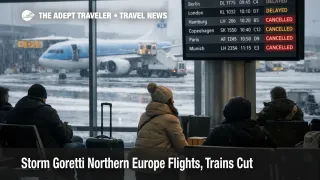
Storm Goretti is no longer just a United Kingdom weather and Channel disruption story. On January 9, 2026, weather driven constraints spread deeper into northern Europe, with additional flight cancellations and widening rail suspensions in the Netherlands, France, and Germany. The practical consequence for travelers is that backup options are also tightening, because the same storm system and cold pattern is stressing the alternates that normally absorb displaced demand.
At Amsterdam Airport Schiphol (AMS), KLM warned that severe winter weather is continuing to affect both flight and ground operations, and that conditions may persist over the coming days. KLM's alerts note that transfer passengers may be proactively rerouted via alternative airports, and published waiver style options for flights to, from, or via Schiphol from Tuesday, January 6, through Monday, January 12, 2026, with rebooking timelines extending to Monday, January 19, 2026, depending on ticket rules. KLM also temporarily suspended unaccompanied minor travel to, from, or via Schiphol through January 11, 2026, to reduce stranding risk.
In France, the storm's wind and infrastructure damage hit the Paris to Normandy rail spine hard. SNCF NOMAD Train reported widespread network damage in Normandy and described a staged reopening that begins gradually on Friday, January 9, 2026, expands Saturday, January 10, 2026, and targets additional lines on Sunday, January 11, 2026. For travelers, that means the headline is not just cancellations, it is uneven restarts that can flip hour by hour as inspections clear segments and crews reset diagrams.
Germany's rail disruption is being driven by the same broader winter weather pattern following the storm track, and Deutsche Bahn attributed the most acute impacts to low pressure system Elli in official updates. Deutsche Bahn said long distance trains in northern Germany cannot operate until further notice, warned of growing impacts in eastern Germany, and extended flexible ticket rules by lifting train specific restrictions for eligible tickets, with seat reservations cancellable at no cost under the stated conditions.
On the aviation side in northern Germany, Hamburg Airport (HAM) warned of ongoing extreme weather disruptions and told travelers to check flight status regularly and contact their airline directly for flight specific guidance. Even when runways remain open, winter operations often throttle capacity through longer de icing cycles, slower taxi and turnaround times, and air traffic flow restrictions, which is why airport wide "disruptions and delays" language tends to translate into missed connections for tight itineraries.
Who Is Affected
The most exposed group is anyone traveling on a connection dependent itinerary through Amsterdam Airport Schiphol (AMS), especially if the trip includes short intra Europe connections, separate tickets, or a same day rail or coach transfer after landing. When KLM and partner carriers cancel proactively, the first order problem is the canceled flight, but the bigger traveler problem is reaccommodation into an already full network, where alternative hubs are also weather constrained.
Rail travelers are taking a double hit. In France, passengers relying on the Paris to Normandy corridor for coastal weekends, cruise positioning, or onward access to regional airports face the highest probability of last minute timetable changes as lines reopen in stages rather than snapping back to normal. In Germany, travelers who planned to bridge city pairs by long distance rail, then connect onward by regional trains, face compounded risk because a long distance cancellation can strand them far from their planned interchange, and replacement buses, when offered, are often capacity constrained and slow in snow conditions.
Travelers starting, ending, or connecting through Hamburg Airport (HAM) are also in the impact set, particularly on short haul routes that feed hub banks. When a feeder flight cancels, the downstream effect is not limited to Hamburg, it can break an entire day's long haul itinerary because the connecting seat disappears and rebooking options narrow quickly.
What Travelers Should Do
Travelers should start by protecting the most brittle segment, usually the first departure that unlocks the rest of the day. That means checking the operator status page before leaving for the station or airport, adding buffer time for snow, queues, and slower ground transport, and reserving a refundable backup hotel near the last reliable node if the itinerary depends on a late day connection. For Schiphol itineraries, use KLM's self service tools early, because reaccommodation queues grow fastest when multiple waves cancel at once.
Decision thresholds matter more than optimism during multi day winter disruption. If the trip is optional and you are inside a waiver window, moving travel outside the peak disruption band is usually the highest value move, because it removes you from the competition for scarce same day seats. If you must travel, set a hard cutoff: if your train or flight is not clearly operating by the time you would normally depart for the terminal, pivot to an overnight plan rather than gambling on a late cancellation that strands you after hotel inventory tightens. For Germany rail tickets under Deutsche Bahn's flexible rules, confirm eligibility, then use the lifted train restriction to shift to a later date that avoids the worst corridor constraints.
Over the next 24 to 72 hours, monitor three recovery indicators. First, meteorological warning updates, because a downgrade often helps, but snow and wind can still sustain operational limits. Second, operator restart statements, especially SNCF NOMAD Train's staged reopening in Normandy and Deutsche Bahn's corridor level updates, because these define when connections become realistic again. Third, hub flow health at Amsterdam Airport Schiphol (AMS), where continued cancellations, crew displacement, and constrained rebooking capacity can keep the system fragile even after the worst weather passes.
Background
Storm driven disruption spreads through travel systems in layers, and this escalation phase is where travelers get surprised. The first layer is direct safety and infrastructure impact: strong winds drop trees onto tracks, snow reduces braking performance, and airports lose departure rate because de icing and low visibility slow every movement. Météo France's vigilance language explicitly warns that major air and rail disruptions are likely during severe events, which aligns with the staged restarts now visible in Normandy and the rolling caps at Schiphol.
The second layer is asset and crew positioning. A canceled flight does not just remove one departure, it puts an aircraft and crew on the wrong side of the next rotation, and duty time limits can prevent a fast recovery even when conditions improve. Rail has an analogous problem, trainsets and crews get trapped behind closed segments, and depots may not be reachable to reset the plan. That is why you can see a corridor reopen in pieces, but still have thin service and crowding, because the physical network is not the only constraint.
The third layer is traveler behavior and substitution, which creates ripples across other modes. When flights cancel at Amsterdam Airport Schiphol (AMS), displaced travelers try to reroute via alternative airports, and when rail corridors close in France or Germany, passengers shift to short haul flights or rental cars. Those substitutes strain hotel inventory near hubs and stations, tighten seats on remaining departures, and raise the odds that a separate ticket plan fails. For earlier storm setup and UK focused impacts, see Storm Goretti UK Ferries And Airports Disrupted Jan 9, and for compounding disruption at Schiphol, see Schiphol Terminal 2 Power Outage Delays Flights.
Sources
- Red warning for wind issued as Storm Goretti approaches
- VIGILANCE METEO FRANCE
- Travel alerts and disruptions, Amsterdam Airport Schiphol severe winter weather
- Impact of Winter Weather on KLM Flights
- Aktuelle Statements, Deutsche Bahn
- Plan de transport Tempête, SNCF NOMAD TRAIN
- Departures, Hamburg Airport
- Today Friday 9th January adjusted NS timetable because of adverse weather conditions
- Liveblog code oranje gladheid januari 2026, KNMI
- Hundreds of thousands without power as Storm Goretti hits France, Britain