

Greece Ferry Sailing Bans Hit Piraeus and Rafina
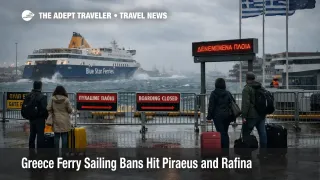
Greece ferry sailing bans linked to gale force southerly winds suspended many departures from the Athens area ports of Piraeus and Rafina on January 8, 2026. Island travelers, day trippers, and anyone trying to chain a flight into a ferry check in window were the most exposed, because cancellations can arrive close to departure time once port authorities impose restrictions. The practical next step is to assume the first available sailing may not be the one you board, then add buffer time, protect lodging, and build a credible flight alternative for islands with airports.
The disruption matters because Greece ferry sailing bans do not just pause a single ship, they can temporarily sever the mainland mobility layer that makes Greek island itineraries work, especially when travelers are relying on same day transfers across modes.
Officials and reporting indicated winds reached roughly 8 to 9 on the Beaufort scale in affected sea areas, prompting widespread service suspensions. The Coast Guard guidance relayed by major outlets said that from Piraeus, only sailings to the Dodecanese were operating while other island routes were temporarily suspended, and Saronic Gulf services were halted until further notice.
Rafina departures to the Cyclades were reported canceled, and a sailing ban remained in effect at Lavrio, which matters because those ports are common departure points for Cyclades itineraries and for travelers trying to avoid longer surface transfers across Athens.
Who Is Affected
Travelers already on the mainland with tickets for island departures are the first group hit, particularly those departing from Piraeus and Rafina, where terminal crowding can rise quickly when multiple sailings are pulled at once. If you are attempting an airport to ferry chain after arriving at Athens International Airport Eleftherios Venizelos (ATH), the risk is not only a canceled sailing, it is a missed check in cutoff that forces a same day rebook scramble when inventory may already be thin.
Island hopping travelers are the next group exposed. When one leg is canceled, the downstream legs often become impossible to make, even if later sailings resume, because the itinerary depended on a narrow timing ladder and specific vessel rotations. This is where second order effects show up, tours can be missed, hotels on the next island may treat the arrival as a no show depending on policy, and paid transfers that were timed to a specific arrival can become sunk costs.
The disruption can also extend beyond the Athens region. On January 8, 2026, reports listed additional suspended connections, including Faneromeni (Salamina) to Megara, Nea Styra to Agia Marina, Keramoti to Thassos, Corfu to Igoumenitsa, Rio to Antirrio, and Kyllini to Zakynthos, plus cancellations on the Alexandroupoli to Samothrace route for both January 8 and January 9.
Finally, travelers should expect operator specific changes even within the same day. Ferry lines can cancel particular sailings while modifying others, and carrier notices around January 8 referenced cancellations and schedule changes on named vessels and itineraries from Piraeus and other ports due to adverse weather.
What Travelers Should Do
Start with immediate triage. Treat your ticket as a place in a queue, not a guarantee of a specific departure time, then confirm status directly with your ferry operator and the relevant port authority before you leave your hotel. If you are not already near the port, protect an overnight option near Piraeus or Rafina so you are not forced into a last minute hotel hunt if the ban extends into the next sailing bank.
Use decision thresholds instead of waiting on vibes. If the port is still under a formal ban, or if your operator has already canceled at least one sailing on your route, shift your plan toward either an overnight wait or a flight substitution for islands with reliable air service. If you must preserve a same day arrival, rebook the earliest flight you can tolerate, or move the entire island sequence by at least one day, because a resumed sailing schedule can still be capacity constrained while the system unwinds.
Over the next 24 to 72 hours, monitor the wind forecast trend and, more importantly, the operational restart pattern at your departure port. In many strong wind events, more sheltered routes and conventional ferries may return earlier than high speed craft, while exposed corridors can remain off limits longer even after conditions improve elsewhere. If your itinerary depends on multiple ferry legs, watch for compounding risk and be willing to collapse island hopping into a single base island until sailings stabilize.
If you are also planning ground transfers in Athens during the same period, it is worth factoring in overlapping surface transport fragility. Athens Taxi Strike, Airport and Port Transfers Jan 13 is a separate event, but it is the same failure mode, last mile uncertainty to port check in windows. Similarly, Highway Blockades In Greece Disrupt Road Transfers can tighten timing margins for anyone driving to ports or airports.
How It Works
A sailing ban is an operational safety stop, not a commercial choice. When winds and sea state exceed safe limits for specific vessel classes and routes, port authorities and the Coast Guard can restrict departures, which immediately pauses the ferry network that moves both passengers and rolling cargo between the mainland and islands.
First order effects happen at the port. Departures are suspended, terminals fill, and ticket changes, standby rules, and refund options become the bottleneck. The next layer is vessel and crew positioning. When a ship does not complete a round trip, it is no longer where tomorrow's timetable assumes it will be, and crew duty limits can reduce how aggressively operators can "catch up," even after restrictions lift. That is why cancellations can persist after the wind peak, the system is not just restarting, it is re sequencing.
The ripple then moves into at least two other layers of the travel system. Aviation absorbs displaced demand as travelers switch from ferries to flights for islands with airports, which can tighten seats and raise last minute fares, especially on short haul sectors. Lodging and tours absorb disruption because arrivals slip, hotel check ins shift, and day trips get canceled or compressed. On islands, freight timing can be affected, which matters in winter shoulder periods when fewer sailings already mean thinner buffers for supplies, rentals, and excursion operators.
The traveler takeaway is that the "all clear" is not a single moment. The operational restart is a rolling process, and your best defense is time, flexible bookings, and minimizing single point failures, especiallyyana.
Sources
- Strong winds keeping many ferries tied up at ports | eKathimerini.com
- Strong Winds Disrupt Ferry Travel Across Greece on January 8 | GTP Headlines
- Sailing ban in force due to strong winds - which routes are operating - ProtoThema English
- Previous itineraries modifications due to adverse weather conditions | Blue Star Ferries