

Athens Taxi Strike, Airport and Port Transfers Jan 13
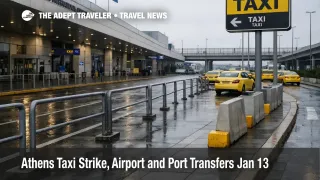
A planned taxi strike in Athens, Greece, is set to disrupt airport and port transfers across the city and the wider Attica region. Travelers arriving at Athens International Airport Eleftherios Venizelos (ATH), heading to Piraeus ferry and cruise departures, or relying on late night taxi availability are the most exposed to long waits and missed check in cutoffs. The practical move is to treat taxis as unreliable on January 13, 2026, and January 14, 2026, then route key transfers onto metro, airport express buses, or pre booked pickups with a clear fallback.
The Athens taxi strike airport transfers issue matters because the city's taxi supply is a core last mile layer for the airport, the port, and hotel districts, and a two day supply shock forces travelers into fixed capacity alternatives that can fill quickly.
Who Is Affected
Airport bound travelers are the first group at risk, especially anyone landing at Athens International Airport Eleftherios Venizelos (ATH) in the evening bank, or departing early morning when typical surface alternatives are thinner and baggage, check in, and security deadlines are unforgiving. When taxis thin out, the failure mode is not just a longer curbside wait, it is an arrival that slides past bag drop cutoffs, missed domestic repositioning flights, and last minute hotel changes that become expensive when many travelers are displaced at once.
Port transfers are the second high sensitivity segment. Piraeus departures run on fixed loading windows, and a delayed city to port trip can quickly turn into a missed sailing that strands travelers until the next departure, sometimes with limited same day availability during peak periods. That risk is highest for anyone chaining a flight arrival into a same day ferry, cruise embarkation, or an island connection that does not have frequent later sailings.
App booked taxis are not a clean workaround if the underlying supply is still licensed taxis choosing not to work. Services such as Uber's taxi option in Athens and Greece's Freenow platform both connect riders to professional taxi drivers, so availability during a taxi labor action can degrade sharply even if the apps remain online and taking requests.
This strike risk also stacks with other surface transport uncertainty already in the Athens region. Travelers who were already planning larger buffers for road disruptions should assume January 13, 2026, and January 14, 2026, are not the days to rely on a single, tight surface transfer chain. For related ground mobility constraints, see Highway Blockades In Greece Disrupt Road Transfers.
What Travelers Should Do
Start by protecting the transfers that cannot slip. If you are landing at ATH, decide in advance whether you will take Metro Line 3, the suburban railway, or an airport express bus, then confirm where you will board and how long the ride typically takes at your arrival hour. If you must use a vehicle, favor a pre booked transfer that provides a confirmed pickup process and a clear cancellation policy, then screenshot pickup instructions so you can execute even if communications are slow at curbside.
Use decision thresholds rather than hoping taxi availability improves. If you open a taxi app and see repeated no driver matches, or if the airport taxi rank is not moving steadily, treat that as the trigger to switch modes immediately, not after another 20 to 30 minutes of waiting. For ferry departures, if your estimated time to Piraeus is drifting later and you are inside a two hour window to check in, move to the fastest fixed route you can execute, even if it means taking metro or a bus to a closer connection point before continuing.
Over the next 24 to 72 hours, monitor whether the Attica taxi union escalates beyond the initial two day action, or shifts from a defined 48 hour stoppage into repeated or extended work stoppages. That matters because an escalation changes how you should price the risk, for example whether to rebook arrivals to daytime hours when metro and express buses are busiest, or to move a port departure to a day with more predictable surface transport.
How It Works
A taxi strike creates an immediate capacity shock in the exact layer many visitors use for last mile travel. Athens has public transit alternatives from the airport, but taxis still absorb a meaningful share of arrivals that want door to door service, are traveling with families and luggage, or are arriving outside the most convenient rail hours. When that taxi layer drops, demand surges onto the airport express bus lines and rail options, and the practical constraint becomes boarding capacity, crowding, and the time it takes a traveler to navigate an unfamiliar system while managing bags and tight deadlines.
The second order ripple shows up quickly at the port and in onward connections. Missed ferry check ins cascade into later sailings, sold out cabins, and unplanned hotel nights in Athens or Piraeus, and that can also disrupt tours and hotel check ins on the islands that assume a specific arrival time. On the aviation side, late arrivals to ATH can force travelers onto later flights, and those rebookings can tighten seats across the short haul network when many passengers self recover at the same time.
The dispute itself is being framed by taxi union leaders around policy and operating cost issues, including the pace and terms of an electric taxi transition starting in 2026. For travelers, the key operational takeaway is that this type of dispute can shift quickly from a defined stoppage into repeat action, so the best planning posture is to treat taxis as a bonus, not a dependency, on the affected dates.
Sources
- Athens Taxi Drivers to Stage 48-Hour Strike on January 13-14 | GTP Headlines
- Σε 48ωρες επαναλαμβανόμενες απεργίες προχωρούν τα ταξί από την Τρίτη - Τι είπε στο ΕΡΤnews ο πρόεδρος του ΣΑΤΑ - ertnews.gr
- Ταξί: Προκήρυξη 48ωρης απεργίας στις 13 και 14 Ιανουαρίου
- Public transportation - Airport | AIA
- 24-hour Service Bus Lines - OASA
- Athens Taxis Near Me - Request a Taxi 24/7 | Uber
- BEAT Taxi Is Now Freenow in Greece | Freenow