

Highway Blockades In Greece Disrupt Road Transfers
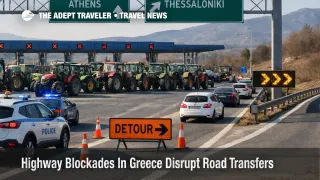
A coordinated wave of farmer roadblocks is disrupting highway travel across Greece, with key closures and diversions reported on the main Athens to Thessaloniki corridor and other national routes. Travelers driving between cities, heading to ports for ferries, or relying on road transfers to airports, resorts, and tours are the most exposed to missed check ins and cascading itinerary failures. Treat any road dependent connection as fragile, build significant buffer time, and be ready to switch modes or reroute onto rail or air where availability allows.
The Greece farmers highway blockade matters for travelers because it turns normally reliable intercity drive times into an operational unknown, and that uncertainty propagates into flights, ferries, hotel check ins, and paid activities that do not wait.
Hellenic Police posted traffic measures and detours tied to the disruptions on the A.TH.E motorway, including diversions around Bralos, Thebes, and Kastro, and a separate routing change around Chalkida where traffic was shifted away from the high bridge. In parallel, Greek media reported concentrated pressure points that include the Tempe area on the Athens to Thessaloniki route, Malgara tolls west of Thessaloniki, and several northern border crossings where freight movement was restricted or slowed.
Who Is Affected
Self drive travelers are the first group at risk, especially anyone attempting the Athens to Thessaloniki drive, western Greece drives that feed Epirus and the Ionian coast, or last mile transfers where a single interchange or toll plaza can become the chokepoint. If you have a fixed arrival commitment, such as a ferry sailing, a flight departure, or a hotel check in deadline that triggers cancellation penalties, assume navigation app ETAs will be wrong during active blockade windows.
Airport bound travelers are exposed even if the airport itself is operating normally, because the surface trip is the dependency that can erase check in and security time. The highest sensitivity is for travelers heading to Athens International Airport "Eleftherios Venizelos" (ATH) or Thessaloniki Airport "Makedonia" (SKG) from outside the immediate metro area, plus anyone connecting onward on separate tickets.
Tourers and cruise passengers positioning by road also face outsized consequences. When highway closures force long detours, coaches arrive late to timed entries, port check in queues compress, and the fallback option often becomes an unplanned overnight near a gateway city, which can be costly when many travelers are displaced at once.
What Travelers Should Do
Start by protecting any time critical handoff. If you must reach a port, an airport, or a tour meeting point by road, depart much earlier than normal, and plan at least one alternate route that avoids the most obvious chokepoints on the national network. If your plan includes a ferry or flight the same day as a long drive, the resilient move is to add a night near the departure point, or to shift to rail or air for the long leg, then use a short local transfer.
Use decision thresholds instead of waiting for conditions to improve. If your planned motorway route is showing repeated closures, if the detour pushes your arrival past airline baggage cutoffs, or if you are inside a two hour window to a ferry departure and your ETA is still moving later, treat that as the trigger to reroute immediately or rebook. In practice, it is usually cheaper to arrive early and wait than to miss the last workable departure and be forced into walk up pricing.
Over the next 24 to 72 hours, monitor whether blockades extend beyond the initial window, and whether police traffic measures expand to additional interchanges, bridges, or approach roads. For a broader transfer resilience playbook when street access is volatile, the same traveler logic applies in other protest environments, see Sydney CBD Protest March Ban Disrupts Airport Transfers.
How It Works
Road blockades create a first order capacity shock at the exact points the network depends on, toll plazas, interchanges, tunnels, and bridges. Even when some traffic is diverted, detours funnel vehicles onto secondary roads that cannot absorb motorway volumes, which increases crash risk, slows emergency response, and makes arrival times non linear, meaning a short delay can suddenly become hours.
The second order ripple shows up quickly in the rest of the travel system. When the Athens to Thessaloniki corridor or western routes stall, travelers shift demand to domestic flights and intercity rail on short notice, which tightens seat inventory and raises last minute fares. Missed ferry check ins, delayed coach touring, and late hotel arrivals then compound, because suppliers have fixed departure times, limited staff, and little ability to flex capacity at the end of the day.
Politically, the dispute is tied to rising production costs, delayed subsidy payments, and opposition to trade policy, and the government has been offering additional relief measures while warning against prolonged paralysis. For travelers, the practical takeaway is that the duration and intensity can change quickly, so treat official police traffic updates and local operator advisories as your trigger for whether to wait, reroute, or rebook.
Sources
- 08-01-2026: Κυκλοφοριακές ρυθμίσεις επί του Αυτοκινητοδρόμου Α.Θ.Ε. λόγω αγροτικών κινητοποιήσεων | Ελληνική Αστυνομία
- Farmers up the ante with escalation of blockades | eKathimerini.com
- Farmers escalating roadblock protests, demand meeting with PM | eKathimerini.com
- Farmers block highways across Greece in protest over rising costs and EU trade deal | AP News
- Greece offers farmers cheaper fuel, damage cover in bid to end blockades | Reuters