

Cold Shuts Kittilä Airport, Lapland Flights
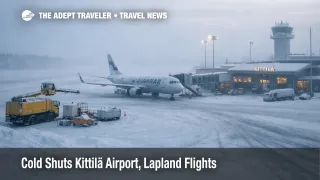
Extreme cold in Finnish Lapland halted flight operations at Kittilä Airport (KTT), after temperatures fell to about minus 37 Celsius and made aircraft servicing impractical. Travelers departing ski and northern lights hubs, including those on weekend package trips, were the most exposed because the cancellations hit whole rotations rather than single delayed flights. The practical next step is to treat the disruption as a multi day backlog risk, confirm rebooking before leaving your hotel, and build an alternate exit plan if your flight is not protected on one ticket.
Kittilä Airport cold cancellations reshaped Lapland itineraries because Finnair cancelled all flights to and from Kittilä on January 11, 2026, and warned that winter weather constraints across northern destinations can slow ground handling and trigger delays and cancellations through January 12, 2026.
Reporting from Finland's public broadcaster said 15 international and 8 domestic flights were scheduled from Kittilä on January 11, 2026, and were cancelled, with thousands of foreign tourists waiting for updates on return flights. The same report noted one Helsinki Airport (HEL) to Rovaniemi Airport (RVN) round trip was also grounded, a signal that the cold snap can disrupt multiple Lapland nodes even when impacts are concentrated at one airport.
Who Is Affected
Travelers most likely to feel the worst effects are those departing Kittilä after short breaks, charter based packages, or tight Sunday to Monday turnarounds, because a full day of cancellations creates a queue that can take longer to unwind than a typical snow delay. If your itinerary relies on a same day connection through Helsinki, the risk is not only a cancelled Lapland leg, it is also missed onward departures once reaccommodation seats tighten across multiple banks.
International leisure travelers are also exposed when flights that typically run direct between Lapland and major European cities do not operate, because those travelers often have fixed hotel check out times and pre booked transfers. When a full rotation is cancelled, the next available options can be later dates via Helsinki, or alternate routings from other Lapland airports, rather than later same day departures from Kittilä.
Local operators get pulled into the disruption quickly. When guests are stranded, hotels extend stays, transfers re sequence pickups, and activity providers face no shows on arrival days and last minute cancellations on departure days, especially for tours that require fixed time blocks and specific weather windows.
What Travelers Should Do
Start with the airline's protected solution, because automated rebooking is usually the fastest way back into the queue when seats are scarce. Confirm your contact details in your booking, watch for SMS or email changes, and do not assume a scheduled departure will operate until it is actively confirmed close to departure.
Set a decision threshold that triggers a pivot. If you do not have a confirmed new itinerary and hotel coverage by late afternoon local time, or if the forecast remains near the extreme cold band into the next morning, shift to alternates such as a later date via Helsinki, moving to an alternate Lapland departure airport by ground, or splitting the trip into an overnight in Helsinki to protect onward flights.
Over the next 24 to 72 hours, monitor three signals, your airline's travel update guidance, the airport operator's operational messaging about ground equipment constraints, and the Finnish Meteorological Institute forecast trend for Kittilä. A modest temperature rise can restore handling capacity, but a prolonged cold plateau keeps cancellations uneven and prolongs the backlog even after flights restart.
How It Works
In extreme cold, the limiting factor is often not runway friction, it is whether ground operations can safely service aircraft on the apron. Finavia has noted that winter conditions can restrict air traffic and require extra processes like de icing and engine thawing, with safety as the primary constraint.
Kittilä's disruption shows how weather propagates through the travel system in layers. The first order effect is simple, aircraft cannot be prepared for departure if de icing and refuelling equipment cannot operate reliably. Finavia said moisture combined with temperatures around minus 40 Celsius can freeze connectors and hatches on maintenance, ground handling, and refuelling equipment, which is a concrete mechanism that turns cold into cancellations.
Second order effects show up in connectivity and asset flow. When Lapland departures cancel, aircraft and crews miss their planned positions, and seats that would have carried inbound visitors instead become recovery capacity for stranded passengers. That pressure concentrates at Helsinki, where connecting itineraries must be rebuilt across multiple legs, often at the same time many other winter affected routes are competing for spare aircraft.
Third order effects hit lodging and local services in resort towns. Hotel extensions rise, transfers must be re sequenced, and activities tied to fixed departure days, such as airport transfers and some packaged tours, can collapse into last minute changes. Travelers who want comparable playbooks for weather led transport stoppages can also review Storm Goretti Turkey Flooding Disrupts Roads, Ferries and Greece Ferry Sailing Bans Hit Piraeus and Rafina.
Sources
- More Lapland flights cancelled, hazardous roads in southern and central Finland
- Winter Weather Challenges at Northern Destinations and Its Effects on Finnair Flights Between 9 and 12 January 2026
- Weather in Kittilä
- Impact of Winter Conditions on Airport Operations
- Thousands of tourists stranded in northern Finland as deep freeze halts flights