

UK ETA London Transit Requirements, February 25, 2026
The United Kingdom is treating the Electronic Travel Authorisation, ETA, as a boarding gate dependency for most visa free visitors traveling to the country, and for some travelers who are only connecting through UK airports. The travelers most exposed are those using London Heathrow Airport (LHR), London Gatwick Airport (LGW), and other London area gateways for same day onward flights, plus cruise and rail passengers who assumed a short stop meant fewer documentation checks. The practical move is to confirm whether an ETA is required for the passport you will present, apply early, and align every booking record to that same passport so airline systems do not surface a mismatch at check in.
UK ETA London Transit Requirements matter because the UK is shifting risk forward to the point of departure, and carriers are expected to screen eligibility before you ever reach the border.
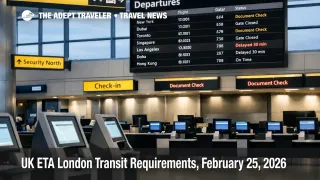
The policy becomes an airline operations issue because the check happens at the airport counter, the kiosk, or the online check in flow, not at immigration. When a traveler is missing an ETA, has an expired ETA, or presents a different passport than the one linked to the ETA, the failure mode is often a hard stop at bag drop or document check. That can strand the traveler outside the UK, and it can also destabilize connection banks into London when multiple passengers are pulled aside for manual resolution.
For many nationalities, the ETA requirement is already live as part of a phased rollout, and the UK government has set February 25, 2026, as a key enforcement milestone for additional visa free visitors who will not be able to board without the permission in place. Travelers should treat that date as a planning cliff for spring travel, school breaks, and any itinerary using London as a hub, because the most expensive problems show up when you discover the requirement at the airport.
Who Is Affected
Most travelers who can visit the UK without a visa will instead need an ETA, including many visitors from the United States, Canada, Australia, and European countries, while British and Irish citizens are exempt. Travelers who already hold permission to live, work, or study in the UK, including settled or pre settled status, generally do not need an ETA, and the same is true for travelers holding a UK visa. The decisive variable is the passport nationality you will use for travel, not the country you are departing from.
Transit passengers are the group most likely to get this wrong, because the rule turns on whether you will pass through UK border control during the connection. If your itinerary requires collecting bags, changing terminals without an airside route, changing airports across London, or overnighting, you should assume you are entering the UK in practice, which makes the ETA a prerequisite for boarding if you are eligible. If you are truly staying airside, exemptions can exist, but they are narrow, airline dependent, and subject to change.
Dual passport holders have a specific mismatch risk. If a traveler applies using Passport A, but the airline reservation, secure flight style document record, or check in flow is updated to Passport B, the airline can treat the traveler as lacking the required permission for the document presented. The same pitfall shows up after a passport renewal, because the ETA is linked to a specific passport, and a replacement passport can invalidate the prior link even though the traveler is the same person.
What Travelers Should Do
Apply as soon as your travel dates are firm, and do it through the official GOV.UK service or the UK ETA app, not third party sites that may overcharge. UK Visas and Immigration says decisions usually arrive within a day, but you should allow up to 3 working days, Monday to Friday, and you should keep the approval email and reference number accessible even though the ETA is digitally linked to your passport. Build a buffer by completing airline document checks earlier than you normally would, because the failure point is typically check in, not arrival.
Use clear decision thresholds for rerouting. If you are inside 72 hours of departure and you do not yet have an approved ETA, or you discover your ETA is linked to a different passport than the one on your ticket, rebook to a routing that does not touch the UK, or shift travel dates, unless your airline confirms in writing that it will accept travel while an ETA decision is pending. If your itinerary includes a London connection under 2 hours, separate tickets, or an airport change across London, treat a missing or mismatched ETA as a high probability misconnect trigger, not a paperwork nuisance.
Over the next 24 to 72 hours, monitor three things: GOV.UK eligibility updates for your nationality, any airline specific advisories about UK documentation checks, and airport connection guidance for your exact terminal path at London Heathrow, London Gatwick, or Manchester Airport (MAN). If your trip involves transit, verify whether your connection stays airside, because a single landside step, like bag reclaim, an overnight, or an airport change, usually converts a transit into a UK entry for documentation purposes.
How It Works
The ETA is a digital permission linked to your passport that allows eligible travelers to travel to the UK for visits of up to 6 months, short term study, certain work concessions, and in many cases, transit. The application requires the passport you will travel with, a facial photo capture, and a payment, and it is designed to be largely automated. The official fee is £16.00 (GBP), about $21.55 (USD), and the permission lasts 2 years or until the passport expires, whichever comes first.
The crucial operational detail is linkage. The ETA is not a document you present at the border the way a visa sticker used to function, it is a record that carriers and border systems can query against your passport details. That is why passport changes matter, and why dual nationals can trip over mismatches, because the system does not follow you across documents unless you apply again on the passport you will use.
Transit complexity is where confusion turns into denied boarding. The UK distinguishes between transiting without passing border control and transiting landside, and the ETA interacts with that distinction by removing the need for a transit visa for many travelers who can obtain an ETA, while still requiring permission when you actually cross the border. The UK government has also described temporary exemptions for some airside transit passengers, which is why travelers should not generalize from one airport to another, or from one airline connection product to another.
The ripple effects are predictable once the check shifts to departure. First order effects are passengers stopped at check in, longer document check queues, and delayed departures when agents must resolve exceptions. Second order effects hit connections and rebooking, because missed London onward flights can cascade into lost long haul seats, broken protected itineraries, and duty time constraints for crews. The disruption then spreads into hotels and ground transport, because denied boarding often forces last minute overnighting near the departure airport, and it can also force unplanned London hotel nights when a traveler is permitted to fly to the UK but cannot continue onward due to a documentation issue discovered mid itinerary.
For travelers building broader documentation discipline, the cleanest approach is to treat the ETA like other digital travel permissions and to centralize checks early. UK Entry Requirements For Tourists In 2026 offers a broader view of how UK entry rules stack with passports, visas, and status. For similar airline first enforcement dynamics, U.S. Passports Flagged Lost Can Block Entry Abroad shows how a document problem can surface only at the travel moment, and EES Delays At EU Airports As Biometric Checks Expand explains how new border systems can convert normal connections into high variance processing events.
Sources
- Get an electronic travel authorisation (ETA) to visit the UK, GOV.UK
- Apply for an ETA, GOV.UK
- When you do not need an ETA, GOV.UK
- Check if you can get an electronic travel authorisation (ETA), GOV.UK
- Electronic Travel Authorisation (ETA) factsheet, Home Office
- Check your electronic travel authorisation (ETA), GOV.UK
- 1 British pound sterling to US dollars, Wise