

Chicago O'Hare Ground Stop Delays Flights Jan 14, 2026
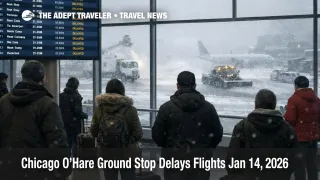
A burst of snow and wind triggered a Federal Aviation Administration ground stop for flights headed to Chicago O'Hare International Airport (ORD) on January 14, 2026. Local reporting cited a morning window from 715 a.m. to 845 a.m. CST, followed by continued delay risk as the queue unwound and winter weather stayed in the area.
Even after a ground stop lifts, the operational hangover can last for hours at a hub like Chicago O'Hare because arrivals that were held at their departure airports land in tighter clusters. That compression forces airlines to reset gate plans, deicing sequences, and connection banks, which is why a short stop can still become an all day reliability problem.
FAA real time airport status after the stop pointed to snow and ice as the driver, with general departure delays described as gate hold and taxi delays in the tens of minutes and increasing, while arrivals were reported as lighter early on.
Who Is Affected
Travelers connecting through Chicago O'Hare are the most exposed, because a disruption to the morning arrival wave can break onward connections across the Midwest and Plains where flights are less frequent. If your itinerary relies on a single daily or near daily regional flight, the cost of one missed connection is often an overnight stay rather than a later same day backup.
Passengers traveling on separate tickets, or self connecting between airlines, should assume elevated risk today. When weather driven traffic management is in play, reaccommodation priorities usually favor protected connections on a single reservation, and the remaining inventory for anyone piecing together a solution manually can vanish quickly.
Travelers departing from Chicago Midway International Airport (MDW) may see some spillover effects if airlines reposition aircraft or if the broader Chicago area weather reduces turnaround efficiency, but the core constraint in this event is the arrival flow into Chicago O'Hare and the knock on gate and crew sequencing that follows.
What Travelers Should Do
Start with immediate buffers and triage. Check your airline app for a waiver or same day confirmed change option, then look up your inbound aircraft, and your first leg's on time performance right now, before you commit to the airport commute. If your first flight is already waiting on an aircraft that is late into Chicago O'Hare, treat that as a strong signal that your connection plan is now fragile, even if your departure airport is clear.
Use a decision threshold for rebooking versus waiting. If your connection at Chicago O'Hare is under 90 minutes today, or if your onward segment is the last reasonable flight to a smaller Midwest city, moving proactively is usually smarter than gambling on a perfect recovery. A longer, earlier routing that avoids the tightest bank can beat the "fastest" itinerary that depends on the same constrained arrival stream and late day rotations.
Over the next 24 to 72 hours, monitor whether additional bursts of lake effect snow, wind, or rapid visibility drops trigger new traffic management initiatives, and whether your airline widens waiver coverage beyond the morning window. Also watch for late day cancellations tied to crew duty limits, which often appear after an airport spends hours operating below its planned arrival rate. For broader context on why hub constraints can ripple nationwide beyond the weather footprint, see U.S. Air Traffic Control Privatization: Reality Check and yesterday's national snapshot in Flight Delays and Airport Impacts: January 13, 2026.
How It Works
A ground stop is a traffic management tool that holds certain flights on the ground at their departure airports so the destination can safely manage demand when conditions reduce arrival capacity. In snow squalls, the limiting factors are often sudden visibility drops, runway braking action concerns, snow removal pacing, and deicing throughput. When any of those constraints tighten at once, arrival spacing increases, acceptance rates fall, and the system responds by metering arrivals rather than letting aircraft stack up in airborne holding.
The first order effect is simple: flights destined for Chicago O'Hare sit at origin gates longer, then arrive in bunches when the stop ends. That creates gate pressure, because arrivals need parking and deplaning capacity at the same time departures are trying to push back, deice, and depart through constrained taxi routes. FAA status during the event reflected this pattern, with snow and ice linked to increasing departure side delays even as early arrival delays were reported as relatively modest.
The second order ripple is where travelers feel the real pain. Chicago O'Hare is a connection engine, so one disrupted bank can strand crews and aircraft out of position, and that displacement spreads into later flights that were not originally in the weather footprint. As the day progresses, delays tend to migrate from "my flight is late" to "my flight is canceled because the airplane and crew never arrived," which is when rebooking lines lengthen and remaining seats tighten across regional spokes.
The third order layer is ground logistics and overnight demand. When arrivals slide into fewer time windows, baggage delivery and curbside pickup are less predictable, and hotels near the airport can fill quickly with misconnected travelers. That is why it is rational to pay for a conservative connection today, or to accept a reroute that lands earlier, even if it looks longer on paper.
Weather wise, the broader Chicago region saw conditions consistent with sudden travel degradation, including snow squall messaging from the National Weather Service office serving Chicago, Illinois.
Sources
- Chicago area hit with snow squall warning; ground stop issued at O'Hare Airport, FOX 32 Chicago
- Chicago OHare International Airport (ORD) Real-time Status, FAA
- FAA Daily Air Traffic Report, Federal Aviation Administration
- Snow squall warning issued as Chicago-area roads see near whiteout conditions, NBC Chicago
- Area Forecast Discussion, NWS Chicago (LOT)