

Love Field TSA Delays After Dallas Terminal Evacuation
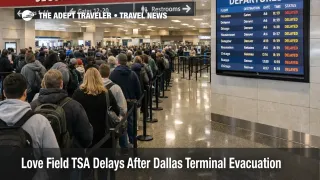
A terminal evacuation at Dallas Love Field Airport (DAL) interrupted normal passenger flow after a fire alarm sounded inside the terminal, sending travelers out of the secure area and halting screening in place. Departing passengers, arriving passengers trying to exit into the terminal, and anyone mid process at security were all exposed to compounding delay risk. The practical next step is to treat security line time as the critical variable, then re plan connections and meeting timing based on whether you can clear screening and reach your gate before boarding closes.
The traveler impact is simple, Dallas Love Field evacuation TSA rescreening delays matter because a cleared alarm does not restore the secure side instantly, it restarts the entire checkpoint flow in a surge rather than a steady stream.
Local reporting and airport statements indicate the alarm was linked to a malfunction within an HVAC unit, and Dallas Fire Rescue determined there was no fire or smoke before the airport moved to reopen screening and repopulate the terminal. Operations resumed, but the restart phase is where the long tail forms, because thousands of people are funneled back through a limited number of TSA lanes at the same time. FOX 4 reported the alarm response began around 2:10 p.m., and that the TSA screening queue reopened around 3 p.m., while also noting an FAA listed ground stop at Love Field through 4 p.m. under an "other" designation. The Dallas Morning News similarly reported that the FAA issued a ground stop, that travelers were preparing to be re screened after the alert cleared, and that Southwest expected delays as it worked back toward schedule.
Who Is Affected
Anyone departing Dallas Love Field is the primary exposure group, especially travelers who had not yet cleared TSA screening when the evacuation occurred, or who were pushed out of the sterile area and had to start over. This hits hardest when you have a tight boarding window, a checked bag cutoff, or a time bound commitment on arrival, because you can lose your buffer without the flight ever canceling.
Arriving passengers can also get trapped in the system. When a terminal evacuation clears staff as well as travelers, aircraft can be held at gates, and deplaning can slow if the terminal is not ready to receive passengers. FOX 4 included passenger accounts of being held on an aircraft during the evacuation window, which is a common operational side effect when the secure area is being reset.
Connecting itineraries are less common at Love Field than at major hub airports, but misconnects still happen, especially for travelers chaining separate tickets, or building same day plans that depend on tight timing. If you are connecting across the Dallas region, for example repositioning from Love Field to Dallas Fort Worth International Airport (DFW) for a long haul departure, this type of disruption behaves like a road closure inside the airport, and it can break your plan even if the weather is fine and aircraft are available.
What Travelers Should Do
If you are in the terminal today, assume the TSA line is the pacing item until you personally clear it. Move your decision making into the airline app first, confirm your latest boarding time, and check whether your aircraft is still at the gate or is waiting on an inbound rotation. If you have not yet checked a bag, treat published bag drop cutoffs as real, and prioritize a rebook to a later departure if you are not confident you will clear screening with time to spare.
Use a clear threshold for rebooking versus waiting that is based on boarding, not on the alarm status. If your flight boards within the next hour and you are still outside the secure area, the odds that you will miss boarding rise quickly in a re screening surge, so shift to a later flight while seats remain. If you are already re screened and inside, it can make sense to wait longer, because gate holds can unwind once crews and aircraft are in position.
Over the next 24 to 72 hours, watch for residual rotation damage. Southwest is the dominant operator at Love Field, and even when it holds some departures to protect customers, the schedule can stay uneven as aircraft and crews re sync. Monitor whether your assigned aircraft is arriving on time, whether your flight flips to a new gate, and whether later day delays begin converting into cancellations when duty limits are reached.
Background
Airport evacuations create a distinctive disruption pattern because the constraint is not runway capacity or en route spacing, it is secure side throughput. When the sterile area is cleared, TSA must restart the checkpoint, and airlines must rebuild their gate operation around a wave of passengers returning at once. That creates an uneven recovery where some flights depart close to schedule, while others slip sharply because their passengers are trapped in the screening queue.
This is also why a brief event can trigger FAA initiatives like a ground stop. If the terminal cannot process passengers, departures back up at gates, arrivals can be managed to prevent ramp gridlock, and the system is stabilized by slowing inbound flow until the airport can handle the volume. In the Love Field incident, reporting noted an FAA ground stop during the response window, and Southwest said it held outbound flights while customers were re screened, which is a classic attempt to reduce misconnect and missed flight outcomes at the expense of on time performance.
For travelers, the practical lesson is to plan evacuation type disruptions like you would plan a major security queue day. The first order effect is time lost at screening, and the second order ripple spreads into aircraft rotations, crew legality, and local hotel demand when same day plans break. A comparable restart dynamic appears in other terminal clearance events, including Brisbane Airport Terminal Evacuation Delays Flights, and it can stack with broader network delay risk flagged in daily operations coverage like Flight Delays and Airport Impacts: January 13, 2026. For deeper context on how FAA flow controls and staffing constraints can amplify small shocks into wider ripples, see U.S. Air Traffic Control Privatization: Reality Check.