

Lufthansa Extends Tehran Flight Suspension to Jan 28
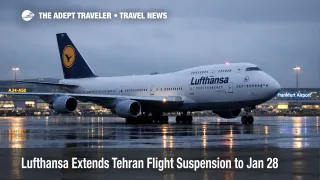
Lufthansa extended its suspension of nonstop service between Frankfurt Airport (FRA) and Tehran Imam Khomeini International Airport (IKA) through Wednesday, January 28, 2026, citing the evolving security situation. Passengers booked on the route, plus anyone connecting onward from Frankfurt to Iran, are the most affected because the cancellation removes the simplest protected itinerary in one step. The practical next move is to decide whether you can wait for a restart window, or whether you need to rebook onto an indirect routing now while seats still exist.
This Lufthansa Tehran flight suspension matters because it is not just a single flight cancellation, it is a network availability change that pushes travelers into more failure prone connection chains, with higher odds of misconnects, overnights, and baggage delivery delays.
For wider context on how quickly Iran routings can tighten when multiple carriers pull capacity at the same time, Iran Unrest Widens Flight Cuts Via Dubai, Doha, Istanbul shows the broader hub pattern that can turn a simple reroute into a sellout problem.
Who Is Affected
Travelers holding Lufthansa issued tickets on the Frankfurt to Tehran nonstop are directly impacted, especially if they booked the route to reduce connection risk, or to keep the trip on a single protected itinerary. If you are connecting into Frankfurt from another city, this change can also break your long haul positioning plan, even when your inbound flight still operates, because the missing Tehran segment forces a same day reaccommodation scramble.
Passengers on separate tickets are the highest risk group. If your Frankfurt bound ticket is on one booking, and your onward Iran travel is on another booking, a cancellation or large retime can trigger no show penalties on the other ticket, and you may also face rechecking baggage and meeting documentation requirements at the connection point. This is where "limited nonstop options" becomes an expensive detail, because once you move to indirect routings, the points of failure multiply.
Time critical travelers should treat this as a threshold moment. If you have a fixed event, a medical appointment, or a last connection of the day inside the region, waiting for a possible restart closer to January 28, 2026, is often worse than locking in a stable alternative now, even if it is longer or more expensive.
What Travelers Should Do
Start by pulling your record locator, verifying whether Lufthansa has already rebooked you, and then checking your options inside "My bookings" or via Lufthansa support channels. If the system has placed you on an alternative itinerary that works, keep it, and immediately request seat assignments and baggage confirmation so you do not discover a problem at the airport.
Use a clear decision threshold for rerouting versus postponing. If your trip cannot tolerate an overnight, or if you must arrive by a specific date and time, reroute now and accept the extra connection risk only if you can build buffer time at the hub. If your trip is discretionary, or if you can shift dates without major losses, consider taking reimbursement and rebooking later, especially if the security situation remains volatile.
Over the next 24 to 72 hours, monitor three things that predict whether your plan will hold. First, whether Lufthansa extends the suspension again, or publishes new handling guidance. Second, whether official government travel advice shifts materially, since corporate approvals and some insurers key off those updates. Third, whether your chosen hub routing remains stable, because hub banks can look fine in the morning and collapse later when aircraft and crews fall out of position.
If you are also transiting Frankfurt during winter disruption windows, treat the hub itself as a second independent risk factor. Frankfurt Airport Flight Cancellations, 102 Flights Jan 12, 2026 is a useful reminder that even a perfect reroute on paper can fail if the hub is constrained by weather or deicing throughput.
How It Works
A route suspension propagates differently than a one off delay because it removes inventory across multiple days, not just one departure bank. The first order effect is straightforward, Lufthansa passengers are canceled, and Lufthansa must either reroute or reimburse, depending on what the traveler accepts and what seats exist. The second order ripple shows up in connection systems: once travelers are forced onto Gulf or Turkish hubs, the itinerary adds segments, border and baggage decision points, and more timing dependencies, which raises misconnect risk, especially on tight connections or mixed carrier itineraries. The third order ripple lands in pricing and availability, because when a major carrier pulls a nonstop, remaining routings can surge in demand and sell out quickly, which then pushes travelers into next day departures and hotel overnights.
On the traveler rights side, cancellations generally trigger a choice between reimbursement and rerouting, plus a duty of care framework for assistance during disruption, while cash compensation can be limited when the cause is considered extraordinary, such as security risk or political instability. Practically, that means your best outcome usually comes from acting early, staying on a single ticket where possible, and choosing routings with slack that can absorb short notice retimes.
Sources
- Lufthansa cites unrest as it postpones resumption of Tehran flights, Yahoo
- Lufthansa delays Tehran flights amid Iran unrest, AeroTime
- Lufthansa will erst Ende Januar wieder in den Iran fliegen, t-online
- Iran: Reise- und Sicherheitshinweise, Auswärtiges Amt
- Iran Travel Advisory, U.S. Department of State
- Air passenger rights, Your Europe, European Union
- Passenger rights, Lufthansa
- Refunds, Lufthansa