

Miami Airport Ground Stop Delays Arrivals January 14
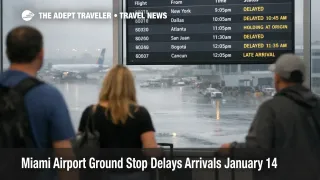
A Federal Aviation Administration traffic management program slowed inbound flying into Miami International Airport (MIA) on Wednesday, January 14, 2026, with low ceilings cited as the weather trigger. The FAA's airport status page showed departures bound for Miami being held until at or after 9:30 am Eastern Time, a typical sign of an arrival focused restriction that holds flights at their origins to prevent unsafe airborne congestion. Local reporting also described the action as a ground stop for inbound flights tied to low ceilings and poor visibility.
For travelers, the operational problem is not only the initial halt, it is the unwind. When arrivals restart, Miami's gates, ramps, and baggage systems can get hit by a compressed arrival bank, which shifts delays into later departures, and can cascade into evening rotations to the Caribbean and Latin America.
Who Is Affected
Travelers flying into Miami International Airport (MIA) are directly exposed because inbound flights can be held at their origin airports until Miami's acceptance rate recovers. If you are connecting in Miami, the most fragile structures are tight domestic to international connections, and "island hop" itineraries where the next flight only operates once daily or has limited same day seats. The risk is higher on separate tickets, because even a modest hold can erase your self transfer buffer, and airlines are not obligated to protect the onward leg.
Caribbean cruise travelers are a special risk group because Miami is a major gateway for same day cruise embarkations. A morning arrival that slides into midday, or early afternoon, can collide with ship boarding cutoffs, terminal traffic, and limited margin if you need to retrieve checked bags, and then transfer to PortMiami by road. Even if your cruise line allows later check in, you can still face long curbside queues and slower rideshare pickup when delayed arrivals bunch together.
You can also be affected without ever touching South Florida. When Miami bound flights are held at origin, aircraft and crews end up out of sequence, and the late inbound aircraft becomes the late outbound aircraft on later legs. That is how a Miami arrival restriction can create downstream delays on evening departures from other cities, especially when the same aircraft is scheduled to turn and continue to another destination.
What Travelers Should Do
If you are traveling today, treat your itinerary as time sensitive the moment you see a Miami arrival restriction. Check your airline app for a waiver or same day change option, then look up where your inbound aircraft is coming from, because a held inbound is the earliest signal that your departure will slide. If you are checking a bag, assume baggage delivery can be slower when multiple delayed flights arrive together, and plan ground transport with extra slack.
Use a firm decision threshold for rebooking versus waiting. If your Miami connection is under 90 minutes, or if you must reach PortMiami the same day, move proactively to an earlier arrival, or to an alternate gateway, while seats still exist. Waiting can work if ceilings are forecast to lift soon and your buffer is real, but once the restart queue forms, published departure times often keep moving as the airport works through arrival sequencing and gate availability.
Over the next 24 to 72 hours, monitor three signals: the FAA airport status page for Miami as it shifts from a stop to residual delays, your airline's waiver language and reaccommodation queues, and the local ceiling and visibility trend. If you see delays persisting into late afternoon, assume the evening bank is at higher cancellation risk because crews can time out and aircraft rotations have less slack. For broader context on why flow programs can ripple beyond the weather footprint, see U.S. Air Traffic Control Privatization: Reality Check. Related network patterns have also shown up in recent FAA driven daily risk coverage, including Flight Delays and Airport Impacts: January 13, 2026, and U.S. Flight Delays Risk at Major Hubs January 12.
Background
A Miami airport ground stop is an arrival flow tool, even though it is enforced at the departure airport. In practice, flights destined for Miami are held at their origin gates so the system avoids airborne holding, saturated arrival streams, and unstable spacing when ceilings and visibility reduce the safe arrival rate. The FAA's Miami status page explicitly framed the event as weather and low ceilings, and showed a hold time that kept Miami bound departures from leaving until the restriction eased. In industry terms, this is a traffic management initiative designed to match demand to the reduced acceptance rate at the destination.
The first order effect is immediate arrival delay and missed connections at the airport. The second order effect is aircraft and crew displacement, because late arrivals turn into late departures, and that lateness rolls forward across later legs, often into the evening when there is less schedule slack. A third layer is on the ground, where compressed arrival banks can slow gate availability, baggage unload, customs hall timing for international arrivals, and curbside pickups, which is why travelers can feel disruption long after the original weather improves. If the restriction lifts quickly, you may still see uneven recovery as the queue unwinds, and as airlines decide whether to protect later flights by preemptively swapping aircraft, consolidating loads, or canceling low yield segments.
Sources
- Miami International Airport (MIA) Real-time Status
- MIA Airport Status, Federal Aviation Administration
- Ground Stop Issued for Flights Coming to Miami International Airport Due to Weather
- FAA Issues Ground Stop for Incoming Flights to MIA Amid Foggy Conditions
- NWS Forecast for Miami International Airport
- NBAA Glossary of Traffic Flow Management Terms