

Iran Iraq Overflight Avoidance Extends Flight Times
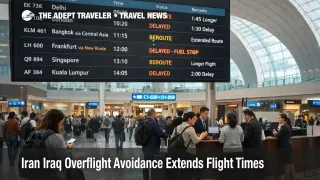
Iran/Iraq airspace avoidance is persisting even after Iran reopened its airspace following a short notice closure on January 14, 2026. Long haul travelers moving between Europe, the Gulf, and South Asia are the most exposed because many itineraries normally depend on the shortest great circle routings that cross Iran or Iraq. The practical next step is to assume longer block times for the next several days, then protect your itinerary with more connection time, earlier departures, or routings that do not depend on a single tight hub bank.
The change for travelers is straightforward, Iran Iraq airspace avoidance means more flights are detouring around the region, and those detours can stack into missed connections, crew legality issues, and last minute aircraft swaps that change your arrival time even when your departure looks normal.
Who Is Affected
The highest risk group is travelers on Europe to Gulf and Europe to South Asia journeys that connect through major hubs, especially when the first long haul leg arrives close to the minimum connection time for an onward flight. When aircraft take longer routes, the schedule cushion that usually absorbs small delays shrinks, and a connection that was safe on paper can become a misconnect in real operations.
Travelers booked on carriers that have publicly signaled continued avoidance of Iranian and Iraqi overflights should expect the most variability in block times and day to day routing. Reuters reporting based on airline statements and flight tracking described multiple European and international airlines continuing to avoid overflights of Iran and Iraq, with some services taking longer routings through Central Asia and, in some cases, requiring technical stops in places such as Cyprus or Greece. Finnair has also published traveler facing guidance noting it is not using Iranian airspace and that reroutes can extend flight times on services to and from Gulf points such as Dubai and Doha.
Anyone traveling on separate tickets is disproportionately exposed. If your first flight arrives late and you miss a separately booked onward flight, the onward carrier can treat you as a no show, and your only recovery path is buying new last minute inventory. Cruise embarkation days and fixed time tour starts are also high risk because even a modest late arrival can cause you to miss boarding windows and transfer cutoffs, pushing you into expensive same day recovery.
What Travelers Should Do
Start by checking your airline app for reroute or re timing notices, then look at your connection time using the updated scheduled arrival, not the original one. If your connection is already tight, treat this as a reliability event, not a normal delay day, and move to an earlier departure or a longer connection before airport lines and call centers build. Reuters reporting indicates some flights have required technical stops due to longer routings, which is a strong signal to add margin, even when the flight still shows as on time.
Use a decision threshold that matches your stakes. If you have a fixed arrival commitment such as a cruise embarkation, a wedding, a meeting, or a last connection of the day, do not wait for day of operations to settle, rebook to an itinerary with more buffer, or arrive a day earlier. If your trip is flexible and all sectors are on one ticket, you can often wait longer, but only if your connection time is comfortably above the airport's minimum and you have later same day backup flights.
Over the next 24 to 72 hours, monitor three things, your flight's planned routing, your inbound aircraft's progress, and any carrier waiver language that enables no fee changes. Also watch for hub level knock on delays, because reroutes can put aircraft and crews out of position, which then ripples into later departures and reduced reaccommodation inventory. If your itinerary includes Iran service changes specifically, this related update can help frame reroute and refund choices: Lufthansa Extends Tehran Flight Suspension to Jan 28.
Background
Airspace reopenings do not automatically restore normal airline routings. Carriers run their own risk models, align with government advisories, and weigh insurance and crew duty constraints, so they can keep avoiding a corridor even when it is technically open. In this case, Reuters reported that Iran reopened its airspace after a brief closure on January 14, 2026, but many airlines continued avoiding overflights of Iran and Iraq, citing safety assessments and official guidance.
For travelers, the first order effect is time. Longer routings add block time, increase fuel burn, and can reduce payload margin, which sometimes forces an additional technical stop for fuel or crew even when the flight still operates. The second order ripple is network positioning. When a long haul aircraft arrives late, it can miss its next departure slot, or it can force a tail swap that changes seat assignments and cabin products, and it can push crews toward maximum duty limits, which raises cancellation and delay risk later in the day.
The ripple spreads beyond aviation. Late arrivals compress airport and ground transport peaks, shift hotel check in patterns, and break timed transfers for cruises and tours that assume a normal arrival window. On the policy side, regulators continue to flag the region as elevated risk, including ongoing U.S. restrictions for certain operators in the Tehran and Baghdad flight information regions. EASA also maintains conflict zone guidance mechanisms for affected airspaces, which is a reminder that risk assessments can stay conservative even after short closures end.
Sources
- European airlines continue to avoid Iran and Iraq despite airspace reopening
- Iran reopens airspace after temporary closure forced flights to reroute
- Impact of the situation in Iran on our flights
- Prohibitions, Restrictions and Notices
- EASA publishes CZIB for airspace of Iran, Iraq, Israel, Jordan, and Lebanon