

Sydney ATC Staffing Shortage Cuts Flights Jan 15
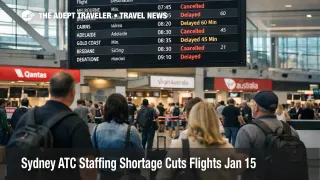
A shortage of air traffic controllers forced flow restrictions at Sydney Kingsford Smith Airport (SYD) on Thursday, January 15, 2026, leading to same day cancellations and long gate holds. Domestic and trans Tasman travelers were hit first, but the disruption quickly spread as aircraft and crews slipped out of sequence across the network. If you are flying today or connecting through Sydney, protect your seat in the airline app, build extra time into any connection, and be ready to shift to a later bank, an alternate airport, or a next day departure if recovery stalls.
The Sydney ATC staffing shortage reduced how many flights could safely arrive and depart, so delays and cancellations can persist beyond the initial squeeze while airlines rebuild rotations. Airservices Australia told airlines it needed to implement spacing intervals for arriving and departing aircraft after short notice sick and carers leave reduced staffing, which is the kind of capacity cut that turns into cancellations once the schedule falls behind. Public reporting indicated at least 25 cancellations spanning roughly 630 a.m. to 940 p.m. local time, with major domestic carriers affected, and some airlines reporting broader network delays as the day unraveled.
For travelers, the practical problem is not only the first cancellation, it is the speed at which alternatives disappear. Sydney is a high frequency hub, but once a large share of passengers are rebooked onto later flights, the remaining seats on trunk routes can sell out within hours, and that forces next day departures or longer routings via other cities. Gate holds and departure metering also consume crew duty time, which can turn a late flight into a canceled flight late in the day, even if the weather is fine and the aircraft is physically available.
Who Is Affected
Travelers on domestic routes in and out of Sydney are the most exposed, especially on high demand corridors where cancellations push everyone onto the same limited set of later departures. Reporting on January 15 indicated Qantas, Virgin Australia, and Jetstar were among the airlines cancelling flights, and the disruption was concentrated on domestic flying, which is where short haul rotations are tightest and recovery depends on rapid turnarounds.
Connecting passengers are the second group at risk, particularly anyone stacking a domestic hop into Sydney with an onward international flight. A modest delay into Sydney can become a misconnect if your onward flight is departing from a different terminal flow, has a firm bag drop cutoff, or is held back by the same metering that is delaying domestic departures. Travelers on separate tickets are the most vulnerable because the onward carrier may not protect the second segment, even when the cause is outside the airline's control.
Passengers not touching Sydney can still feel the effects. When Sydney departures are throttled, aircraft that should have repositioned to Melbourne, Brisbane, Perth, or regional spokes do not arrive on time to operate the next sector, and crews can time out while waiting at the gate. That is how a Sydney capacity problem becomes a nationwide reliability problem, with knock on delays and cancellations in other cities as carriers try to rebuild a coherent aircraft and crew sequence.
What Travelers Should Do
If you are traveling on January 15, treat the airline app and official SMS or email alerts as the decision trigger, and act before airport queues form. If you have a connection, add buffer immediately by moving to a later flight while seats still exist, and consider traveling carry on only if you have the option, since rebooking with checked bags can slow reroutes and force you into fewer viable alternatives.
Set a clear threshold for when to stop waiting and rebook. If your departure is repeatedly sliding and your inbound aircraft is late, assume the next update could be a cancellation once crew duty limits and gate availability tighten, and move early to protect a seat on a later bank. For domestic travel, a practical pivot is rerouting via another hub city when the direct trunk route is selling out, or shifting to an alternate airport within driving range if that produces a protected itinerary rather than a standby style gamble.
Over the next 24 to 72 hours, monitor whether airlines describe the issue as ATC flow restrictions and spacing, and watch for waiver language that lets you change dates without fees. Also watch the first morning departure wave on January 16, because that is when you can see whether aircraft are back in position and whether crews are available to operate the rebuilt schedule. If the first wave is delayed, plan for continued rolling disruptions, and consider moving critical events, like cruise embarkation or tours with fixed start times, to a more resilient plan with a night of buffer.
How It Works
Air traffic control staffing constraints propagate differently than a localized weather delay because the system response is deliberate rate limiting. When staffing drops below what is needed to run the usual arrival and departure streams, controllers increase spacing to preserve separation and workload margins, which reduces movements per hour and quickly creates a queue of aircraft waiting to depart, arrive, or access gates. Once that queue forms, airlines start cancelling flights to protect later departures and to avoid pushing crews beyond legal duty limits.
The first order effect is fewer departure slots and arrival acceptance, which strands aircraft at gates and causes inbound flights to hold or be metered. The second order ripple is aircraft and crew mispositioning, because most domestic operations rely on multi sector days where the aircraft's next flight is only possible if the prior flight operates close to schedule. When Sydney is constrained, the aircraft that was meant to fly onward to another city may never leave, and the crew assigned to the later leg may time out while waiting, which then forces an equipment swap, a new crew, or a cancellation.
Recovery often extends into the next day because airlines have to rebuild rotations while managing passenger reaccommodation. Even if ATC staffing improves quickly, the network may still be short of aircraft in the right places for the first morning bank, and that is when knock on delays show up outside Sydney. Airservices has previously described staffing and resilience work as a network priority, and its reporting has highlighted how short notice staffing challenges can still produce long ground delay periods even when overall recruitment is improving.
For related travel disruption mechanics, see Brisbane Airport Terminal Evacuation Delays Flights and Greece Air Traffic Control Outage Audit 2026.
Sources
- Airservices staff shortage disrupts Sydney flights
- Dozens of flights cancelled or delayed over air traffic controller shortage at Sydney Airport
- Dozens of Sydney flights axed amid controller shortage
- Sydney Airport in chaos as air traffic staff shortages hits flights
- ATFM Daily Plan
- Australian Aviation Network Overview June 2025