

Turkish Airlines BCN Diversion Security Delay Tips
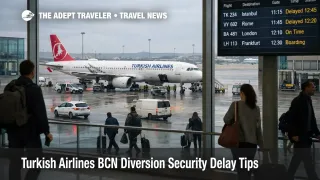
A Turkish Airlines flight from Istanbul, Türkiye, made an emergency landing at Josep Tarradellas Barcelona El Prat Airport (BCN) after a threat alert was triggered during the approach. Passengers on the flight, plus travelers booked on later Turkish Airlines departures that depend on the same aircraft, were most exposed to knock on delays. The practical next step is to treat this like a rotation risk event, confirm whether your aircraft and crew are still on schedule, and make rebooking decisions before seats tighten on the next available options.
The Turkish Airlines BCN diversion matters because security inspections can delay an aircraft long enough to break same day connections and later departures, even when the airport stays open.
Turkish Airlines said the alert was tied to a passenger created onboard Wi Fi network name, and Spanish authorities inspected the aircraft and reported no explosive was found. Airport operator Aena said the airport continued operating normally while protocols were active, and Turkish Airlines indicated the return flight would proceed as planned once cleared. Even with a fast all clear, the inspection itself can create an uneven recovery, because the aircraft is removed from the normal gate and turnaround flow, and crews can drift toward duty time limits while they wait.
Who Is Affected
Passengers on Turkish Airlines flight TK1853, and anyone booked on the next sector operated by that same aircraft, are the primary exposure group. When a plane is routed to a remote stand for screening, deplaning and baggage handling can take longer than a typical arrival, and that can compress or eliminate the buffer travelers were counting on for transfers, hotel check in, and pre booked tours.
Connecting travelers in Barcelona, Spain, are the second group at risk, especially those chaining separate tickets, or trying to make a same day rail departure, cruise embarkation, or a long drive pickup. If the inbound arrival is late, you can miss a connection even when the onward flight or train runs on time, because cutoffs for bag drop, boarding, and gate close do not move in lockstep with a delayed inbound.
The third group is travelers not in Barcelona at all, but flying later in the day on flights that depend on the same aircraft and crew. A single inspection delay can force an equipment swap, a late departure, or a cancellation if crew duty clocks run out, and those changes often show up with limited warning in airline apps once the carrier commits to a recovery plan. Tight supply makes this worse, because when load factors are high, reaccommodation is slower and more expensive, a dynamic explored in FAA Delays on Boeing 737 MAX 10 Hit Airline Capacity.
What Travelers Should Do
If you are traveling through Barcelona El Prat today, prioritize facts that change your options. Check the status of your specific flight, then look up the inbound aircraft assignment and its latest arrival time, because that is often the real driver of whether your departure will go. If you are still landside, add buffer for curbside congestion, terminal walks, and any re screening delays that can form when schedules slip and passenger waves bunch up.
Use a clear decision threshold for rebooking versus waiting. If your arrival delay is likely to push you inside your onward cutoff, for example last train of the day, cruise boarding window, or a non refundable hotel check in policy, move early while alternative seats exist, even if the airline has not yet canceled your flight. If you have flexibility and your flight is still scheduled, it can be rational to wait longer, but only after you have identified at least one viable backup routing and confirmed seat availability on it.
Over the next 24 to 72 hours, monitor the rotation cycle, not just the single flight. Watch for aircraft swaps, crew driven delays, and rolling retimes that propagate into later departures. If you see the airport experience shifting into restart mode, long lines rebuilding after a disruption, and boarding times compressing, treat it the same way you would treat an evacuation driven queue day, patterns that appear in Love Field TSA Delays After Dallas Terminal Evacuation and Brisbane Airport Terminal Evacuation Delays Flights.
Background
A threat alert on an aircraft triggers a security playbook designed to protect passengers first and restore normal operations second. In practice, that usually means isolating the aircraft away from terminal gates, moving passengers to a controlled area, and performing inspections that can include cabin checks, hold checks, and follow up interviews. Even when the airport remains open and flights continue around the event, the affected aircraft is effectively removed from the system until cleared, which is why the delay impact can outlast the news cycle.
The first order effect is straightforward, the inspected flight arrives late, and the aircraft cannot be turned for its next sector on the normal timeline. The second order ripple spreads through two layers that travelers actually feel. First, network connections, because late arrivals compress connection windows, and misconnects feed rebooking queues that quickly absorb remaining seats. Second, crew flow, because crews are bound by duty and rest rules, so a delay that looks small on a board can become a cancellation if it pushes beyond legal limits and there is no standby coverage positioned at the right airport.
For travelers, the actionable lesson is that security events behave like a capacity shock in miniature. The airport can be operating normally, and yet your itinerary can still fail on timing, because the constraint moves from runway access to aircraft availability, crew legality, and the speed at which the airline can rebook passengers onto scarce alternatives.
Sources
- Turkish Airlines flight makes emergency landing in Barcelona after 'threat' alert | AP News
- Security protocols activated after 'bomb threat' detected on Turkish Airlines' Barcelona flight
- Una broma en el móvil de un pasajero obliga a un aterrizaje de emergencia por aviso de bomba en Barcelona | EL PAÍS