

Amman Security Alert, Add Roadblock Buffers Jan 16
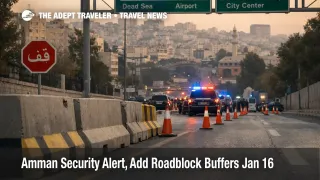
A U.S. Embassy message is prompting travelers to tighten personal security habits in Amman, Jordan, and to plan for sudden roadblocks on Friday, January 16, 2026. The alert frames the issue as regional tension and preparedness, while stating embassy operations and staffing are unchanged and consular services continue as normal. For visitors, the practical change is not "can you travel," it is whether you can move across the city, or out to major sites, on predictable timelines.
This matters most on a Friday because Jordan regularly sees demonstrations that can form, move, and dissipate quickly, sometimes producing rolling roadblocks, temporary checkpoints, and localized traffic freezes. Even when incidents stay peaceful, security cordons can pinch major circles and arterials, and detours can force long, slow loops that break tight schedules for tours, restaurant reservations, and flight departures.
The embassy messaging also ties preparedness to Jordan's civil defense siren system, including shelter guidance if alarms activate. A siren activation is not the baseline expectation, but it is part of the same "move less, confirm more" posture that can amplify congestion if people simultaneously reroute, pause, or shelter.
Who Is Affected
Travelers staying in Amman neighborhoods that funnel into central routes, including Abdoun, Rabieh, Jabal Amman, Abdali, and Downtown, are most exposed to sudden traffic constraints because the city's road network concentrates flows through a small number of circles, corridors, and interchanges. Visitors with fixed time commitments, especially guided departures, prebooked drivers, and timed entry tickets, will feel the disruption sooner than travelers with flexible days.
Anyone headed to Queen Alia International Airport (AMM) is in the highest risk category for consequences, because airport timelines have hard cutoffs for bag drop, security, and boarding. The embassy guidance explicitly urges travelers to monitor local media and to contact airlines directly if flights are affected, and it points travelers to live departure updates.
Day trips that rely on predictable highway timing can also be impacted, particularly movement toward the Dead Sea Highway and other intercity links. Canada's Jordan travel advice notes that demonstrations can disrupt traffic, and that authorities may establish checkpoints and roadblocks, with specific reference to possible temporary closures affecting the Dead Sea highway and surrounding roads. That is the same failure mode that turns a two hour plan into a half day ordeal.
What Travelers Should Do
Start by treating Friday movement as time critical. If you are going to the airport, aim to arrive earlier than you normally would, and build a buffer large enough to survive a detour, a checkpoint queue, and a slow final approach. If you have a driver, confirm a primary route and a backup route, and agree on a "turn around and reroute" rule the moment traffic stops looking like normal congestion.
Decide now what would make you rebook versus wait. If your plan depends on a tight connection, a same day onward domestic flight, or a nonrefundable tour departure, you should move earlier or switch to a more protected itinerary rather than betting on a smooth run. If you are only shifting a dinner reservation or a flexible museum visit, waiting out a localized closure may be rational, but only if you can stay put safely and you are not forced into walking through gathering areas.
For the next 24 to 72 hours, monitor three things before you leave your hotel: credible local reporting on road conditions, any embassy messaging updates, and your airline's operational notices for delays or schedule changes. If you hear civil defense sirens, follow local instructions, shelter indoors, and assume road conditions will worsen immediately after as traffic patterns reset. If you need more structural prep for entry and movement planning, keep Jordan Entry Requirements For Tourists In 2026 handy as a reference for the broader trip setup.
Background
Jordan's "alert day" risk is less about a single closed attraction and more about how fast mobility can degrade across layers of the travel system. The first order effect starts at the street level: police presence, checkpoints, and cordons can block direct routes, and spontaneous gatherings can create stop start traffic that is hard to predict from apps alone. When that happens, tour operators miss their departure windows, private drivers get trapped on the wrong side of closures, and groups arrive late enough that sites compress or cancel scheduled experiences.
The second order ripple hits the airport and hotel ecosystem. Late airport arrivals drive missed flights, which then create unplanned hotel nights in Amman, or force expensive last seat reaccommodations the next day. Aircraft operations may be normal, but passenger flow disruption can still spike no show rates, baggage reunification problems, and rebooking workload. Hotels feel it through late check ins, late check outs, and friction around room release policies when guests are stuck in traffic and cannot provide accurate arrival estimates.
A third layer is corridor travel, especially on Thursdays and Fridays when demonstrations are more common. Even without a formal closure, intermittent checkpoints can turn highway travel into a sequence of slowdowns, and that propagates into missed meal stops, delayed guided handoffs, and drivers timing out on duty. Government travel guidance consistently advises avoiding demonstrations and monitoring local media because even peaceful events can change quickly and disrupt transportation networks.
Sources
- السفارات الأميركية تحذّر رعاياها في دول بالإقليم بينها السعودية وقطر والكويت والأردن وإسرائيل | عين رم | وكالة رم للأنباء
- Jordan International Travel Information, U.S. Department of State
- Jordan Travel Advisory, U.S. Department of State
- Travel advice and advisories for Jordan, Government of Canada
- Message to U.S. Citizens: Security Alert: Personal Security and Preparedness, U.S. Embassy Amman (January 16, 2026)