

Warsaw US Embassy Protest Delays Aleje Ujazdowskie
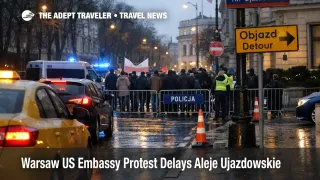
A scheduled demonstration is expected to take place outside the US Embassy in Warsaw, Poland, during the late afternoon on January 16, 2026, with police warning of traffic impacts in surrounding streets. Visitors staying nearby, crossing central Warsaw by car, or heading to time sensitive plans like airport departures and long distance trains are most exposed to delays. The practical next step is simple, avoid the Aleje Ujazdowskie corridor near the embassy during the announced window, build extra time into transfers, and be ready to switch modes if cars cannot reach your pickup point.
The Warsaw US Embassy protest changes the reliability of late afternoon surface travel near Aleje Ujazdowskie 29/31 and the adjacent Piękna frontage, because even a peaceful, time boxed gathering can trigger short notice lane closures, restricted turns, and rerouted traffic. OSAC reporting based on the embassy notice says the demonstration is scheduled from 400 p.m. to 500 p.m., with an expected turnout of roughly 80 to 100 people, and notes that traffic may be affected in the surrounding area.
For travelers, the most useful way to picture an avoid map is as a compact exclusion zone centered on the embassy address. If a trip plan depends on driving straight through that block, assume it may not work as planned. When police cordons appear, apps often keep suggesting the same blocked approach while drivers circulate for legal turns, which is why walking a few blocks to a wider avenue can be the difference between an on time departure and a cascading delay.
Who Is Affected
Travelers staying in the embassy adjacent blocks around Aleje Ujazdowskie and Piękna are the first to feel disruption, because vehicles may be diverted before they reach hotel entrances, and rideshare pickup pins may shift outside the controlled perimeter. Anyone with late afternoon museum entry times, dinner reservations, or theater start times in central Warsaw should also expect variability, because traffic slowdowns tend to propagate outward from the initial cordon as drivers seek parallel routes.
Airport bound travelers are a priority risk group, particularly anyone aiming to reach Warsaw Chopin Airport (WAW) during the late afternoon bank. The airport itself is not the issue, the issue is road access reliability across the city at a predictable pinch point. If a transfer route clips the embassy corridor, a small delay can become a larger one when the driver must loop for access, or when the pickup point is moved unexpectedly.
Rail travelers can get caught in a similar way. Long distance departures do not wait, and Warsaw's main stations can be unforgiving if a rideshare arrives at the wrong curb or is forced to drop passengers a few blocks away. This is where the second order ripple shows up, road disruption drives missed trains, missed trains drive last minute hotel nights, and rebooking costs rise quickly.
What Travelers Should Do
Immediate actions and buffers start with timing. If a trip crosses central Warsaw by car in the late afternoon of January 16, treat the 400 p.m. to 500 p.m. window as unstable, and leave earlier than you normally would, especially if you have a flight, a reserved train seat, or timed entry tickets. If you are staying near the embassy frontage, plan on walking a few blocks for pickup, and communicate with drivers that access may be restricted.
Decision thresholds are about deadlines. If you need to be at Warsaw Chopin with a firm check in cutoff, or you are trying to catch a fixed departure from a main rail station, this is a re route situation, not a wait it out situation. Switching to rail for the airport leg can remove the most fragile part of the plan, because Chopin Airport has an on site rail station and is served by city rail and public transport options that are less sensitive to one specific street cordon.
Over the next 24 to 72 hours, what to monitor is more practical than dramatic. Track credible local updates, watch for police direction on the ground, and treat navigation app ETAs as a starting point rather than a promise. If the demonstration footprint grows beyond the immediate block, expect detours to widen, and assume that car based travel will become less predictable even if the event remains peaceful.
Background
Street level demonstrations create travel disruption in a specific way. The first order effect starts at the source, a controlled frontage where police may restrict lanes, crossings, curb access, and turning movements to keep the area secure and safe. That instantly reduces road capacity in a small grid, and it often shifts taxi and rideshare behavior, because drivers either cannot enter the zone or do not want to idle inside it.
The second order ripple is where travelers feel the cost. When vehicles are pushed to parallel routes, congestion increases at the next few junctions, pickups move to less convenient curbs, and what should be a short cross town ride becomes a sequence of small delays. Those delays then propagate into the travel system, missed airport check in windows, missed trains, late hotel check ins, and rescheduled tours.
Warsaw has a built in mitigation tool for airport access, mode switching. Official public transport options connect the city and the airport by rail and bus, and those links can be more resilient when a single corridor becomes constrained. In practical terms, the best travel plan on days like this is the one that does not depend on driving through the most likely cordon area at the exact hour it is expected to be active.
Travelers who want a broader playbook for handling demonstration driven transfer risk, including how checkpoints and rolling roadblocks change pickup behavior, can also reference Amman Protests And Airport Transfers Risk Guide. For a recent example of how a protest near a US Embassy corridor can shift pickup points and airport runs in a European capital, see Madrid Protest Blocks Serrano Transfers Jan 4-5.