

Iran And Iraq Airspace Avoidance Extends Flight Times
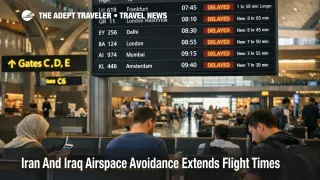
Airlines continue to route flights around Iranian and Iraqi airspace on major long haul corridors, even after Iran reopened airspace following a short restriction window tied to heightened regional security concerns. Long haul travelers between Europe, the Gulf, and South Asia are most exposed because the detours add time, compress connection buffers, and increase the chance that a small disruption turns into a misconnect. The practical move is to assume longer routings for now, then book, or rebook, with larger connection margins and clearer fallback options.
The Iran Iraq airspace avoidance trend matters because it converts what would normally be routine block times into a higher variance operation, which is where missed connections and last minute cancellations tend to cluster.
Reroutes have commonly tracked farther east through Central Asia and Afghanistan, based on flight tracking observations described in reporting, rather than the more direct overflight paths that many routings used when transiting Iran and Iraq. In parallel, regulators have reinforced the risk picture, with the European Union Aviation Safety Agency issuing a Conflict Zone Information Bulletin on January 16, 2026, recommending operators not fly in Iran's Tehran flight information region at any altitude, and to apply contingency planning for neighboring airspace.
Who Is Affected
Travelers connecting between Europe and South Asia via Gulf hubs are the core risk group because many itineraries are built around timed connection banks. When an inbound arrives after a bank is mostly gone, the outcome is often not a slightly later arrival, it is a same day misconnect that cascades into reaccommodation, baggage delays, and sometimes an overnight near the hub. That effect is especially visible on flows into major Gulf transfer points such as Hamad International Airport (DOH), Dubai International Airport (DXB), and Zayed International Airport (AUH), where long haul arrivals feed dense onward banks to South Asia and beyond.
Europe to Gulf city pairs are also sensitive because westbound legs can be close to operational margins when detours add time and fuel burn. In reporting, Wizz Air described scenarios where avoiding Iranian and Iraqi airspace can require refueling and crew change stops on some westbound flights from Dubai and Abu Dhabi, an example of how a reroute becomes a traveler visible schedule risk even when origin and destination airports are operating normally.
Travelers flying on Indian carriers can see compounded detours, because some Indian operators already face constraints that limit routing flexibility, and additional airspace avoidance can push more flying time onto already long sectors. Recent disruptions tied to Iranian airspace restrictions affected airlines including Air India and IndiGo, which matters for passengers connecting onward on tight, single day plans in Europe, the Gulf, or North America.
What Travelers Should Do
Start with immediate buffers. Check your updated scheduled arrival time for each long haul sector, then rebuild your connection plan around the new, later arrival reality, not the original timetable. If your connection is close to the airport's minimum connection time, treat it as unstable while reroutes remain in place, and move to an earlier inbound or a longer connection now, because fixes at the airport get harder once misconnects stack up.
Use clear decision thresholds for rebooking versus waiting. If you cannot miss a cruise embarkation, a wedding, a meeting with a hard start time, or the last flight of the day into a smaller destination, shift to a next day protected itinerary or add an overnight buffer at the hub. If you are flexible, and all segments are on one ticket, waiting can be reasonable, but only if you have later same day backup flights and enough connection margin that a moderate arrival slip does not eliminate all onward options.
Monitor the next 24 to 72 hours for signals that the detour is becoming a steady state. Watch for airline waiver language that covers your dates and city pairs, repeated schedule retimes that widen block times, and technical stop patterns that can protect safety and legality but still break your onward connection bank. If you want a primer on the initial disruption that pushed many routings into detour mode, see Iran Airspace Closure Reroutes Europe Gulf Flights, and if you are also routing through India in late January, factor in Delhi Republic Day Airspace Blocks Hit Flights Jan 21-26 because planned capacity squeezes can stack on top of reroute driven variability.
How It Works
When airlines avoid an airspace corridor, the first order effect is longer great circle distance, which increases planned block time and fuel burn, and often reduces schedule recovery room. Dispatchers may choose routings that preserve safety and operational legality rather than shortest time, and that can mean shifting a flight onto less direct tracks or building in alternates and additional contingency fuel. EASA's January 16, 2026 bulletin highlights why this can persist even after a brief reopening, because elevated alert postures and the risk of misidentification create a high consequence hazard that operators tend to manage conservatively.
The second order ripple shows up in network timing. Longer block times can push arrivals past connection banks, then missed connections create concentrated rebooking demand on later departures, which inflates loads and reduces the odds of same day reaccommodation. Late inbound aircraft also disrupt rotations, a delay into one hub can become a cancellation out of another hub hours later, and crew duty limits can force airlines into a choice between adding a technical stop, swapping aircraft, or canceling a flight that can no longer be operated inside planned constraints.
For travelers, the most important practical implication is that a reroute driven delay is less predictable than a localized airport delay, because it can vary by carrier, by day, and by which flight plan is filed. That is why a safe plan is less about chasing the shortest scheduled connection, and more about building protected itineraries with slack, choosing hubs with multiple later same day options, and keeping an eye on repeated retimes that signal the airline has accepted a longer baseline.
Sources
- Iran and neighbouring airspace (CZIB 2026-02)
- European regulator warns airlines not to fly in Iranian airspace
- European airlines continue to avoid Iran and Iraq despite airspace reopening
- Iran reopens airspace after temporary closure forced flights to reroute
- Detours at 35,000 ft: Indian airlines hit as Iran airspace closure adds to Pakistan ban woes
- Impact of the situation in Iran on our flights
- Iran - Safe Airspace