

Iran Airspace Closure Reroutes Europe Gulf Flights
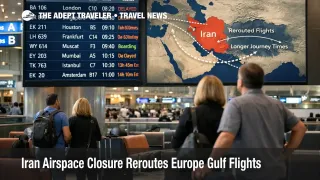
A short notice restriction in Iranian airspace triggered diversions and reroutes across long haul corridors that normally cross the Tehran flight information region. Travelers moving between Europe, the Gulf, and South Asia were most exposed because many itineraries depend on short great circle routings, and tight hub connection banks that leave little margin when block times expand. The practical next step is to assume longer routings for several days, then protect onward plans with bigger connection buffers, earlier departures, or next day itineraries when the cost of arriving late is high.
Iran airspace closure reroutes are translating into longer flights, later arrivals, and occasional cancellations even when departure airports remain open and weather is calm.
During the restriction window, flight tracking showed aircraft diverting around Iran, and airlines began issuing updated operating plans that avoid Iranian and, in many cases, Iraqi airspace even after the corridor reopened. The effect is not uniform across carriers, some operators already avoided Iran, while others had to rebuild routings quickly, which is why travelers can see a normal outbound departure paired with a significantly later arrival and a tighter, riskier connection.
Who Is Affected
The highest risk group is travelers whose trips chain a long haul sector into a same day onward connection at a hub that runs in timed "banks," especially Hamad International Airport (DOH), Dubai International Airport (DXB), and Zayed International Airport (AUH). When an inbound arrives after the bank is mostly gone, the disruption is not a 20 minute delay, it becomes a misconnect that forces reaccommodation into later inventory, and sometimes an overnight.
Europe to Gulf city pairs are heavily exposed because many routings that used to cross Iran or Iraq now swing south and east, adding time and increasing fuel burn. In Reuters reporting, Wizz Air described needing refueling and crew change stops for some westbound flights from DXB and AUH when avoiding Iranian and Iraqi airspace, which is a strong traveler signal that the schedule is operating near its margins. British Airways also canceled its Bahrain services through January 16, 2026, a reminder that when the network math fails, airlines will remove flying rather than operate unstable rotations.
Gulf to South Asia travelers can get hit twice. First, the long haul inbound from Europe arrives late to the Gulf hub. Second, the onward leg to India, Pakistan, Sri Lanka, or Bangladesh may have limited same day frequency, so a single misconnect can turn into a next day arrival even though both airports are operating normally.
Travelers on separate tickets are disproportionately at risk. A reroute driven delay that is "minor" operationally can still cause a no show on an unprotected onward booking, and baggage can lag when connections rebook through different hubs or when flights arrive after the primary sort and transfer window.
What Travelers Should Do
Start with your connection math, not your departure time. Check your updated scheduled arrival, then compare it to your onward departure and the airport's minimum connection time, and treat anything close to minimum as unstable while routings are shifting. If your itinerary is built on a tight bank, moving to an earlier inbound or a longer connection now is usually easier than trying to fix it from a gate line once misconnects pile up.
Use decision thresholds based on what you cannot miss. If you have a cruise embarkation, a wedding, a medical appointment, or the last flight of the day into a smaller destination, choose a next day protected itinerary or an earlier departure that creates slack, even if it costs time. If your trip is flexible and all sectors are on one ticket, you can often wait, but only if you have later same day backup options and your connection buffer is comfortably above minimum.
Over the next 24 to 72 hours, monitor three signals that predict whether your plan will hold. First, watch for waiver language, look for phrases like "one time change," "no change fee," "rebook without penalty," and the covered travel dates and city pairs. Second, track your aircraft rotation, if your inbound aircraft is arriving late from a prior leg, you are already behind before the airspace issue is applied. Third, watch for technical stop patterns on your route, because a fuel stop can protect safety and legality but still break your onward connection bank.
For broader context on the longer term pattern behind this event, Iran Iraq Overflight Avoidance Extends Flight Times explains why many carriers keep avoiding the corridor even after a reopening. If you are specifically routing to Iran and seeing capacity tighten, Lufthansa Extends Tehran Flight Suspension to Jan 28 is a useful reference point for when a reroute problem becomes a schedule removal problem.
How It Works
An airspace closure or restriction is published through official channels, often as a Notice to Air Missions, NOTAM, and implemented by air traffic control across a flight information region, FIR. In this case, notices posted via the U.S. Federal Aviation Administration described time windows where most flights were prohibited from transiting Iranian airspace, with limited exceptions for flights to and from Iran operating with permission. Even when a restriction is short, it can trigger an overnight cascade because long haul networks are tightly timed.
The first order effects are airborne reroutes, diversions, and longer block times. Longer routings increase fuel burn, can reduce payload margins, and can force dispatchers to choose alternates that preserve safety and legality rather than schedule purity. When that pushes the operation near crew duty limits, airlines may add a technical stop for fuel and, in some cases, a crew change, or they may cancel a flight that cannot be operated legally inside planned resources.
The second order ripple shows up hours later, often in a different place than the initial closure. An aircraft that arrives late into London Heathrow Airport (LHR) or Frankfurt Airport (FRA) may miss its next departure slot, and the airline may swap tails, which can change seat assignments, cabin product, and baggage loading. Crews that time out do not just delay one flight, they remove capacity from later waves, which reduces same day reaccommodation options and pushes more disrupted passengers into hotel inventory near hubs.
Those ripples also spread into traveler behavior and ground systems. More travelers self reroute through alternative hubs, which can inflate loads on already constrained flights. Missed connections raise baggage mismatch rates and increase the chance that checked bags arrive a day later, especially when rebookings change the path through intermediate sort points. Hotels near hubs see short notice demand spikes, and onward rail, car, and tour transfers become harder to re time because the arrival uncertainty is higher than during a typical weather delay day.
Sources
- European airlines continue to avoid Iran and Iraq despite airspace reopening
- Iran reopens airspace after temporary closure forced flights to reroute
- Iran shuts airspace for most flights, Flightradar24 says
- Prohibitions, Restrictions and Notices
- Iran closes airspace to most flights amid threat of US attack, monitors
- Summary - Safe Airspace
- Impact of the situation in Iran on our flights