

LaGuardia Snow Delay Program Risk January 18, 2026
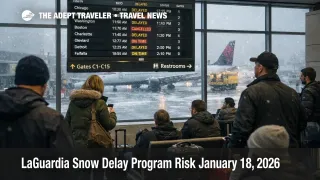
Air traffic managers are flagging a Northeast snow event that can trigger traffic management initiatives across the New York area on Sunday, January 18, 2026, with LaGuardia Airport (LGA) specifically listed for probable ground stop or delay programs into the afternoon. Travelers connecting through the New York, New York, region, or flying short haul in the Northeast corridor, are the most exposed to missed connections and last minute gate changes as arrival rates tighten. The practical move is to protect connection time now, favor earlier routings where possible, and watch for initiatives to shift from "possible" to active as conditions evolve.
The LaGuardia snow delay program is a system level trigger that often shows up first as a delayed departure from your origin airport, even when your local weather looks fine, because the FAA prefers holding aircraft on the ground instead of building airborne holding in constrained terminal airspace.
Who Is Affected
The highest risk is for travelers scheduled to fly into, out of, or through LaGuardia on January 18, 2026, especially during the late morning through afternoon period when snow operations, arrival metering, and runway configuration changes tend to stack together. The FAA planning advisory also notes a scheduled closure of Runway 04 22 from 1030 a.m. to 1050 a.m. ET, which is short, but poorly timed closures can still compress arrival queues when the airport is already working through winter procedures.
Newark Liberty International Airport (EWR) and Philadelphia International Airport (PHL) are next in line for spillover risk. Both are listed in the FAA plan for possible programs after 1200 p.m. ET, a window that matters because it overlaps with the build of afternoon banks, and because disruption in the New York terminal area often forces broader spacing, reroutes, and miles in trail that reduce throughput at nearby hubs. Boston Logan International Airport (BOS) is listed for possible programs after 200 p.m. ET, which can turn into late day misconnects for travelers relying on tight domestic to international connections, or last flights to smaller New England cities.
Even if your ticket does not touch New York, the advisory's Lake Erie routing constraints are a classic propagation mechanism into the Midwest and the East Coast. When flows are restricted across that corridor, aircraft may take longer routings, accept departure holds to meet metering times, or arrive late into Midwest hubs, which then ripples into East Coast departures as the same aircraft and crews are scheduled onward. Those second order effects tend to worsen later in the day, when gates fill, turns take longer, and crew duty time buffers shrink.
On the weather side, National Weather Service products for the New York region indicate wintry precipitation in the metro area, with advisories posted for parts of the broader forecast area, which is consistent with the FAA's expectation of reduced terminal capacity and a higher chance of initiatives being issued as conditions shift through the day.
For related context on how FAA initiatives can cascade through hub banks and create origin delays far from the weather, see Flight Delays and Airport Impacts: January 16, 2026. For deeper structural context on why New York area constraints so often ripple nationwide, see U.S. Air Traffic Control Privatization: Reality Check.
What Travelers Should Do
Start with buffers that actually change outcomes. If you are connecting through the New York area, aim for longer connections, earlier departures, and single ticket itineraries that keep rebooking options open when a program is issued. If you must travel today, prioritize flights that arrive before the afternoon peak, and consider alternate hubs that reduce dependence on the New York terminal area when your itinerary can tolerate the change.
Use a clear threshold for rebooking versus waiting. If your connection is under about 90 minutes at a Northeast hub, if your onward flight is the last reasonable departure to a smaller market, or if you are on separate tickets, proactive changes usually beat hoping the system recovers quickly once snow operations begin stacking. If LaGuardia shifts from "probable" planning language to active initiatives and extended programs, that is typically the moment when moving to an earlier routing, or rerouting away from the New York area, outperforms waiting for the same bank to clear.
Over the next 24 to 72 hours, monitor three signals. First, watch for new FAA traffic management initiatives as they are issued, expanded, or extended, because those updates are the best near real time indicator of how much capacity has been lost. Second, track whether Lake Erie constraints persist into the next push, because that can quietly turn moderate delays into late aircraft and crew mispositioning that drives evening cancellations. Third, watch the overnight recovery into Monday, January 19, 2026, because MLK weekend demand can reduce reaccommodation options if airlines need to protect aircraft rotations and crew legality.
Background
The FAA's Air Traffic Control System Command Center uses traffic management initiatives to match demand to reduced capacity when weather, runway availability, staffing, or route constraints limit how many arrivals an airport can accept per hour. The traveler facing effect is that flights may be held at their departure airports, assigned longer routings, or sequenced to later arrival slots, which is why you can see a departure delay from a clear sky origin when the constraint is actually downstream at a Northeast hub.
Winter disruption propagates in layers. First order effects happen at the constrained airports, where snow and mixed precipitation slow runway treatment, increase deicing demand, and reduce arrival rates. Second order effects then spread across connections and crew flow, late inbound aircraft miss their next departure slot, gates fill, turns lengthen, and crews run out of duty time margin, which increases cancellation risk later in the day. A third layer often appears as reroutes and flow constraints like the Lake Erie initiatives, which lengthen block times and reduce system wide flexibility, pushing delays into Midwest arrivals and the next East Coast departure wave.