

SFO Runway 1R Closure Cuts Summer Capacity 2026
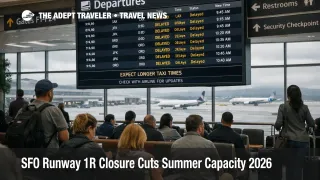
San Francisco International Airport (SFO) will close Runway 1R from March 30, 2026, to October 2, 2026, for repaving, lighting, striping, and adjacent taxiway improvements. Travelers using SFO in spring, summer, and early fall should expect a long period with fewer runway options, which raises the chance that routine weather and peak demand will translate into tangible delays. Plan now by choosing flights outside the most saturated banks, adding connection slack that matches your risk tolerance, and building ground transfer buffers for airport access and onward plans.
The core travel impact is simple, the SFO Runway 1R closure concentrates both arrivals and departures onto the 28 runway pair, which reduces operational flexibility during the busiest part of the 2026 travel calendar.
SFO says it expects fewer than 10 percent of flights to be delayed due to the closure, with average delays under 30 minutes, and the highest likelihood of delay in peak periods around 900 a.m. and 800 to 9:00 p.m. That estimate can be true in an average sense while still producing traveler visible pain on the specific days you care about, especially when marine layer ceilings, wind, gate congestion, or late inbound aircraft compress the recovery window.
Who Is Affected
Anyone departing from, arriving into, or connecting through San Francisco International is in the exposure group for the full March 30 to October 2, 2026 window. The most sensitive itineraries are international arrivals connecting onward domestically, short domestic connections feeding long haul departures, and any trip anchored to a hard deadline like a cruise embarkation, a wedding, a meeting start time, or a same night event.
The closure also matters for travelers who do not touch SFO directly but rely on aircraft and crews that do. When a busy hub runs with less slack, minor delays can roll forward into later flights, which can strand aircraft away from their next city, burn crew duty time, and turn what looks like a small schedule slip into a late day cancellation risk. That network effect is especially relevant for long haul rotations, where a delayed inbound can collide with curfews, gate constraints, and crew legality limits with fewer spare options to recover quickly.
Regional alternates become part of the decision set, too. When SFO delay probability rises, some travelers shift time critical trips to Oakland International Airport (OAK) or Norman Y. Mineta San Jose International Airport (SJC), which can tighten pricing, reduce seat availability, and move congestion onto different road and rail transfer corridors.
If you want the broader mechanics of how arrival rate cuts cascade into systemwide delays, the pattern is similar to the flow described in Flight Delays and Airport Impacts: January 16, 2026.
What Travelers Should Do
Take immediate actions that reduce the chance a modest delay breaks your itinerary. For summer 2026 bookings that touch SFO, bias toward earlier departures, avoid the last flight of the day when you have no recovery options, and give yourself connection time that can absorb a longer taxi out plus a small arrival delay without forcing a sprint. If your trip has a hard start time, treat SFO as a higher variance node during this window, and add ground transfer buffer before hotels, events, and cruise piers.
Use clear decision thresholds for rebooking versus waiting. If your connection is short, if you are on separate tickets, or if your onward flight is the last practical departure to a smaller city, proactive changes usually beat hoping for perfect on time execution during a peak bank. If your itinerary is flexible, you can often wait and monitor, but you should still prefer mid day departures that sit outside the busiest runway demand clusters SFO flagged.
Monitor the right signals in the 24 to 72 hours before you fly. Watch your airline for schedule padding and retimes as carriers adapt block times to the new airfield setup, and watch for FAA traffic management programs that indicate arrival metering into the Bay Area. Also track forecast triggers that matter at SFO, especially low ceilings and reduced visibility from marine layer conditions, because those scenarios tend to force larger spacing and lower arrival rates, and the runway closure removes one of the levers the airport normally has to manage peaks.
For continuity on what has already been announced about the project window and expected peak risk periods, see SFO Runway 1R Closure May Cause Summer 2026 Delays.
How It Works
SFO runway use is fundamentally a wind and visibility problem. The airport describes its most common operating mode as the West Plan, where prevailing winds mean arrivals typically use Runways 28L and 28R, while departures often use the north facing 01 runways. That split matters because it spreads demand across more surfaces, reduces contention between arrivals and departures, and gives air traffic control more ways to keep queues from locking up at peak.
The March 30 to October 2, 2026 closure removes Runway 1R, and SFO says Runway 1L will not be used for takeoffs or landings during the project, instead serving as an additional taxiway. Operationally, that pushes the airport into a configuration where the 28 pair handles both arrival and departure demand. On clear, windy days, that can work well because the 28 pair is already a preferred and frequently used configuration, and the longest runways are the most capable for heavy jets.
The traveler risk rises when common Bay Area constraints stack. Low visibility and low ceilings can force dependent approaches and larger arrival spacing, which reduces how many aircraft can land per hour. When arrival acceptance drops, the system responds by holding departures at origin airports, slowing pushes off gates, and stretching taxi out times as departure queues reorganize around fewer runway options. That is the first order impact at the airport itself. The second order ripple hits connections and crew flow, late inbound flights arrive out of position, gates fill, turns lengthen, and crews lose duty time margin, which increases the odds of missed connections and late day cancellations even when the initial delay looks modest. A third ripple shows up in traveler behavior, when enough people perceive SFO as higher variance, demand can spill toward Oakland International and San Jose International for time sensitive trips, shifting both prices and ground transport pressure across the region.
This is also why runway work intersects with wider system resilience debates. Even when an airport project is well planned, the national air traffic control network and its ability to meter demand cleanly shapes how painful constraints feel at the traveler level, a theme explored in U.S. Air Traffic Control Privatization: Reality Check.
Sources
- SFO Announces Six-Month Closure of Runway 1R in 2026 for Repaving
- SFO Flight Patterns and Operations
- San Francisco International (SFO) Airport Capacity Profile (2019)
- Appendix B Ultimate Airport Capacity and Delay Simulation
- San Francisco International to close Runway 1R for six months in 2026 for repaving works