

Amsterdam Schiphol Connections Need Bigger Buffers
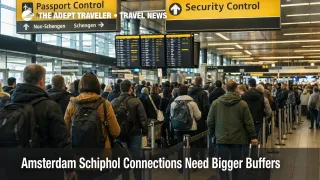
Amsterdam Airport Schiphol is still operating with limited capacity, and that reality is showing up most clearly in connection reliability during the busiest banks. Travelers transiting the hub are seeing tighter margins when inbound flights arrive late, and when security and border control queues run longer than scheduled. The practical adjustment is to treat minimum legal connections as a baseline, not a plan, then choose safer transfer windows, build buffers, and lean on airline self service rebooking when the hub gets saturated.
Amsterdam Schiphol connection times matter more right now because the airport is managing demand against caps and peak constraints that do not disappear when the weather is fine. The Dutch government has said Schiphol is moving toward a lower annual movements ceiling from 2025, which reinforces that the system has less slack for recovery once a peak wave starts running behind.
Who Is Affected
Connecting passengers are the first group exposed because Amsterdam's hub design relies on large, timed "banks" of arrivals feeding a tight window of departures. When a bank runs late, the problem is not just one delayed flight, it is hundreds of passengers hitting the same corridors, security checkpoints, and passport control desks at once. Schiphol has explicitly flagged that morning peak concentration can stress the "entire airport process," which is why peak handling limits have been adjusted in recent planning discussions.
Non Schengen itineraries carry extra fragility because they often require additional screening steps. KLM notes minimum transfer times at Schiphol that can be as low as 40 minutes for Schengen connections and 50 minutes for non Schengen connections, but those figures assume normal flow and do not protect you from a single chokepoint queue or a late arriving inbound aircraft.
Long haul travelers are disproportionately affected because there are fewer later departures to "save" a missed connection. If you miss a once daily flight, the hub can look operationally fine while your itinerary still slips into an overnight. That overnight spill then drives second order pressure on hotels near the terminals and on ground transport availability, especially when many passengers roll at the same time after a late afternoon disruption.
Finally, anyone traveling on separate tickets, including air to rail combinations, is at higher financial risk. A capacity driven misconnect can be operationally common but commercially unforgiving if your onward segment treats you as a no show.
What Travelers Should Do
Take immediate steps to increase your connection buffer, and reduce points of failure. If you are booking now, aim for connections that are meaningfully longer than the minimum, especially when you must clear passport control, re clear security, or collect and re check bags. If you are already ticketed on a short connection, prioritize seat selection closer to the front on the inbound, minimize carry on friction, and plan a fast, direct path through the terminal once you land.
Use decision thresholds that tell you when to rebook versus when to wait. If your inbound is delayed and your usable connection margin drops below what you would need to absorb one long queue, treat the onward flight as a probable miss and start shopping alternatives before boarding doors close. If your onward is once daily, or your trip includes a cruise embarkation, a non refundable tour start, or a same day meeting, your threshold for proactive rerouting should be higher, because waiting for "recovery" often means competing with everyone else after seats are already gone.
Over the next 24 to 72 hours, monitor the signals that predict whether the hub is staying stable. Watch your inbound aircraft rotation, not just your flight number, because late inbound turns are what break banks. Track Schiphol's security guidance, including the airport's free security time slot system for departing passengers, which can reduce queue risk at the checkpoint when it is available for your terminal and timing.
For nearby context on how fast AMS disruption can cascade across days, see KLM Cancellations Amsterdam Schiphol Flights January 5 and Netherlands Rail Shutdown Breaks Schiphol Airport Links.
How It Works
Capacity constraints at a hub propagate through the system in layers. The first order effect is throughput: if the airport can only process so many passengers per hour through security and border control, then a bank that arrives slightly late can still overwhelm the fixed staffing and lane capacity, even if runway conditions are good. Schiphol and Dutch authorities have framed the broader cap discussion around reducing annual movements, which, in practice, means the airport and airlines have less flexibility to add recovery flying or to re time peaks without tradeoffs.
The second order ripple is network rotation. When departures leave late, aircraft and crews do not arrive on time for their next legs, which pushes delays into later banks and can trigger cancellations that look disconnected from the original queue. That ripple extends beyond Amsterdam because partner hubs must absorb reroutes, and because rebooking demand concentrates into the same alternative corridors. Brussels and Paris often become pressure valves for rebooking when Amsterdam inventory is thin, but those hubs have their own capacity constraints, so "just reroute" can translate into longer days and more tight connections elsewhere.
The third order ripple is on the ground. Once passengers roll overnight, airport area hotels tighten quickly, and the ground transport market becomes a constraint, not a convenience. That matters most for travelers on separate tickets or for those whose next day plan depends on a fixed departure such as an early long haul flight or an international rail check in window.
Sources
- Government commits to fewer flights at Schiphol
- Room for 483,000 flights in 2024
- Transfer to a connecting flight with KLM
- Schiphol, Timeslots
- Choose your own time slot for security
- KLM, Timeslot for security at Schiphol
- Capacity declaration AMS S26
- Netherlands Rail Shutdown Breaks Schiphol Airport Links
- KLM Cancellations Amsterdam Schiphol Flights January 5