

FAA Mexico, Central America Flight Caution Through March
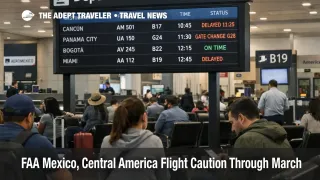
The FAA has issued 60 day advisory Notices to Airmen covering overwater portions of airspace associated with Mexico, Central America, Panama, Colombia, Ecuador, and parts of the eastern Pacific. The practical effect for travelers is occasional reroutes, longer flight times, and more knock on delay risk on U.S. routes to Mexico, Central America, and the wider Caribbean that rely on those corridors. If your itinerary involves a tight connection, a last flight of the day, or separate tickets, build extra buffer now and favor routings with more backup options.
The FAA Mexico Central America caution means airlines may keep conservative dispatch plans in place through March 17, 2026, especially on days when military activity and intermittent GNSS interference increase the odds of flow constraints and longer routings.
Who Is Affected
Travelers are most likely to notice impacts on flights that use the eastern Pacific and adjacent overwater corridors, including many routings that link U.S. gateways to Mexico's Pacific side, onward connections into Central America, and longer southbound legs that continue toward Panama, Colombia, and Ecuador. Even if your flight is bound for the Caribbean on a map that looks straightforward, airline routings and alternates can still be influenced when dispatchers plan for navigation resilience and possible traffic management constraints.
The risk profile is higher for itineraries that depend on short connection banks at busy hubs. When block times creep later, the first order effect is missed connections. The second order ripple is that reaccommodation gets harder, because the same aircraft and crews often operate multiple legs, and a late inbound can break the schedule for the rest of the day. That is how a caution notice aimed at overwater operations can still show up as a gate change, a delayed departure, or a forced overnight in a gateway city that never appears in the advisory text.
What Travelers Should Do
If you are flying in the next 7 days, open your itinerary and identify the tightest point, usually the connection, the last leg of the day, or any separate ticket handoff. Add time buffer where you can by shifting to earlier flights, choosing longer connections, or booking a single ticket so the airline has responsibility to rebook you if irregular operations hit.
If you are deciding whether to wait or to rebook, use a simple threshold. If your connection is under 2 hours on an international to international path, or under 90 minutes when you must clear immigration, collect bags, or change terminals, you are betting against small delays that can compound. Rebook to a longer connection or a different day. If your connection is already 3 hours or more, and you are on one ticket, it is usually reasonable to monitor and keep the itinerary, because the airline has more room to protect you even if block times stretch.
Over the next 24 to 72 hours, watch for signs that affect your specific flight rather than the region headline. Track your inbound aircraft, because a late inbound is a strong predictor of a late outbound. Watch for schedule change emails and updated estimated times in the airline app, and keep an eye on airport level advisories if you are connecting through busy U.S. departure banks. If reliability is critical, plan a deliberate overnight at your connection point, because crew duty time failures tend to convert small delays into cancellations that cannot be fixed the same day.
How It Works
The FAA advisories point to two operational hazards that matter for airline planning, military activity, and intermittent GNSS interference. GNSS is the satellite navigation ecosystem that includes GPS. When interference occurs, aircraft can lose satellite based position performance, see degraded accuracy, or receive unreliable signals, which pushes crews and dispatchers to lean harder on backups such as inertial reference systems, radio navigation, procedural routing, and more conservative approach and spacing assumptions.
Those conservative assumptions propagate through the travel system in predictable ways. First, dispatchers may choose routings and alternates that reduce exposure, which adds distance and time. Second, air traffic flow can tighten when aircraft need more spacing, when navigation performance is uncertain, or when military operations require coordination. Third, longer block times and occasional holding push arrivals later, which collides with gate availability and connection banks at hubs.
The less obvious ripple is crew and aircraft rotation math. A 20 to 40 minute delay that looks manageable on a single leg can become a duty time problem by the third or fourth segment of a day, forcing unplanned overnights for crews and stranding aircraft out of position. When that happens, the passenger facing impact is not only a late arrival, it is fewer same day rebook options because the schedule has less slack, and airlines may proactively trim frequencies on vulnerable days to protect reliability.
Sources
- FAA Background Information Regarding U.S. Civil Aviation Operations in Specified Areas of the Mexico (MMFR), Central American (MHTG), Panama (MPZL), Bogata (SKED), Guayaquil (SEFG), Mazatlán Oceanic (MMFO), and XX01 Flight Information Regions (FIRs)
- FAA issues warnings to airlines on Central, South American flights over potential military actions
- FAA urges pilots to exercise caution over eastern Pacific, citing 'military activities'
- FAA GPS Anomaly Reporting