

Adamuz, Spain Train Crash, Why Price Caps Did Not Trigger
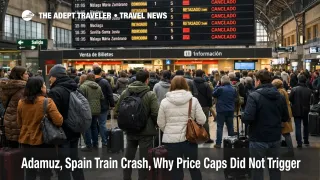
A deadly high speed rail collision near Adamuz, Spain, cut the main rail link between Madrid, Spain, and Andalusia, Spain, and forced a rapid shift to alternative transport on January 18, 2026. Travelers holding Renfe and other operator tickets suddenly competed for a limited pool of coaches, flights, and one way car hire, and multiple passengers reported sharp price increases when they tried to book substitutes at short notice. If you were stranded or canceled, the practical next step is to document your disruption, choose reimbursable alternatives first, and file a structured claim for refunds, rerouting, and reasonable substitute costs.
The Adamuz train crash price caps debate matters because Spain tightened consumer protections after the 2024 DANA floods, but those protections only switch on when authorities formally declare a civil protection emergency, and that declaration was not issued for this rail disaster.
Who Is Affected
Rail passengers traveling between Madrid and Andalusia are the most exposed group, especially those on time bound itineraries that were built around AVE and long distance slots, or around overnight trains that anchor hotel and tour check in. When a mainline corridor collapses, the first order effect is simple capacity loss, there are fewer seats available in the same time window, and the remaining seats become scarce fast.
Travelers trying to substitute by air faced a second layer of risk because short haul flight inventory can be thin outside peak banks, and airline pricing systems usually react immediately to sudden demand. Several affected travelers reported that the cheapest fares vanished during checkout and repriced higher on the next search, which is consistent with inventory moving quickly rather than a single fixed fare being held for a long time. Car hire also became a choke point because one way rentals from Madrid to Andalusian cities are constrained by fleet positioning, return logistics, and the limited supply of cars at the exact counters where stranded travelers show up.
Travelers with separate ticket connections are also at elevated risk. A rail cancellation that forces a same day scramble can turn a protected itinerary into an unprotected chain, and that is where missed flights, lost lodging nights, and expensive rebooking outcomes appear. For broader context on how stacked rail disruption can persist after a major incident, see Spain Rail Strike Risk After Adamuz, Barcelona Crashes.
What Travelers Should Do
Start with the claims that are most likely to succeed. Under EU rail passenger rights, you generally have the right to a refund or rerouting, and if the operator does not offer a timely solution, you can buy an appropriate alternative public transport option and seek reimbursement for the reasonable cost. That is the cleanest path for travelers because it aligns with how rail rights are written and enforced.
Use a decision threshold that separates waiting from rerouting. If you are inside two to three hours of a hard deadline such as a cruise departure, a medical appointment, a wedding, or a nonrefundable timed entry, stop waiting for perfect information and move to a viable substitute that you can document. If your plans are flexible and you can tolerate arriving the next day, it can be rational to hold for the operator's rerouting plan, because self booking can push you into higher priced options that may not be reimbursable.
Over the next 24 to 72 hours, monitor three items and act quickly when one changes. Watch the rail operator's service restoration notices for any partial reopening that restores a limited timetable, watch coach inventory because it often becomes the most reimbursable substitute when rail is down, and watch airline capacity actions such as extra flights and price caps, which can signal when the air market is stabilizing. If you are also moving by road due to the rail outage, note that rolling road disruption can compound transfer timing in some regions, and Spain Protest Roadblocks Disrupt City Access is a useful reminder to build buffer and check official traffic tools before committing to tight handoffs.
How It Works
Spain's post disaster consumer change that targets automated price surging is narrower than many travelers assume. The reform approved after the 2024 DANA floods focuses on preventing companies from using automated, demand based personalization to raise prices when consumers are in an urgent, unavoidable need state tied to an officially recognized civil protection emergency. In practice, that means the legal trigger is not simply that a catastrophe happened or that the news cycle is intense, the trigger is the formal declaration of a civil protection emergency by the competent authority. When that declaration is not made, the specific automated price curb is not activated, even if the situation feels like an emergency to travelers on the ground.
That is why protective measures did not automatically kick in after Adamuz. Travelers can still be protected by other rules, including rail passenger rights for refunds, rerouting, assistance, and accommodation, but the dynamic pricing clamp that many people think of as a price gouging ban is tied to the emergency declaration step. Consumer groups have argued that this leaves a gap for fast moving transport disruptions that strand large numbers of people but are handled as transport incidents rather than civil protection emergencies.
The travel system ripple is predictable. At the source, suspending rail removes the highest capacity mode on the corridor, and that immediately shifts demand into modes with less elastic supply, flights, coaches, and one way cars. In the second order wave, those substitutions create new bottlenecks, airport access and check in flows become more stressed, hotel demand rises around stations and airports when same day travel fails, and customer service channels degrade as thousands of travelers try to rebook at once. Pricing systems then respond to scarcity, and without a formal civil protection emergency declaration, the consumer law mechanism that blocks automated price spikes does not apply, even though the traveler experience can feel indistinguishable from a declared emergency.
There is also a separate legal boundary that frustrates passengers, reimbursement rights are strongest when you choose substitutes that fit within rail's framework, typically other public transport like rail replacement buses or coaches. When travelers instead choose a flight as a personal substitute, rail rights generally do not extend to covering that higher cost, even if the flight is the only practical way to protect a time bound trip. That is why, in this incident, a traveler may be eligible to recover the rail ticket cost and a reasonable coach cost, but not the extra cost of an expensive flight.
Sources
- Sold-out buses and sky-high flight prices: Spain's train crash leaves passengers stranded
- Accident in Adamuz
- Railway accident in Andalusia, fare cap and flexibility measures
- EU rail passengers' rights, EUR-Lex summary
- Spanish government bans price hikes and profiteering in disaster situations
- Consumo prohíbe que apps como Uber o Cabify suban los precios durante catástrofes
- Consumo alerta de una posible subida de precios tras el accidente en Adamuz
- EU civil protection definition